
Imagine spending millions of dollars in legal fees to challenge a brand-name drug patent, winning the right to be the first generic on the market, and then watching your profits evaporate because the original manufacturer launched their own "generic" version alongside you. This isn't a hypothetical scenario; it is the reality for many generic pharmaceutical companies navigating the Hatch-Waxman Act. While the law was designed to balance innovation with affordability, the interplay between 180-day exclusivity and authorized generics has created a complex legal battlefield that continues to shape drug prices today.
The Promise of 180-Day Exclusivity
To understand why this issue matters, we have to look at how the system works. The Drug Price Competition and Patent Term Restoration Act of 1984, commonly known as the Hatch-Waxman Amendments, established a specific incentive for generic manufacturers. If a company files an Abbreviated New Drug Application (ANDA) with a Paragraph IV certification-essentially claiming that a listed patent is invalid or won't be infringed-and successfully defends that position in court, they get a reward. That reward is 180-day marketing exclusivity.
During these six months, the FDA cannot approve any other generic applications for the same drug. It’s meant to be a monopoly window where the first entrant can capture significant market share before competitors flood the zone. For a small generic firm, this period can be worth hundreds of millions of dollars. It covers the massive upfront costs of patent litigation, which often run between $2 million and $5 million per challenge. Without this carrot, fewer companies would bother suing big pharma over patents, and patients might wait years longer for cheaper drugs.
The Authorized Generic Loophole
Here is where things get tricky. The statute grants exclusivity against other generics, but it doesn’t explicitly ban the brand-name manufacturer from selling the same drug under a different label. Enter the authorized generic. An authorized generic is essentially the brand-name product sold without the brand name on the packaging. Because it’s made by the original manufacturer, it doesn’t need to prove bioequivalence through a new ANDA process. It just exists.
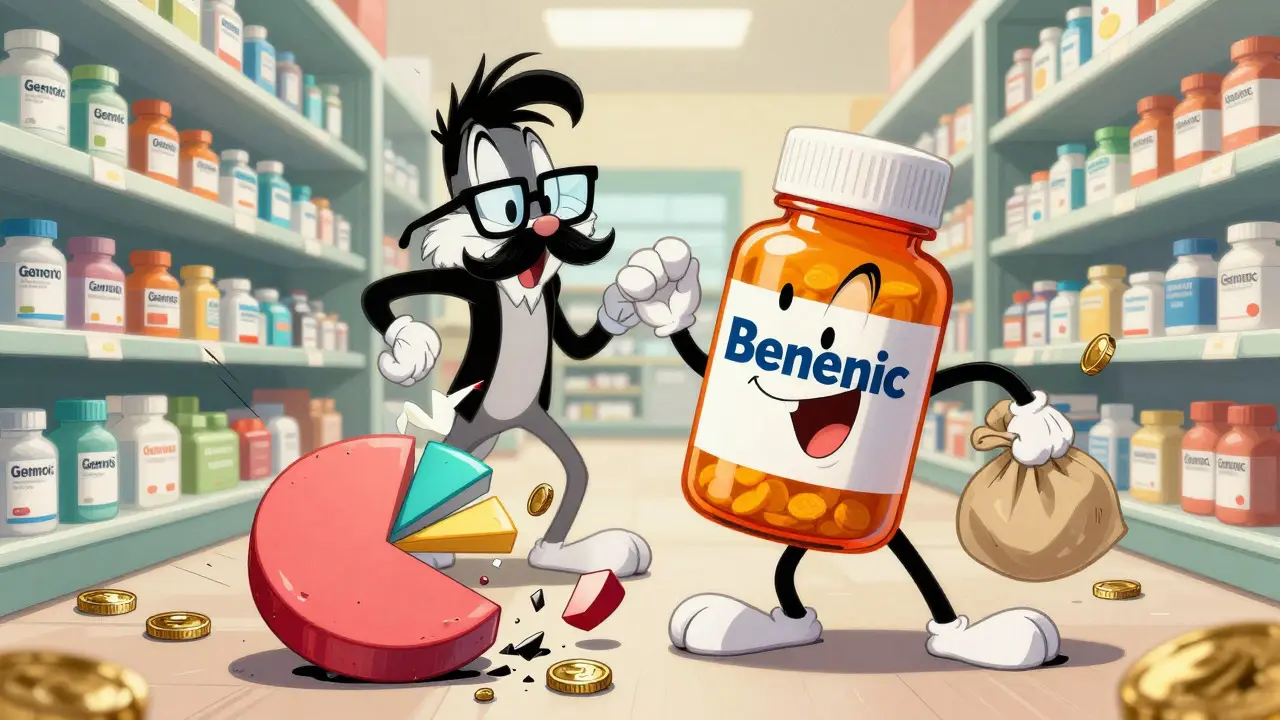
When a brand launches an authorized generic during the 180-day exclusivity period, it effectively breaks the exclusivity. The first generic filer now faces competition not from another third-party generic, but from the brand itself. This strategy fragments the market. Instead of capturing nearly 80% of sales, the first generic often sees its market share drop to around 50%. Revenue projections plummet, sometimes by 30-50%, turning what should have been a lucrative victory into a break-even scenario or even a loss.
Legal Battles and Strategic Shifts
This dynamic has sparked decades of litigation and policy debate. Critics argue that authorized generics undermine the very purpose of the Hatch-Waxman framework. If the goal was to encourage early challenges to weak patents, allowing brands to compete directly with the challenger discourages those challenges. Why risk millions in legal fees if the incumbent can simply undercut you with their own product?
Data supports this concern. Between 2005 and 2015, approximately 60% of cases involving 180-day exclusivity saw the launch of an authorized generic. In one notable instance, Teva Pharmaceuticals estimated losing $287 million in revenue due to Eli Lilly’s authorized generic entry for the diabetes drug Humalog. These aren't abstract numbers; they represent real capital that could have funded further research or lower prices elsewhere.
However, brand manufacturers and groups like PhRMA argue the opposite. They claim authorized generics benefit consumers by driving prices down immediately upon generic entry. A RAND Corporation study suggested that prices are 15-25% lower when an authorized generic competes with the first generic compared to a single-generic scenario. From a consumer perspective, more competition equals better deals, regardless of who the competitor is.
| Metric | Without Authorized Generic | With Authorized Generic |
|---|---|---|
| Average Market Share (First Generic) | ~80% | ~50% |
| Revenue Capture Potential | High (Theoretical 100%) | Moderate (Reduced by 30-50%) |
| Consumer Price Impact | Slower initial price drop | Faster initial price drop (15-25% lower) |
| Incentive for Patent Challenges | Strong | Weakened |
Current Legislative and Regulatory Landscape
As of 2026, the tension remains unresolved. Several legislative attempts, such as the Preserve Access to Affordable Generics and Biosimilars Act, have sought to prohibit authorized generics during the exclusivity period. Although introduced repeatedly since 2009, these bills have struggled to pass Congress. The Federal Trade Commission (FTC) has weighed in, filing multiple antitrust lawsuits against brands accused of using authorized generics to improperly delay competition. Their 2022 report recommended amending the law to exclude authorized generics from the exclusivity period, estimating this would boost first generic revenues by 35%.
Meanwhile, generic manufacturers have adapted. Many now negotiate contractual provisions in patent settlements to delay authorized generic entry. According to industry analysis, about 78% of first generic applicants include clauses addressing authorized generic timing. This shift turns patent disputes into complex business negotiations rather than pure legal battles. Smaller firms, however, often lack the leverage to secure these terms, making them less likely to initiate Paragraph IV challenges. This consolidation of power among larger generic players is a side effect few anticipated in 1984.
Practical Implications for Stakeholders
If you are involved in pharmaceutical development, pricing, or policy, here is what you need to watch:
- For Generic Developers: Factor authorized generic risk into your ROI models. Don't assume full market capture. Engage cross-functional teams early to manage the "trigger date" for exclusivity, ensuring you don't waste time waiting for FDA approval while the clock runs.
- For Brand Manufacturers: Weigh the short-term revenue protection of an authorized generic against potential regulatory scrutiny and long-term reputational risks. The FTC continues to monitor these strategies closely.
- For Payers and Providers: Understand that initial price drops may be steeper with authorized generics, but long-term sustainability depends on robust third-party generic competition. Monitor formulary decisions accordingly.
The system is imperfect, but it drives access. Since 1984, the Hatch-Waxman framework has contributed to $2.2 trillion in healthcare savings. Yet, as the average time to multiple generic competition shrinks-from 28 months in 2000 to just 9 months in 2022-the value of exclusivity erodes. The question isn't whether authorized generics help consumers in the short term; they do. The question is whether they sustain the pipeline of future challengers who keep prices low in the long run.
What exactly is an authorized generic?
An authorized generic is a drug product that is identical to the brand-name drug but is marketed without the brand name. It is manufactured by the brand-name company or a licensee, so it does not require a separate Abbreviated New Drug Application (ANDA) or proof of bioequivalence. It enters the market simultaneously with the first generic challenger.
How does 180-day exclusivity work under the Hatch-Waxman Act?
The first generic applicant to file a Paragraph IV certification challenging a patent gets 180 days of marketing exclusivity. During this period, the FDA cannot approve other generic applications for the same drug. This incentive encourages companies to invest in costly patent litigation to bring generics to market sooner.
Why do brand manufacturers launch authorized generics?
Brand manufacturers launch authorized generics to retain market share and revenue when a generic competitor enters. By offering a lower-priced version of their own drug, they prevent the first generic from capturing the entire market, thereby reducing the financial impact of losing patent protection.
Does an authorized generic violate the 180-day exclusivity?
Legally, no. The exclusivity prevents the FDA from approving other generic applications. It does not prevent the brand-name holder from selling the drug themselves under a different label. However, critics argue this practice undermines the spirit of the exclusivity provision.
Are there efforts to change the rules regarding authorized generics?
Yes, legislation like the Preserve Access to Affordable Generics and Biosimilars Act has been proposed to ban authorized generics during the exclusivity period. Additionally, the FTC has filed antitrust suits alleging that some uses of authorized generics improperly delay competition. As of 2026, no federal law explicitly bans them, but regulatory pressure remains high.



hareesh kumar
August 31, 2026 AT 04:03they arent just breaking exclusivity theyre rigging the whole damn game so big pharma keeps milking us dry while we pay for their lawyers and i bet its all coordinated behind closed doors with congressmen who own stock in lilly or pfizer because why else would the law be so conveniently vague about what constitutes a competitor if not to let the fox guard the henhouse and laugh all the way to the bank while generic companies bleed out trying to compete against their own manufacturer who has infinite resources and no bioequivalence hurdles to jump through it makes me sick thinking about how many patients could have had cheaper meds if these corporate sharks werent playing 4d chess with our health insurance premiums
Pearl Richardson
September 1, 2026 AT 08:29The statistical manipulation here is egregious 📉🚫. One must consider that the 'authorized generic' is merely a semantic sleight of hand designed to obfuscate true market competition. The FTC's inability to enforce stricter boundaries suggests regulatory capture is absolute. We are witnessing the systematic erosion of antitrust principles under the guise of consumer benefit, which is frankly insulting to any analyst who understands basic supply chain economics. The data does not lie, but the interpretation certainly does when influenced by PhRMA lobbying dollars 💸.
larry williams
September 3, 2026 AT 01:30I appreciate the nuanced breakdown of such a complex regulatory landscape. It is truly heartening to see an analysis that acknowledges both the financial struggles of the first-to-file generics and the undeniable short-term price benefits for consumers. While the current system feels imperfect, perhaps this tension drives innovation in settlement strategies rather than stifling them entirely? I remain optimistic that as stakeholders adapt-like those negotiating contractual provisions-we will find a sustainable equilibrium that rewards risk-taking without penalizing patient access. Keep up the great work highlighting these critical industry shifts!
Stephen Horn
September 4, 2026 AT 13:52Your analysis lacks the requisite depth regarding the geopolitical implications of pharmaceutical sovereignty. By allowing authorized generics to dilute the Hatch-Waxman incentive structure, we are effectively outsourcing our national security interests to entities that prioritize shareholder value over strategic autonomy. This is not merely a legal loophole; it is a symptom of broader institutional decay where regulatory bodies fail to comprehend the asymmetry of information between incumbent monopolies and new entrants. The pretense of 'consumer benefit' masks the fundamental failure of American jurisprudence to protect domestic innovation pipelines from predatory litigation tactics employed by legacy conglomerates.
Gurjit Singh
September 5, 2026 AT 10:28This situation highlights a moral failing in our healthcare system. It is wrong for corporations to exploit legal technicalities to maintain high prices while pretending to offer competition. Patients deserve honest markets, not games played by lawyers. We need laws that reflect ethical business practices, not just loopholes for the wealthy. The focus should always be on fairness and accessibility for everyone, regardless of their ability to navigate complex legal battles.
Venkatesan V.K.
September 5, 2026 AT 16:13It is exhausting reading about yet another instance where capital exploits regulation. The emotional toll on smaller firms attempting to challenge giants is immense and largely ignored. When you strip away the jargon, it is simply bullying by those with deeper pockets. The sadness of seeing good intentions twisted into profit mechanisms is palpable. One cannot help but feel drained by the relentless cycle of litigation and maneuvering that defines this sector.
Eryn Manchego
September 6, 2026 AT 17:46honestly though the market share drop is wild but at least prices go down faster right its kinda cool that even the brands gotta play ball eventually lol
Crystal Torres
September 7, 2026 AT 20:20Crystal Torres: The adaptation strategies mentioned, particularly the inclusion of contractual clauses in patent settlements, represent a significant evolution in how intellectual property disputes are resolved. It demonstrates that the market self-corrects through negotiation when statutory incentives are insufficient. Furthermore, the distinction between immediate consumer savings and long-term pipeline sustainability requires rigorous longitudinal study. I believe future policy should focus on transparency requirements for authorized generic launches to ensure fair competition metrics are accurately reported to payers and providers alike.