
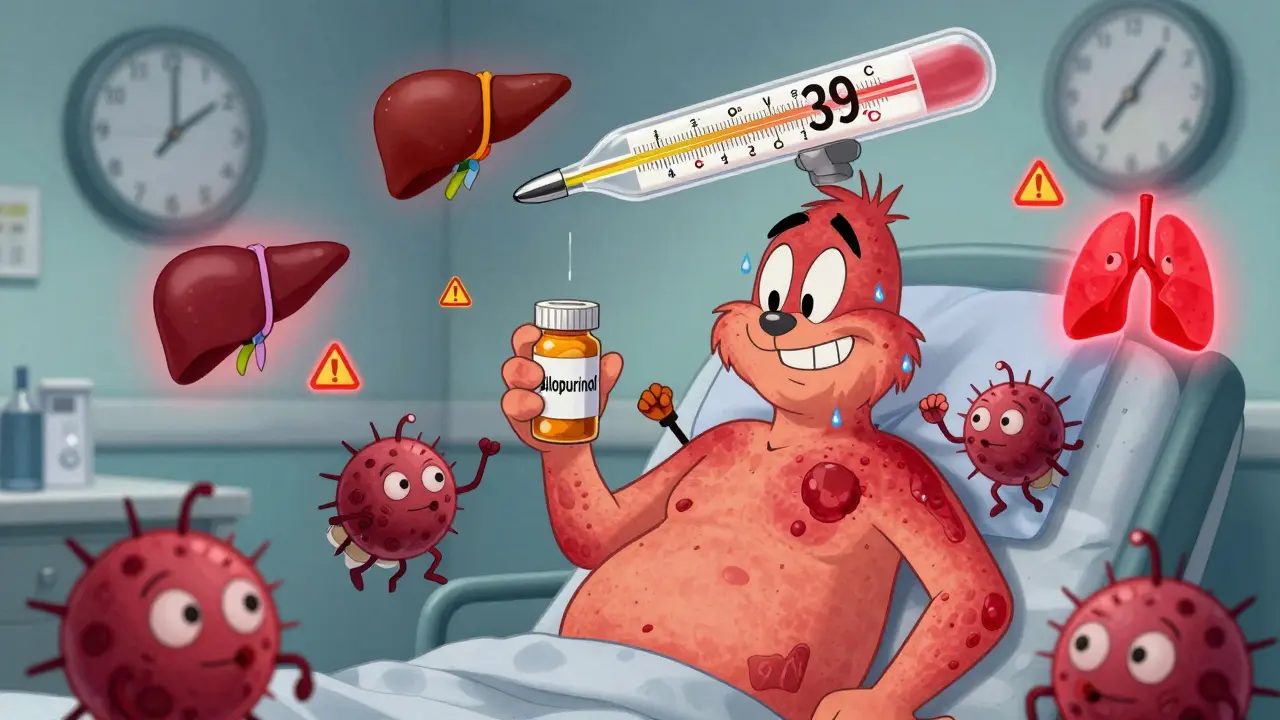
DRESS syndrome is not just a rash. It’s a full-body crisis triggered by a medication you thought was safe. One day you’re taking your pill for gout or seizures, and weeks later, you’re in the hospital with a fever, swollen lymph nodes, and a skin rash that won’t go away. Your blood test shows your eosinophils - a type of white blood cell - are through the roof. Your liver enzymes are skyrocketing. You’re told this is DRESS: Drug Reaction with Eosinophilia and Systemic Symptoms. It’s rare, but deadly if missed. And it’s happening more often than you think.
What DRESS Really Looks Like
DRESS doesn’t start with a rash. It starts with a fever - often above 38°C - and a feeling of being hit by the flu. You feel tired, your throat hurts, your lymph nodes swell. Then, 2 to 8 weeks after starting a new drug, a red, flat, measles-like rash appears. It spreads. It itches. It doesn’t respond to antihistamines. This is the hallmark: a skin eruption that comes late, lasts long, and doesn’t look like a typical allergic reaction.
But the skin is just the beginning. In 70% to 90% of cases, the liver gets hit hard. ALT and AST levels can jump to over 1,000 U/L - that’s 20 times the normal range. Kidneys follow: creatinine climbs, urine output drops. Lungs can fill with fluid. Blood counts go haywire: eosinophils above 1,500 per microliter, atypical lymphocytes everywhere. This isn’t one organ failing. It’s multiple systems collapsing at once.
And here’s what makes it different from other drug rashes: the delay. If you break out in a rash 2 days after taking a new antibiotic, you know it’s the drug. With DRESS, it’s weeks. That’s why doctors miss it. They think it’s a virus. Or mononucleosis. Or even a flare-up of lupus. By the time they realize it’s DRESS, the damage is already done.
Which Drugs Cause DRESS?
Not every drug causes DRESS. But some are notorious. Allopurinol - the go-to medication for gout - is the biggest culprit, responsible for 40% to 50% of all cases. Especially if you have kidney disease. People with an eGFR below 60 are 50 times more likely to develop DRESS on allopurinol than those with normal kidney function.
Antiepileptic drugs are next in line. Carbamazepine, phenytoin, and lamotrigine each carry a risk. Lamotrigine, in particular, can cause a rash that looks harmless at first - but in some, it spirals into DRESS. Sulfonamide antibiotics like sulfamethoxazole-trimethoprim (Bactrim) are also common triggers.
There’s a genetic angle, too. If you carry the HLA-B*58:01 gene - common in people of Asian descent - your risk of allopurinol-induced DRESS jumps from 1 in 10,000 to nearly 1 in 200. That’s why Taiwan started testing for this gene before prescribing allopurinol. Since then, DRESS cases from allopurinol dropped by 75%.
Even newer drugs aren’t safe. Some immunotherapy agents and antivirals have been linked to DRESS in case reports. The pattern is clear: if a drug is metabolized slowly, triggers immune activation, or is used long-term, it’s on the radar.
DRESS vs. SJS/TEN: The Critical Difference
People confuse DRESS with Stevens-Johnson Syndrome (SJS) and Toxic Epidermal Necrolysis (TEN). All are severe drug reactions. But they’re not the same.
SJS and TEN come on fast - within days, not weeks. They’re defined by blistering and skin sloughing. Up to 30% of your body can peel off. Mucous membranes - mouth, eyes, genitals - are almost always destroyed. Mortality is 30% to 40% for TEN.
DRESS? No skin peeling. No massive mucosal damage. Instead, you get eosinophils flooding your organs. Your skin is inflamed, but not detaching. The real danger isn’t the rash - it’s the liver failure, kidney injury, or heart inflammation that sneaks up days later.
The immune response is different too. SJS/TEN is driven by cytotoxic T cells that kill skin cells. DRESS is driven by CD4+ T cells and eosinophils releasing inflammatory chemicals like IL-5 and IL-13. That’s why steroids work better in DRESS than in SJS/TEN.
And then there’s HHV-6. In 60% to 70% of DRESS cases, this common herpes virus reactivates weeks after the rash starts. It’s not the cause - but it makes things worse. It can prolong fever, worsen liver damage, and even trigger autoimmune problems later - like thyroid disease or lupus.

How Doctors Diagnose DRESS
There’s no single blood test for DRESS. Diagnosis is based on a checklist - the RegiSCAR criteria. You need hospitalization plus at least three of these:
- Acute rash
- Fever over 38°C
- Swollen lymph nodes
- Eosinophils above 1,500/μL or more than 10% of white blood cells
- Atypical lymphocytes in blood
- One or more internal organs involved (liver, kidney, lungs, heart, pancreas)
- Reaction lasting more than 15 days
Doctors also look for the timeline. Did the drug start 2 to 8 weeks ago? Is there no other explanation - like a recent infection? Did symptoms improve after stopping the drug? If yes, DRESS is likely.
Testing for HHV-6 DNA in blood helps confirm. Elevated eosinophil cationic protein (ECP) levels are another clue. But the biggest mistake? Waiting for skin sloughing to appear. That’s not DRESS. That’s something else.
What Happens If You Don’t Act Fast
Delay costs lives. If the drug isn’t stopped within 24 hours of recognizing symptoms, mortality jumps from 5% to 15%. Why? Because organ damage keeps progressing. The liver keeps dying. The kidneys keep failing. Infections take hold - bloodstream infections from E. coli, MRSA, or Candida are common in hospitalized patients.
One patient in a 2022 case report had AST levels of 2,840 U/L after starting allopurinol. She spent 45 days in the hospital. Another developed Graves’ disease five weeks after DRESS resolved - a known long-term risk. About 5% to 10% of survivors develop autoimmune conditions months or years later.
And the damage doesn’t always reverse. A 2022 survey of 150 DRESS survivors found 27% still needed ongoing kidney monitoring. Some had permanent scarring in the liver. Others had chronic fatigue, joint pain, or recurring rashes.
This isn’t just about surviving the acute phase. It’s about what comes after.
How DRESS Is Treated
Step one: Stop the drug. Immediately. No exceptions. Even if you think it’s “just a rash.” Even if your doctor says, “Wait and see.” If it’s DRESS, every hour counts.
Step two: Hospitalize. You need monitoring. Daily liver tests. Blood counts. Kidney function. You might need ICU care if your organs are failing.
Step three: Steroids. Prednisone or methylprednisolone at 0.5 to 1 mg per kg per day is standard. Treatment lasts 4 to 8 weeks, then tapers slowly. Stopping too soon? The rash and fever come back. Worse, organs can flare again.
For severe cases, newer treatments are showing promise. Anakinra - a drug that blocks interleukin-1 - cut hospital stays from 18.5 days to 11.2 days in a 2022 trial. Tocilizumab, which blocks IL-6, is being tested in clinical trials for steroid-resistant cases.
Infection control is critical. Skin breaks are entry points. Antibiotics and antifungals are often given preventively. No visitors with colds. No flowers. No risky foods.
What Comes After DRESS
You’re not done when you leave the hospital. You need lifelong caution.
- Never take the offending drug again. Ever. Even a tiny dose can trigger a deadly relapse.
- Avoid all drugs in the same class. If allopurinol caused DRESS, don’t take febuxostat without a specialist’s approval.
- Get genetic testing if you’re of Asian descent. If you carry HLA-B*58:01, avoid allopurinol completely.
- See a rheumatologist or immunologist annually. Autoimmune diseases can appear years later.
- Carry a medical alert card. List the drugs you can’t take.
Some patients join support groups. The DRESS Syndrome Foundation helps people navigate follow-up care, find specialists, and avoid dangerous drug combinations. Since 2018, they’ve helped over 1,200 people cut their diagnostic delays by half.
The Bigger Picture
DRESS is rising. Why? More people are on long-term medications. More elderly patients with kidney disease are getting allopurinol. More doctors are prescribing it for asymptomatic high uric acid - even when guidelines say not to.
The American College of Rheumatology now recommends febuxostat over allopurinol for patients with eGFR below 60. That’s a game-changer. It could prevent 1,200 to 1,500 DRESS cases every year in the U.S. alone.
And awareness is growing. ICD-10 billing for DRESS has quadrupled since 2015. That’s not because it’s more common - it’s because doctors are finally recognizing it.
But here’s the hard truth: 65% of patients see three or more doctors before getting the right diagnosis. One in three internal medicine residents can’t identify DRESS in a case study.
So if you’re on a high-risk drug - allopurinol, carbamazepine, lamotrigine, Bactrim - and you get a fever, rash, or swollen glands two to eight weeks later, don’t wait. Don’t assume it’s a virus. Ask: Could this be DRESS? Because if it is, time is the only thing that can save you.


Karen Droege
January 26, 2026 AT 23:30The moment I read about the HLA-B*58:01 link to allopurinol in South Asian populations, I immediately flagged every patient I manage with CKD. This isn't theoretical - I've seen two cases in the last year. One 68-year-old man with eGFR 45 developed multi-organ failure after 3 weeks of allopurinol. His rash looked like a sunburn. No one suspected DRESS until his AST hit 3,200. He nearly died. Now we test before prescribing. It's not optional. It's standard of care.
Suresh Kumar Govindan
January 27, 2026 AT 14:24They say it's rare. But if you look at the data, the pharmaceutical companies knew. They buried the genetic risk. The FDA approved allopurinol without mandatory HLA screening. Why? Profit. The same companies that sell the drug also sell the expensive ICU beds and steroids needed to treat the damage they caused. This isn't negligence. It's systemic malice.
Skye Kooyman
January 28, 2026 AT 12:57My aunt had this. They thought it was shingles. She lost 20 pounds in two weeks. No one connected the dots until her liver crashed. She's fine now but still gets fatigue attacks. Never take a new med without asking: what if this isn't just a rash?
Kipper Pickens
January 30, 2026 AT 03:35From a pharmacovigilance standpoint, DRESS represents a paradigm shift in adverse drug reaction (ADR) profiling. The delayed onset, immune-mediated eosinophilic cascade, and viral reactivation dynamics (particularly HHV-6) suggest a complex pharmacogenomic-immunovirologic interface. Traditional ADR databases fail to capture the temporal-spatial correlation required for early detection. We need real-time genomic-phenotypic integration in EHRs.
Peter Sharplin
January 30, 2026 AT 19:58I work in ER medicine. We see maybe one DRESS case every 18 months. But here's the thing - every time we miss it, the patient ends up in the ICU. I've had residents tell me, 'It's probably just a virus.' I show them the RegiSCAR criteria on my phone. If they're on allopurinol or lamotrigine and have a fever + rash + swollen nodes? Stop the drug. Now. Call consult. Don't wait for labs. This isn't a differential - it's an emergency.
Faisal Mohamed
January 31, 2026 AT 19:44Isn't it ironic? We weaponize science to cure, yet the very molecules designed to heal become agents of systemic collapse. DRESS is not an accident - it's the body's rebellion against the hubris of pharmacological intervention. We prescribe as if the human immune system is a machine we can calibrate. But it remembers. It retaliates. The eosinophils? They're not just cells - they're the soul's scream against chemical betrayal.
Rakesh Kakkad
February 1, 2026 AT 16:58As someone from India, I've seen this too many times. Doctors give allopurinol like candy to gout patients with kidney issues. No testing. No warning. I had a cousin die from this. Now I carry a printed list of high-risk drugs in my wallet. I show it to every new doctor. If you're prescribing allopurinol to someone over 50 with any kidney problem - you're playing Russian roulette. And if you're Indian or Southeast Asian? You're already holding the loaded gun.
eric fert
February 1, 2026 AT 22:13Let’s be real - this whole DRESS thing is overblown. You know how many people take allopurinol? Millions. How many get DRESS? A few hundred. That’s like 0.005%. But now you’ve got people terrified of every new pill because some blogger wrote a 5,000-word essay about it. And don’t even get me started on the HHV-6 nonsense. Everyone has herpes viruses. They reactivate all the time. You’re telling me a fever and a rash means your immune system is being possessed by a dormant virus? That’s not medicine - that’s astrology with a lab coat. And don’t even mention the 'lifelong caution' nonsense. People are supposed to avoid every drug in the same class? What if they need it? What if they’re allergic to everything else? You’re creating a generation of hypochondriacs who won’t take a single aspirin without a 30-minute consult. This isn’t helping. It’s fearmongering dressed up as science.