

Heavy periods aren’t just inconvenient-they can be dangerous when you’re on blood thinners
If you’re taking a blood thinner and your periods have suddenly become unbearable, you’re not alone. About 70% of menstruating women on anticoagulants experience heavy menstrual bleeding (HMB) that impacts their daily life. That’s not a rare side effect-it’s the norm. Yet, most doctors don’t talk about it until it’s already causing anemia, missed work, or panic attacks in public restrooms.
It’s not just about soaking through pads every hour. It’s about carrying emergency changes in your bag, avoiding social plans, and living in fear of leaking through your clothes. And here’s the worst part: many women stop taking their blood thinners because they’re overwhelmed. But skipping doses? That raises your risk of a life-threatening clot by five times.
You don’t have to choose between bleeding too much and clotting too much. There are real, effective ways to manage this-and most of them let you stay on your blood thinner safely.
Why blood thinners make periods heavier
Blood thinners-also called anticoagulants-work by slowing down your blood’s ability to clot. That’s great if you’re at risk for a stroke or deep vein thrombosis. But it’s a problem when your uterus sheds its lining every month. Without enough clotting, the bleeding doesn’t stop as quickly.
Normally, about 10-30% of women have heavy periods. But once you start a blood thinner, that number jumps to 70%. That’s not a coincidence. It’s a direct effect. And it’s not the same for every drug.
Studies show that rivaroxaban is linked to the highest risk of heavy bleeding. Apixaban and dabigatran carry a lower risk. Warfarin, the older blood thinner, also increases bleeding-but not as predictably as some newer options.
Why does this happen? Blood thinners don’t just affect clots in your legs or brain. They affect every small blood vessel in your body-including those in your uterus. The result? Longer, heavier, more unpredictable periods. Some women describe it as “a faucet turned on full blast.”
What heavy menstrual bleeding looks like in real life
It’s not just “a lot of blood.” Here’s what HMB actually means:
- Changing pads, tampons, or menstrual cups every 30-60 minutes
- Leaking through products, even with overnight pads
- Passing large clots (bigger than a quarter)
- Periods lasting longer than 7 days
- Feeling dizzy, tired, or short of breath from blood loss
- Having to cancel work, school, or plans because you’re afraid you’ll bleed through
One woman in a Reddit thread wrote: “I had to leave work early three times last month because I soaked through two tampons and a pad in under two hours. My boss thought I was faking it.”
Iron deficiency anemia is common. Your body can’t replace lost blood fast enough. Symptoms include exhaustion, pale skin, rapid heartbeat, and brain fog. A simple blood test can check your iron and hemoglobin levels-and if you’re on a blood thinner, you should get tested every 3-6 months, even if you feel fine.
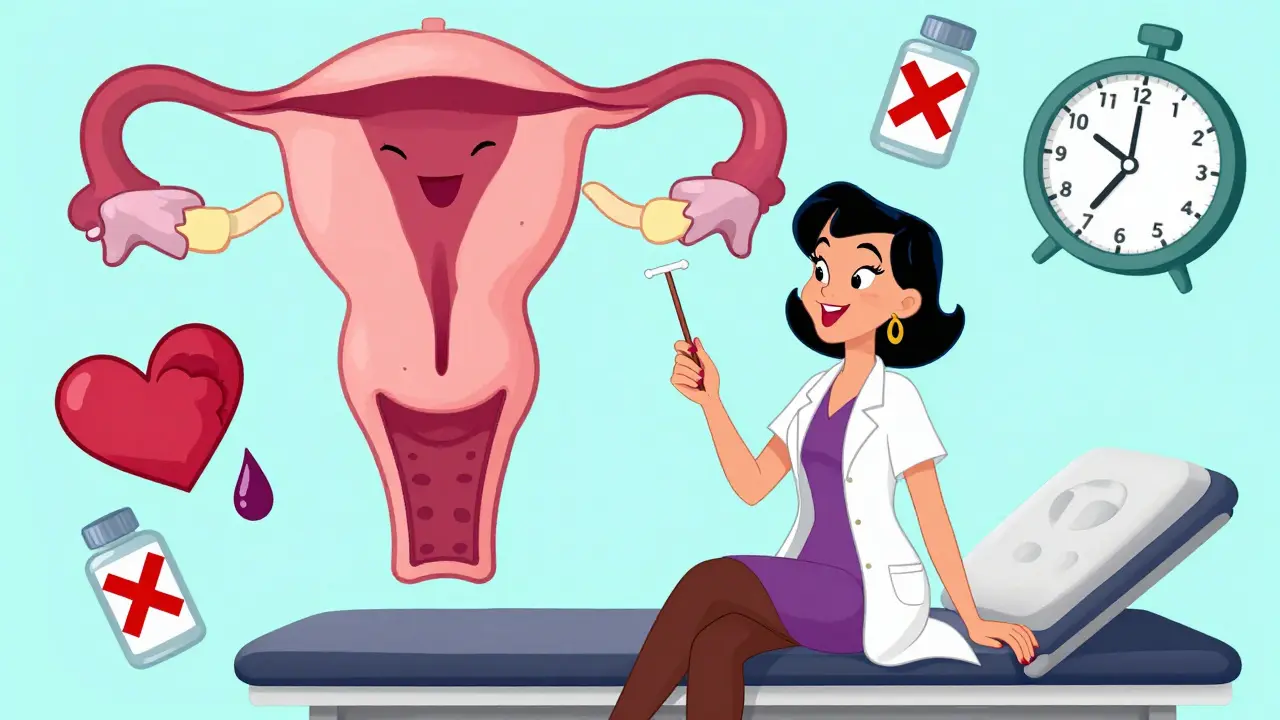
The treatment options that actually work
You don’t have to suffer. There are proven treatments that reduce bleeding without stopping your anticoagulant. Here’s what works:
1. Levonorgestrel IUD (Mirena, Kyleena, etc.)
This is the gold standard. A small T-shaped device inserted into your uterus releases progesterone directly into the uterine lining. It thins the lining, so there’s less to shed.
Studies show it reduces menstrual blood loss by 70-90% within 3-6 months. Many women stop having periods altogether. One user on a patient forum said: “After getting Mirena, my ER visits for bleeding stopped. I went from needing 12 pads a day to barely noticing my period.”
It’s safe with blood thinners. No need to stop your medication. Lasts 3-7 years, depending on the brand. Insertion might be a little uncomfortable, but it’s a one-time procedure.
2. Progesterone-only pills or implants
If you don’t want an IUD, progesterone-only options like the subdermal implant (Nexplanon) or daily pills like norethisterone can help.
The American Society of Hematology recommends a high-dose norethisterone regimen: 5 mg three times a day for 21 days, starting at the beginning of your period. It can cut bleeding by 50% or more.
Implants are even easier-just one small rod under your skin that lasts 3 years. No daily pills to forget. Side effects? Possible spotting at first, but most women adjust within a few months.
3. Tranexamic acid
This isn’t a hormone. It’s a medication that helps blood clot locally-right where you need it.
You take it only during your period: 2 tablets 3 times a day for up to 5 days. It reduces bleeding by 30-50% in clinical trials. It’s not a long-term solution, but it’s perfect for heavy days.
Important: Don’t take it with NSAIDs like ibuprofen unless your doctor says it’s safe. Both can increase bleeding risk when combined with anticoagulants.
4. Combined hormonal birth control
Pills, patches, or rings that contain estrogen and progestin can also help. They regulate your cycle and thin the uterine lining.
But here’s the catch: estrogen increases clotting risk. So if you have a history of clots, deep vein thrombosis, or pulmonary embolism, your doctor might avoid this option. But if your clotting risk is low and you’re on a DOAC like apixaban, it can be safe and effective.
What doesn’t work-or could hurt you
Some common “solutions” are risky or ineffective:
- NSAIDs (ibuprofen, naproxen): They can reduce bleeding by 20-40%, but they also thin blood. Combining them with anticoagulants increases bleeding risk. Only use if your doctor approves and you’re on a low-risk anticoagulant.
- Stopping your blood thinner: This is the most dangerous option. Skipping doses raises your risk of stroke or clot by fivefold. Never do this without medical supervision.
- Endometrial ablation: A procedure that burns or removes the uterine lining. It works well for women not on anticoagulants, but it’s risky if you’re on blood thinners. Bleeding during or after can be severe. It’s also not recommended if you might want children later.
- Herbal supplements (vitamin K, turmeric, ginger): These interfere with anticoagulants unpredictably. Some can make them less effective. Others can make bleeding worse. Avoid them unless your doctor says it’s okay.
How to talk to your doctor-without sounding paranoid
Here’s the hard truth: 68% of women say their hematologist never asked about their periods after starting anticoagulants. That’s not your fault. It’s a system failure.
But you can change that. Here’s how to start the conversation:
- Be specific: “My periods have gotten so heavy I’m changing pads every 30 minutes. I’m bleeding through my clothes.”
- Ask directly: “Is this a known side effect of my medication? What can we do about it?”
- Bring data: “I read that 70% of women on DOACs have this issue. Is there a treatment that won’t interfere with my blood thinner?”
- Request a referral: “Can you refer me to a gynecologist who understands anticoagulant-related bleeding?”
Don’t wait for them to ask. Most won’t. And if they dismiss you? Get a second opinion. Your quality of life matters as much as your clot risk.
What’s changing in 2025-and what you should know now
Good news: Experts are finally paying attention. The American Society of Hematology and the American College of Obstetricians and Gynecologists are releasing joint guidelines in Q2 2025. For the first time, there will be official recommendations on how to screen and treat heavy bleeding in women on anticoagulants.
Right now, the National Blood Clot Alliance recommends that all women under 50 be told about this risk before they start a blood thinner. If your doctor didn’t mention it, ask why.
There’s also a major clinical trial underway (NCT04987654) comparing heavy bleeding rates across all major DOACs. We’ll soon know which ones are safest for your period.
And here’s one more thing: if you’re on a blood thinner and your period has changed, get your iron checked. Now. Not next year. Not when you feel tired. Now.
You’re not broken. You’re just not being heard.
Heavy bleeding on blood thinners isn’t normal. It’s not just “part of being a woman.” It’s a treatable side effect of a life-saving medication. And you deserve to live without fear, exhaustion, or shame.
Start with your doctor. Ask about the IUD. Ask about tranexamic acid. Ask for a referral. Get your iron levels tested. And if they say, “It’s just your period”-find a new doctor.
You’re not choosing between safety and comfort. You can have both. You just need the right information-and the right care team.


Kelly Weinhold
January 30, 2026 AT 21:44Okay I just read this and I’m crying in my office because I didn’t think anyone else understood what it’s like to carry spare underwear and pads in my purse like it’s a survival kit. I’ve been on apixaban for AFib and my periods went from manageable to full-on flood mode. I thought I was just weak or broken until I found this post. The Mirena IUD changed my life. No more ER visits. No more panic about leaking at the grocery store. I was scared to get it done but it was worth every second of discomfort. You’re not alone. And you don’t have to suffer.
Kimberly Reker
January 31, 2026 AT 02:09This is such an important piece. So many women are told it’s just ‘heavy periods’ and sent away. The stats here are eye-opening - 70% is not a minority, it’s a majority. Tranexamic acid is underused and I’m glad it’s mentioned. I’ve seen patients on DOACs who were terrified to even ask about bleeding because they thought their doctor would blame them. This post gives people the language to advocate for themselves. Also - iron checks every 3-6 months? Yes. Please tell your provider this.
Rob Webber
January 31, 2026 AT 06:57Stop acting like this is some groundbreaking revelation. Of course blood thinners cause heavier bleeding. That’s the whole point of them. If you can’t handle your period, maybe you shouldn’t be on anticoagulants. Or maybe you should just take a pill and deal with it. This is not a crisis. It’s biology. Stop making it a political issue.
calanha nevin
February 1, 2026 AT 00:25Heavy menstrual bleeding in anticoagulated patients is a well-documented clinical challenge with significant quality-of-life implications. The levonorgestrel IUD remains the most effective non-surgical intervention with Level 1 evidence supporting its use. Tranexamic acid is a safe adjunct when used intermittently. Avoid NSAIDs unless contraindications are ruled out. Iron deficiency anemia must be monitored routinely. Referral to a hematogynecology clinic is strongly advised. This information should be standard of care.
Lisa McCluskey
February 1, 2026 AT 16:31I got the implant last year after bleeding for 11 days straight. It took two months to adjust but now I have light spotting once a month. I still take rivaroxaban. No more fear. No more panic. Just… normal. The hardest part was convincing my doctor it wasn’t ‘just how it is.’ You deserve better.
owori patrick
February 2, 2026 AT 07:21Thank you for writing this. I’m from Nigeria and I didn’t know this was even a topic people talked about. Here, many women are told to just endure it. But I have a cousin on warfarin and she was suffering silently. I’m sharing this with her. Knowledge is power. You’re helping more people than you know.
Darren Gormley
February 2, 2026 AT 23:5570%? That’s not a statistic - that’s a systemic failure. Why are we still treating this like an embarrassing side effect instead of a clinical priority? Also, why is everyone ignoring the fact that DOACs aren’t equally risky? Rivaroxaban is a nightmare for periods. Apixaban? Much better. But no one tells you this before you’re prescribed. And don’t even get me started on the fact that gynecologists don’t talk to hematologists. 🤦♂️
Russ Kelemen
February 4, 2026 AT 12:16There’s a deeper truth here: medicine treats bleeding like a woman’s problem, not a physiological side effect of a life-saving drug. We’ve normalized suffering because it’s ‘female.’ But this isn’t about femininity - it’s about physiology, pharmacology, and dignity. You shouldn’t have to beg for basic care. The fact that you’re reading this means you’re already fighting. Keep fighting. And if your doctor doesn’t get it - find someone who does. Your body isn’t broken. The system is.