
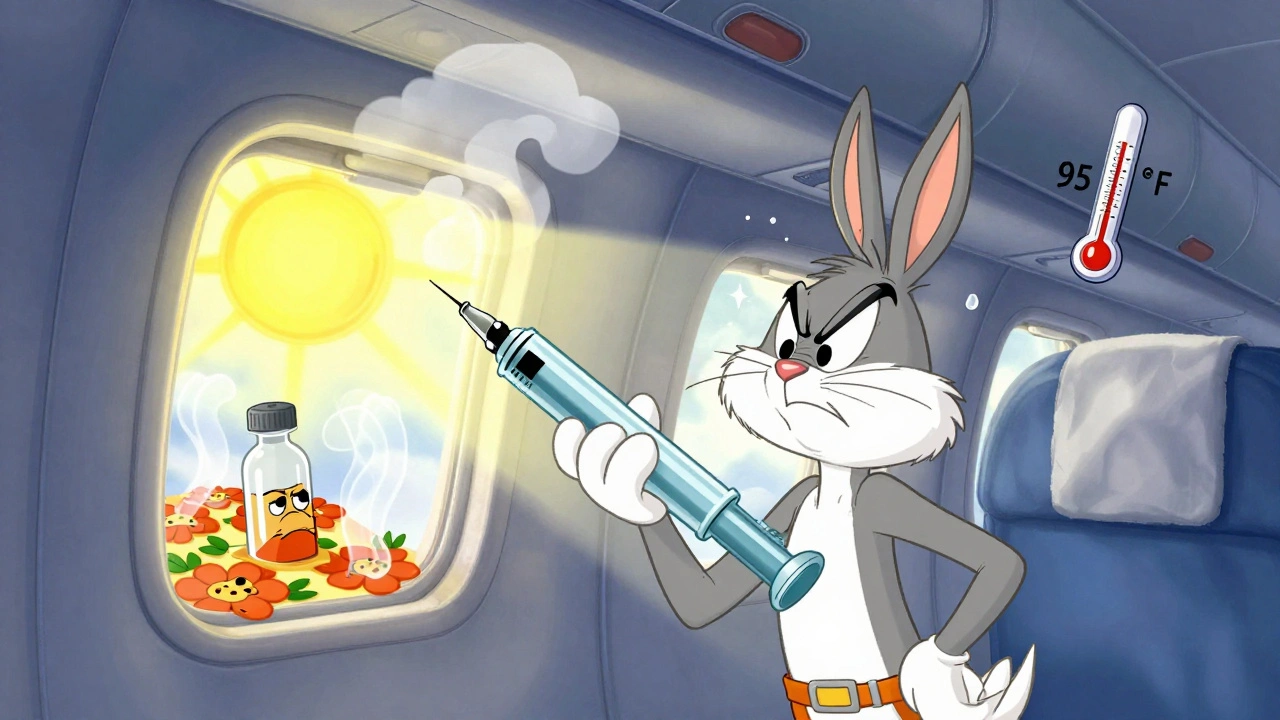
Imagine you’re on a 14-hour flight to Tokyo, your insulin is in your carry-on, and the cabin gets hot near the window. You didn’t pack a cooler. By the time you land, your insulin could be damaged-no warning, no alert, just silently losing effectiveness. That’s not a hypothetical. It happens. And when it does, your blood sugar can spike dangerously fast. Storing insulin and biologics safely during long flights isn’t optional. It’s life-saving.
Why Temperature Matters More Than You Think
Insulin isn’t like a bottle of water. It’s a complex protein. When it gets too hot-above 86°F (30°C)-it starts breaking down. Too cold, below 32°F (0°C), and it freezes. Frozen insulin turns cloudy, forms clumps, and stops working. Even if it looks fine, you can’t trust it. A 2021 study in the Journal of Diabetes Science and Technology tracked a traveler whose insulin was exposed to 95°F (35°C) during a 12-hour flight. By the end, their blood sugar spiked to 480 mg/dL. They needed emergency care. Biologics like Ozempic, Wegovy, or Trulicity have even tighter rules. Once opened, most can only stay at room temperature for 56 days. But on a plane? That’s not the real danger. The real danger is heat. Cabin windows can hit 90°F (32°C) in direct sunlight. Overhead bins? Even worse. A 2023 survey by the American Association of Clinical Endocrinologists found that 41% of travelers who stored insulin in overhead bins experienced temperature excursions above 90°F.What the Rules Actually Say
The FDA says unopened insulin must stay between 36°F and 46°F (2°C-8°C). Once you start using it-whether it’s a pen or vial-it’s fine at room temperature (59°F-86°F or 15°C-30°C) for up to 28 days. Some, like Insulin Degludec, last up to 56 days. But here’s the catch: those 28-day windows assume normal room conditions. Airplanes aren’t normal. The cabin might be 70°F, but the pocket behind your seat? That’s 82°F. The bin above? Could be 95°F. The FAA keeps cabin temps between 65°F and 75°F, but that’s the average. Near the windows, especially on long-haul flights, temperatures climb. Boeing 787s, for example, have environmental systems that can let the skin of the plane get extremely hot in direct sunlight. Insulin sitting in a side pocket? That’s where people mess up.The Best Ways to Store Insulin on a Plane
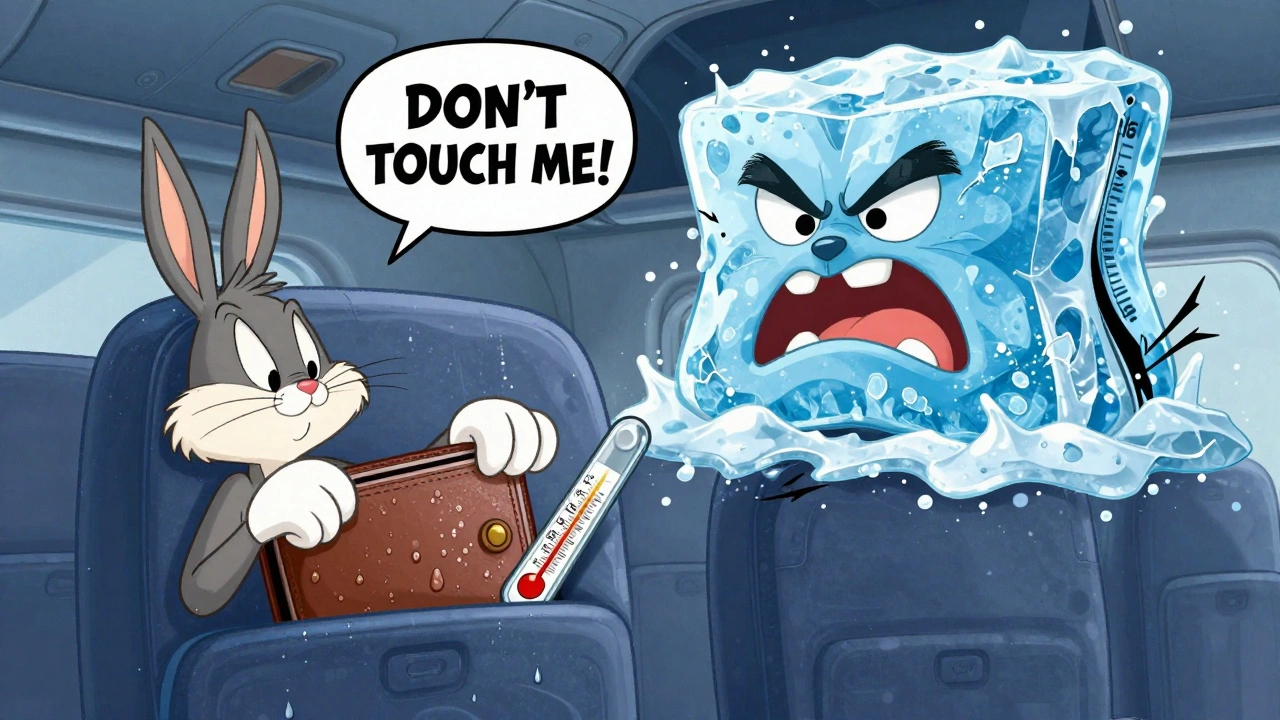
Forget ice packs. They’re risky. If insulin touches ice-even through a thin pouch-it can freeze. A 2022 University of Colorado study found that 23% of insulin samples froze when placed within 1cm of standard ice packs. Here’s what actually works:- FRÍO Wallet: Water-activated, reusable, and tested by Diabetes UK. Soak it in water for 15 minutes, then slip your insulin inside. It holds 59°F-72°F (15°C-22°C) for up to 45 hours-even in 104°F (40°C) heat. Cost: around $35.
- BreezyPack Pro: Uses phase-change material. Keeps insulin between 50°F-72°F for 72 hours. Independent tests show 98.7% temperature stability. Costs about $50.
- TempMed Smart Case: New in late 2023. Bluetooth-connected, alerts your phone if temps go above 82°F. Clinical trials showed 99.2% insulin efficacy after 16-hour flights. Price: $110.
- Seat-back pocket: Not a device, but a tactic. The space behind your seat stays between 68°F-75°F (20°C-24°C) during flight. That’s ideal. Keep your insulin here, not in the overhead bin.
- Overhead bins (temperatures average 82°F)
- Checked luggage (hold compartments can hit -40°F)
- Direct contact with ice packs or frozen water bottles
What to Pack: The Checklist
You’re not just packing insulin. You’re packing your safety. Here’s what to bring:- At least 200% of your expected dose-CDC recommends this for delays or lost luggage.
- Two separate storage devices-in case one fails. Use a FRÍO and a backup cooler.
- A physician’s letter-dated within the last 6 months. It says you need insulin for diabetes. 92% of travelers with this letter avoided TSA delays.
- Original pharmacy labels-on every vial or pen. TSA accepts these 98% of the time.
- Digital copies-save your prescriptions on your phone. Email them to yourself too.
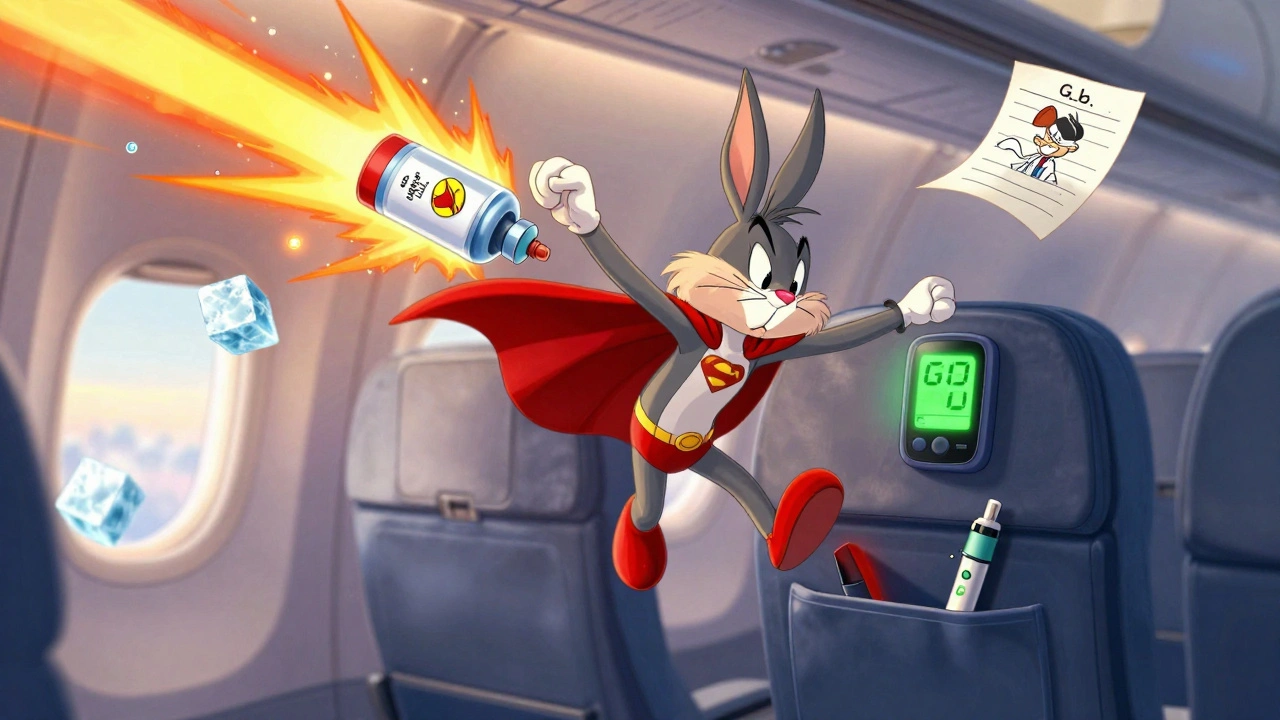
- Glucagon kit-and make sure your travel companion knows how to use it.
- CGM-keep it on. Continuous glucose monitors work fine in flight. Just turn off Bluetooth alerts if you’re worried about interference.
What Airlines Really Allow
TSA and FAA rules say you can bring medical cooling devices in your carry-on. But not all airline staff know that. A JDRF survey in September 2023 found that 37% of travelers were told their cooling wallets weren’t allowed. That’s wrong. TSA Regulation 1544.219 explicitly permits medical cooling containers. If you’re turned away, ask to speak to a supervisor. Show them your physician’s letter. Most will back down. Delta Air Lines updated its policy in April 2023 to clearly allow cooling devices. Spirit Airlines? They require pre-approval 72 hours in advance. Check your airline’s medical policy before you fly. Most have it on their website under “Special Assistance” or “Medical Needs.”Time Zones and Dosing Changes
Flying across time zones isn’t just about jet lag. It changes your insulin timing.- Eastbound flights over 6 hours: Reduce your long-acting insulin dose by 20% for the first day. Your body processes insulin faster when you’re moving forward in time.
- Westbound flights over 6 hours: You may need to increase your dose by 15%. The day is longer, so your insulin needs to last longer.
- For insulin pumps: Manually adjust basal rates. Don’t rely on auto-adjustments. Talk to your endocrinologist before you go.
What to Do If Your Insulin Looks Off
Check your insulin every 4 hours during long flights. Look for:- Cloudiness (normal for NPH, not for others)
- Clumps or particles
- Crystals or frosting
Real Stories, Real Mistakes
On Reddit’s r/diabetes, 287 travelers shared their stories. 63% had at least one temperature problem. 17% saw visible clumping after flights over 14 hours. One woman flying from London to Sydney stored her Ozempic pen in her purse, which went into the overhead bin. The flight was 18 hours. She didn’t check it until landing. Her blood sugar stayed over 300 mg/dL for two days. She had to go to an ER in Australia. Another man used a FRÍO wallet and kept his insulin in his seat-back pocket. He flew 16 hours to Singapore. His glucose stayed steady. He said: “I didn’t even think about it. That’s how good it was.”What’s Coming Next
The FDA approved the TempMed Smart Case in November 2023. It’s the first insulin case with real-time alerts. By 2024, the International Civil Aviation Organization will require airlines to offer temperature-controlled storage on request. And by 2026, the American Diabetes Association hopes to have new insulin formulations that last 45 days at room temperature. But right now? You can’t wait for the future. You need to act today.Final Tip: Don’t Rely on Hope
Hope isn’t a storage solution. A cooler bag isn’t enough. Ice packs are dangerous. The overhead bin is a trap. Use a proven method. Keep your insulin in your seat-back pocket. Use a FRÍO or BreezyPack. Carry your letter. Check your insulin. Know your dosing changes. You’ve managed diabetes every day. Now manage it on a plane. Your health isn’t negotiable. Your insulin isn’t optional. And your flight isn’t the place to risk it.Can I put insulin in checked luggage?
No. Checked luggage goes into the cargo hold, where temperatures can drop to -40°F (-40°C). Insulin will freeze and become unusable. Always keep insulin in your carry-on.
How long can insulin last in a FRÍO wallet?
A FRÍO wallet maintains safe temperatures (59°F-72°F) for up to 45 hours, even in 104°F (40°C) heat. It needs to be soaked in water for 15 minutes before use and reactivated every 45 hours if needed.
Do I need a doctor’s note to fly with insulin?
Yes. The CDC and TSA recommend a physician’s letter dated within the last 6 months that confirms your medical need for insulin. Travelers with this letter have a 92% success rate avoiding delays at security.
Can I bring ice packs on a plane for my insulin?
You can, but only if they’re frozen solid and under 3.4 ounces (100ml) per container. Even then, they’re risky-direct contact can freeze insulin. Water-activated cooling wallets like FRÍO are safer and TSA-approved.
What should I do if my insulin looks cloudy or clumpy after a flight?
Do not use it. Cloudiness, clumps, or crystals mean the insulin has degraded. Use your backup insulin immediately and discard the damaged one. Always carry at least 200% of your expected dose to account for this risk.
Can I use my insulin pump during a flight?
Yes. Insulin pumps are allowed on planes. However, you may need to manually adjust basal rates if you cross time zones by more than 3 hours. Do not rely on automatic adjustments. Consult your endocrinologist before traveling.
Are biologics like Ozempic stored the same way as insulin?
Yes, but with stricter limits. Unopened Ozempic must be kept refrigerated (36°F-46°F). Once opened, it can stay at room temperature for up to 56 days. But on a plane, heat is the enemy. Use a cooling wallet and avoid overhead bins.
Is it safe to carry insulin through airport security?
Yes. TSA allows insulin, syringes, pumps, and cooling devices in carry-on bags. You may be asked to show a doctor’s note or original labels, but they cannot confiscate your medication. Decline any X-ray screening for insulin-it’s not necessary and can damage it.


Elizabeth Crutchfield
December 5, 2025 AT 05:50Ben Choy
December 6, 2025 AT 03:13Emmanuel Peter
December 6, 2025 AT 14:24Chad Handy
December 7, 2025 AT 00:54Augusta Barlow
December 7, 2025 AT 23:06Joe Lam
December 8, 2025 AT 09:49Chase Brittingham
December 9, 2025 AT 09:25Bill Wolfe
December 10, 2025 AT 03:05Michael Feldstein
December 11, 2025 AT 11:04jagdish kumar
December 12, 2025 AT 06:00Benjamin Sedler
December 13, 2025 AT 09:29zac grant
December 13, 2025 AT 13:01michael booth
December 15, 2025 AT 09:43