

For someone with type 1 diabetes, managing blood sugar every single day is exhausting. Injections every morning, every meal, every time your sugar spikes or drops - it never stops. That’s why so many people turn to insulin pump therapy. It’s not a cure, but for many, it changes everything. No more counting shots. No more fumbling with vials in public. Just a small device that delivers insulin quietly, continuously, and sometimes even automatically.
What Exactly Is an Insulin Pump?
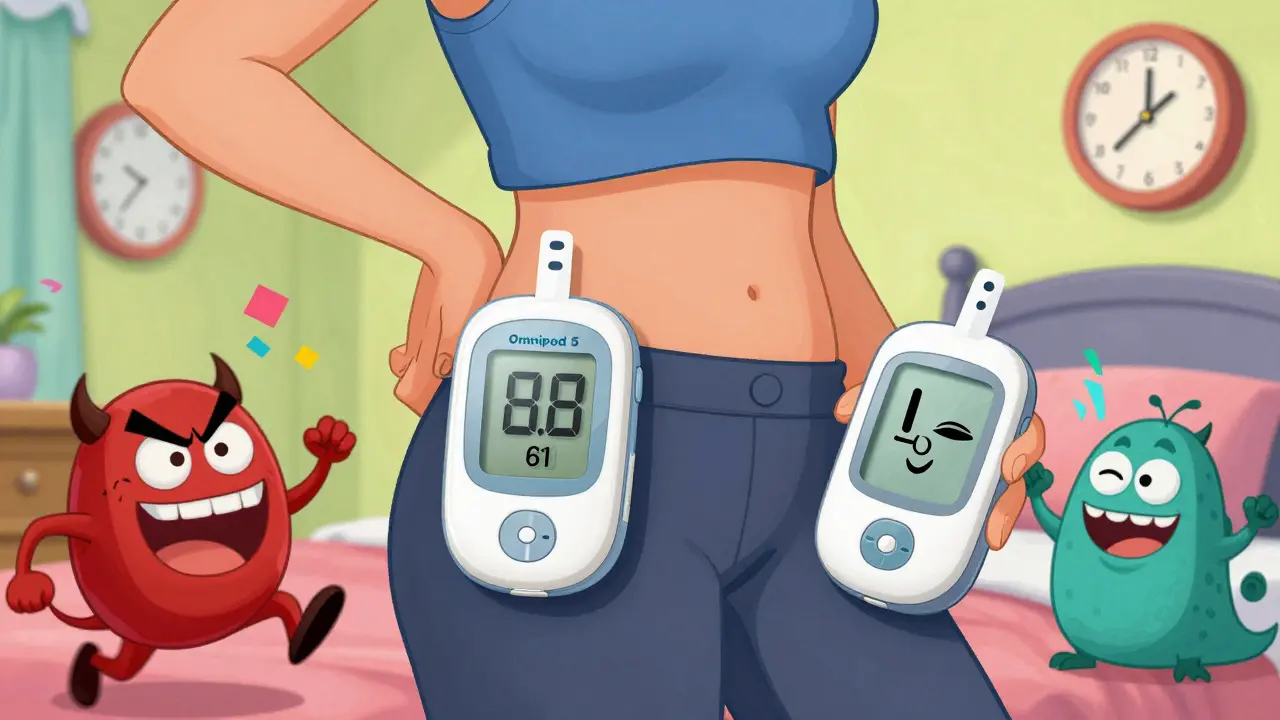
An insulin pump is a wearable device, about the size of a small smartphone, that gives you insulin through a tiny tube or patch stuck under your skin. It doesn’t replace your pancreas, but it mimics how a healthy one works. Instead of big doses a few times a day, it delivers a steady trickle of insulin (called a basal rate) 24/7, then adds extra insulin (a bolus) when you eat. Modern pumps can even talk to your continuous glucose monitor (CGM) and adjust insulin on their own - no input needed from you.There are two main types: tube-based pumps and tubeless patch pumps. Tube-based ones, like the Medtronic MiniMed 780G or Tandem t:slim X2, connect to your body with a thin plastic tube. Patch pumps, like the Omnipod 5, stick directly to your skin and have no tubes at all. Both use rapid-acting insulin and can deliver doses as small as 0.01 units - way more precise than a syringe.
Why People Choose Insulin Pump Therapy
Let’s be real - most people switch because injections are a grind. But the real reason pumps work better? Science backs it up. A 2022 study of over 25 trials found that people using pumps had HbA1c levels that were 0.37% lower on average than those using injections. That might sound small, but in diabetes, even 0.5% can mean the difference between staying out of the hospital and ending up there.
Here’s what else pumps do well:
- Less nighttime lows - Studies show a 32% drop in overnight low blood sugar episodes. That’s huge. No more waking up panicked, shaky, or with a headache.
- More flexibility - You can eat when you want. Skip a meal. Stay up late. Go hiking. The pump adjusts. No more rigid meal schedules.
- Fewer big swings - If your sugar spikes after dinner, you can give a small, precise correction. No more overshooting with a big injection.
- Auto-adjusting insulin - Systems like Omnipod 5 and Medtronic 780G use CGM data to predict drops and reduce insulin before you go low. Some even increase insulin if your sugar starts rising too fast.
Real people say it’s life-changing. One user on Reddit wrote: "My overnight lows went from 3-4 times a week to maybe once a month. I actually slept through the night for the first time in years."
The Downside: What No One Tells You
It’s not all smooth sailing. Pumps are powerful, but they come with risks and hassles.
- Delivery failures - If the tube kinks, the site gets blocked, or the patch peels off, insulin stops flowing. That can lead to diabetic ketoacidosis (DKA) in as little as 4-6 hours. About 15% of users deal with a blockage or disconnection at least once a month.
- Skin irritation - Constant wear can cause redness, bumps, or infections. One survey found 45% of users had site issues. Rotating locations helps, but it’s still a problem.
- Alarm fatigue - Pumps beep for everything: low insulin, low battery, blocked line, high sugar, low sugar. After a while, you start ignoring them. That’s dangerous.
- Technical overload - You have to learn how to calculate insulin-to-carb ratios, correction factors, and how to respond to alerts. It’s not plug-and-play. If you’re overwhelmed by tech, this might not be for you.
- Cost - The pump itself costs $5,000-$7,000. Supplies (tubes, pads, reservoirs) run $3,000-$5,000 a year. Insurance covers most of it in the U.S., but not everywhere. In Australia, coverage varies by state and private insurer. Out-of-pocket costs can still hit $100-$500 per month.
One user on TuDiabetes.org shared: "My pump failed during a family vacation. I didn’t realize until I was vomiting and confused. By the time I got to the hospital, I was in DKA. Now I carry insulin pens everywhere. Always."
Who Is It For? Who Should Skip It?
Not everyone needs a pump. The American Diabetes Association says it’s a good fit if you:
- Have HbA1c above 7.5% despite trying injections
- Get frequent low blood sugars, especially at night
- Have hypoglycemia unawareness (you don’t feel when you’re low)
- Want more freedom with meals or activity
- Are comfortable with tech and willing to learn
But it’s probably not right if you:
- Can’t check your blood sugar regularly (at least 4 times a day, or have a working CGM)
- Have trouble handling small devices or reading tiny screens
- Struggle with anxiety, depression, or eating disorders
- Don’t want to deal with alarms, troubleshooting, or constant monitoring
Children as young as 2 can use pumps now. In fact, 45% of kids with type 1 diabetes in the U.S. use them - higher than adults. That’s because early adoption helps with long-term outcomes. But parents need to be ready to manage it too.
Getting Started: What to Expect
Switching to a pump isn’t a quick switch. It takes weeks. Here’s the typical path:
- See your diabetes care team - Your endocrinologist or certified diabetes educator will review your history, current HbA1c, and lifestyle. They’ll check if you’re a good fit.
- Choose your pump - You’ll try demo models. Some clinics let you test a pump for a few days. Talk about what matters: Do you want tubes? Waterproof? Auto-adjust? Can you afford it?
- Training - You’ll have 3-5 sessions over 2-4 weeks. Learn how to insert the infusion set, change the reservoir, program basal rates, give boluses, and respond to alarms. Practice with your educator until you’re confident.
- Start using it - You’ll begin with a conservative insulin dose. Your team will adjust it over the next few weeks. Expect your sugar to fluctuate as your body adapts.
- Keep monitoring - You still need to check your blood sugar or use a CGM. Pumps don’t eliminate the need for awareness - they enhance it.
Most people take 2-3 weeks to feel comfortable. Common early struggles? Placing the infusion set (42% of users), miscalculating insulin doses (35%), and getting annoyed by alarms (28%).

What’s Next? The Future of Pump Therapy
The tech is getting smarter fast. In January 2023, the FDA approved the Tandem t:slim X2 with Control-IQ for kids as young as 2. That’s 120,000 more children who can now use automated insulin delivery. The Medtronic MiniMed 880G, expected late 2024, will extend its safety pause during low sugar from 90 minutes to 150 minutes. And the Beta Bionics iLet - a bionic pancreas that delivers both insulin and glucagon - is in final trials. It might be the first device that truly mimics a pancreas.
By 2027, over 65% of new type 1 diagnoses in kids are expected to start on automated systems. But adoption isn’t perfect. Insurance denials, high costs, and provider hesitation still block access. In Australia, coverage depends on your state and private insurer. Some get it fully covered. Others pay thousands out of pocket.
Final Thoughts: Is It Worth It?
Insulin pump therapy isn’t magic. It doesn’t make diabetes disappear. But for many, it takes a huge weight off. Less fear of lows. More freedom to live. Fewer injections. Better numbers.
But it demands effort. You have to stay engaged. You have to check your numbers. You have to carry backup insulin. You have to be ready to fix a clogged tube at 2 a.m.
If you’re tired of injections, if you’re tired of guessing, if you want your life to feel less like a medical routine - then it’s worth exploring. Talk to your diabetes team. Try a demo. See how it feels. The technology is there. The question is: are you ready?


Emma Nicolls
March 14, 2026 AT 00:25Jimmy V
March 14, 2026 AT 02:26Richard Harris
March 14, 2026 AT 11:35tamilan Nadar
March 15, 2026 AT 23:39Adam M
March 17, 2026 AT 08:31Rosemary Chude-Sokei
March 17, 2026 AT 23:57Noluthando Devour Mamabolo
March 18, 2026 AT 10:24Leah Dobbin
March 18, 2026 AT 10:53Ali Hughey
March 19, 2026 AT 10:24Alex MC
March 20, 2026 AT 07:32rakesh sabharwal
March 20, 2026 AT 11:41Aaron Leib
March 20, 2026 AT 11:51Dylan Patrick
March 20, 2026 AT 11:52