
Opioid Tolerance Dose Adjuster
This tool helps illustrate how opioid tolerance changes after stopping use. It's for educational purposes only and does not replace medical advice. The FDA recommends starting at 25% of previous dose after 2+ weeks off opioids.
74%: Fatal overdose rate within first few weeks after stopping opioids (e.g., post-release from prison)
25%: FDA-recommended starting dose after 2+ weeks of abstinence
50 MME: Daily dose threshold where overdose risk significantly increases (CDC guideline)
When you first start taking opioids for pain, they work like magic. The ache fades, you can sleep, move better, feel like yourself again. But after a while, something changes. The same dose doesn’t help as much. You need more. Then more again. This isn’t your fault. It’s not weakness. It’s biology. This is opioid tolerance-and it’s one of the most misunderstood, dangerous, and common side effects of long-term opioid use.
What Exactly Is Opioid Tolerance?
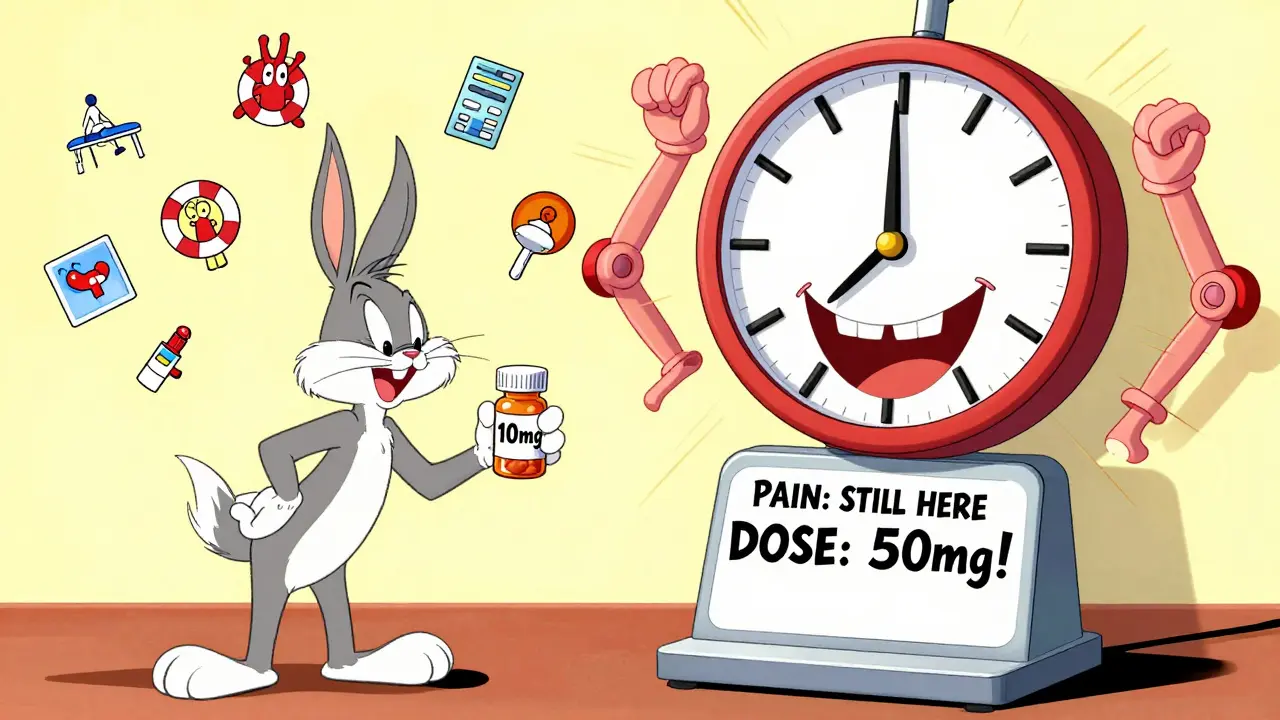
Opioid tolerance means your body gets used to the drug. Over time, the same amount stops doing what it used to. If you were taking 10 mg of oxycodone to control your pain, and now you need 20 mg to get the same relief, that’s tolerance. It’s not addiction. It’s not dependence. It’s a physical change in your nervous system.
The U.S. Food and Drug Administration defines it simply: exposure to opioids causes your body to adapt, reducing the drug’s effect. That’s it. Your brain and spinal cord start to respond less to the drug. The receptors that opioids latch onto-the mu-opioid receptors-get less sensitive. Some even disappear from the surface of nerve cells. Your body tries to balance out the constant presence of the drug by turning down the volume.
This isn’t just about pain relief. Tolerance can develop at different speeds for different effects. You might lose pain control quickly but still feel sleepy or have slowed breathing at the same dose. That’s why doctors warn: increasing your dose doesn’t always mean you’re safer. You might just be getting more side effects without better pain relief.
Why Does This Happen So Fast?
Some people develop tolerance in just a few weeks. Others take months. It depends on your genes, your metabolism, how often you take the drug, and even your level of inflammation.
At the cellular level, opioids trigger a chain reaction. They bind to receptors, which then signal your brain to release dopamine-that’s the feeling of calm or euphoria. But when this happens over and over, your cells start to shut down the response. They pull receptors inside the cell (internalization), reduce how many are made (downregulation), and change how signals are passed along. Inflammatory molecules like TLR4 and NLRP3 also get involved, making your nerves more sensitive to pain and less responsive to the drug.
Studies show that about 30% of people on long-term opioid therapy need higher doses within the first year. And for 40% of chronic pain patients, the medication loses its effectiveness within six months. That’s not rare. It’s expected.
Genetics play a big role too. The OPRM1 gene controls how your mu-opioid receptors are built. Small differences in this gene can make one person highly sensitive to opioids while another needs much higher doses just to feel the same effect. That’s why two people on the same dose can have completely different experiences.
Tolerance vs. Dependence vs. Addiction
This is where things get confusing-and dangerous. People mix up tolerance, dependence, and addiction. They’re related, but not the same.
- Tolerance means you need more to get the same effect.
- Dependence means your body has adjusted to having the drug around. If you stop suddenly, you get sick-sweating, shaking, nausea, anxiety. That’s withdrawal. It doesn’t mean you’re addicted.
- Addiction (Opioid Use Disorder) is when you keep using the drug even though it’s hurting your life-your job, your relationships, your health. You can’t stop, even if you want to.
The Centers for Disease Control and Prevention (CDC) is clear: tolerance alone doesn’t mean you have an addiction. But it’s a major stepping stone. When you’re chasing relief and the dose keeps rising, you’re more likely to cross into risky territory.
The Hidden Danger: Losing Tolerance
Here’s the part no one talks about until it’s too late: tolerance can disappear.
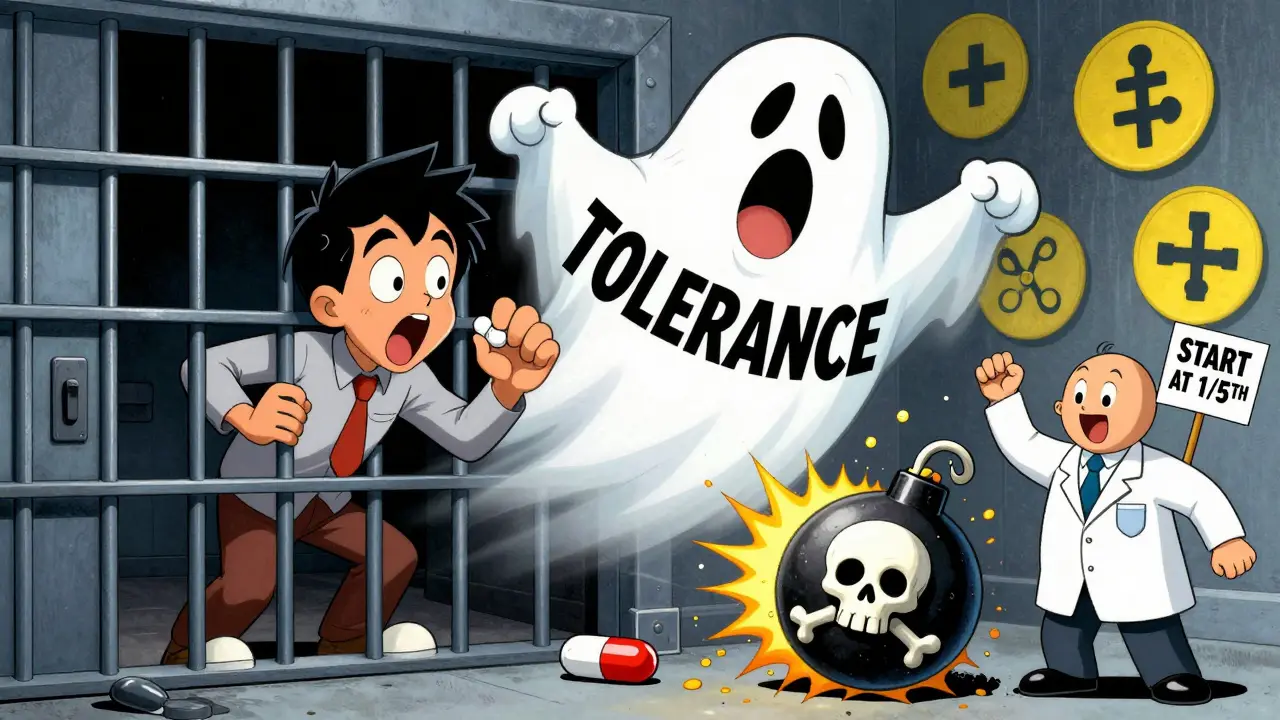
If you stop taking opioids-even for a few days-your body forgets how to handle them. Your receptors come back. Your sensitivity returns. That’s why people who’ve been in rehab, jail, or just took a break from drugs are at extreme risk when they start using again.
Studies show that 74% of fatal opioid overdoses happen in the first few weeks after someone is released from prison. Why? Because they go back to their old dose. They think they can handle it. But their body can’t. A dose that was once safe is now deadly.
And it’s not just people with opioid use disorder. Someone on a stable prescription for years might take a week off for surgery or travel. When they restart, they might not realize their tolerance has dropped. One pill. One dose. And it’s over.
That’s why experts say: if you’ve been away from opioids, even briefly, start with a fraction of your old dose. A quarter. A fifth. Don’t guess. Don’t assume. Your body doesn’t remember how much it used to take.
Why Dose Escalation Is a Trap
Doctors sometimes increase doses because they think, “If a little helps, more must help more.” But that’s not how opioids work.
Research shows that after a certain point, higher doses don’t give better pain control. They just increase side effects: constipation, drowsiness, nausea, and worst of all-slowed breathing. That’s what kills people in overdoses.
The CDC recommends that doctors pause before raising doses above 50 morphine milligram equivalents (MME) per day. At that level, overdose risk jumps significantly. And if you’re already at that level and still in pain, the answer isn’t more opioids. It’s a different approach.
Alternatives exist. Physical therapy. Nerve blocks. Cognitive behavioral therapy. Non-opioid pain meds like gabapentin or antidepressants. Sometimes, switching to a different opioid-called opioid rotation-can reset tolerance and improve pain control without increasing the total dose.
What’s Being Done to Fix This?
Scientists are working hard to break the cycle of tolerance. One promising area is targeting inflammation. Researchers found that blocking certain inflammatory pathways (like TLR4 and NLRP3) in lab studies can slow or even prevent tolerance from developing.
Another approach? Low-dose naltrexone. Naltrexone is usually used to block opioids entirely. But at tiny doses-1 to 4.5 mg-it seems to calm the immune response in the brain that drives tolerance. Early clinical trials show patients on this combo need 40-60% less opioid over time to get the same pain relief.
The FDA is encouraging drug makers to develop new painkillers that don’t cause tolerance. That’s a big shift. For decades, the goal was just to make stronger opioids. Now, the goal is to make ones that last.
What You Need to Know
If you’re on opioids for pain:
- Tolerance is normal, not a failure.
- More isn’t always better. Higher doses increase risk without guaranteeing better pain control.
- If your pain isn’t improving, talk to your doctor about alternatives-not just more pills.
- If you’ve stopped taking opioids-even for a short time-never go back to your old dose. Start low. Way low.
- Ask about opioid rotation or combination therapies like low-dose naltrexone.
If you’re helping someone in recovery:
- Remind them: their tolerance is lower now.
- Don’t let them underestimate street drugs. Fentanyl is 50 times stronger than heroin. A pill that looks like their old oxycodone could kill them.
- Support access to medication-assisted treatment (like methadone or buprenorphine). It prevents relapse and overdose.
Final Thought
Opioid tolerance isn’t a flaw in the person. It’s a flaw in the system. We’ve treated pain like a simple equation: more drug = more relief. But the body doesn’t work that way. It adapts. It resists. And when we push harder, we push people toward danger.
Understanding tolerance isn’t about blaming patients or doctors. It’s about recognizing a biological truth-and changing how we respond to it. Better pain management doesn’t mean more opioids. It means smarter, safer, and more thoughtful care.
Is opioid tolerance the same as addiction?
No. Tolerance means you need higher doses to get the same effect. Addiction, or opioid use disorder, means you keep using the drug despite harm to your health, relationships, or life. You can have tolerance without addiction, but tolerance often leads to risky behaviors that increase addiction risk.
Can you develop tolerance to opioids in just a few days?
Yes. While tolerance usually builds over weeks, some people-especially those with certain genetic traits or who take high doses frequently-can show signs of tolerance in as little as 5 to 7 days. Regular daily use, even at prescribed doses, can trigger biological changes quickly.
Why do doctors keep increasing opioid doses if it’s dangerous?
Sometimes, they don’t realize how fast tolerance develops-or they’re under pressure to relieve pain quickly. But guidelines now warn against dose escalation beyond 50 MME per day without a clear plan. Many doctors are shifting toward non-opioid options, combination therapies, or opioid rotation instead of simply raising the dose.
If I stop opioids for a while, will my tolerance come back if I start again?
No. Tolerance drops quickly after stopping. Your body forgets how to handle the drug. If you restart at your old dose, you’re at high risk of overdose-even if you’ve used opioids for years. Always restart at a much lower dose and work up slowly under medical supervision.
Are there tests to check for opioid tolerance?
There’s no direct test for tolerance. Doctors rely on clinical signs: asking if pain is better, if side effects have increased, and whether the patient feels they need more. Blood tests can show how much opioid is in your system, but they don’t measure tolerance. It’s a behavioral and physical assessment, not a lab result.

Diana Dougan
January 31, 2026 AT 00:42so like... if i take my 20mg oxycodone and then take a week off for a dental thing, and then go back to 20mg... i’m basically doing a suicide run? wow. thanks for the heads up, i guess? lol
Bobbi Van Riet
February 1, 2026 AT 15:38I’ve been on long-term opioids for fibromyalgia for 8 years and this post nailed it. Tolerance isn’t moral failure-it’s biology. My doc tried to push me to 100 MME last year and I said no. Instead, we switched to gabapentin + CBT and my pain is actually *better* managed now. The myth that more opioids = better pain is so dangerous. Also, the part about tolerance dropping after a break? I didn’t know that until I almost OD’d after a hospital stay. Please, if you’re reading this and you’ve taken a break-start at 1/4 your old dose. Your life depends on it.
Holly Robin
February 3, 2026 AT 13:59THIS IS ALL A BIG PHARMA LIE. They made us addicted on purpose. Look at Purdue Pharma. They knew tolerance would make people crave more. They paid doctors. They lied to the FDA. They didn’t care if you died. And now they’re laughing all the way to the bank while you’re burying your kid. The government let this happen. The system is rigged. Wake up. They’re not here to help you-they’re here to profit from your pain.
Shubham Dixit
February 4, 2026 AT 20:24In India, we don’t have this problem because we don’t overprescribe. We have traditional medicine, yoga, ayurveda. People here suffer with pain but they don’t become addicts. This is a Western disease-weak minds, weak bodies, weak will. You think your body is so special it can’t handle pain? Try walking 10km barefoot in the heat. Then come back and tell me about tolerance. This is not biology-it’s entitlement.
KATHRYN JOHNSON
February 6, 2026 AT 06:22There is no such thing as 'tolerance' without underlying addiction. The CDC guidelines are dangerously misleading. If a patient requires escalating doses, it is not a physiological adaptation-it is a behavioral disorder masquerading as biology. The medical community has abdicated its responsibility by normalizing opioid escalation. This post is dangerous.
Sazzy De
February 7, 2026 AT 09:35my mom’s on this stuff for her back and she’s scared to even take a vacation because she thinks she’ll lose tolerance and overdose. i’m glad someone finally explained it. i’m gonna print this out for her. thank you.
Jodi Olson
February 8, 2026 AT 01:44Tolerance is the body’s quiet rebellion against artificial homeostasis. The nervous system doesn’t want to be sedated. It wants to feel-pain, pleasure, the full spectrum. Opioids are a temporary truce with nature, and nature always reclaims its balance. The tragedy isn’t the tolerance-it’s that we mistook the truce for a cure.
Carolyn Whitehead
February 9, 2026 AT 00:41you’re not alone in this. i’ve been there too. it’s okay to feel scared. it’s okay to need help. small steps matter. you got this
Natasha Plebani
February 10, 2026 AT 02:37Neuroadaptive downregulation of mu-opioid receptors via receptor internalization and epigenetic suppression of OPRM1 transcription is a well-documented phenomenon, but what’s underexplored is the role of glial cell priming via TLR4/NLRP3 inflammasome activation in accelerating tolerance kinetics. Low-dose naltrexone’s immunomodulatory effects may be more critical than its opioid antagonism-this could be the key to breaking the cycle without increasing polypharmacy burden.
Rob Webber
February 10, 2026 AT 10:16Everyone’s acting like this is some new revelation. I’ve been in recovery for 12 years. I lost my brother to an overdose after he got out of jail. He took his old dose. He didn’t know his tolerance was gone. Nobody told him. That’s the real crime-not the science, not the biology-but the silence. The system fails people before they even get to the point of tolerance.
calanha nevin
February 11, 2026 AT 22:55As a pain management nurse for 18 years, I’ve seen this over and over. Patients aren’t addicts-they’re survivors. The real failure is when providers don’t offer alternatives. Opioid rotation, ketamine infusions, spinal cord stimulators, even acupuncture-these work. But insurance won’t cover them. We need policy change, not just patient education.
Lisa McCluskey
February 12, 2026 AT 21:53my cousin’s on methadone now and she says the worst part isn’t the withdrawal-it’s the guilt. like she failed because she needed more. this post helped me understand. i’m gonna tell her i’m proud of her for sticking with it
owori patrick
February 14, 2026 AT 18:45in Nigeria, we don’t have this problem because we use herbs and prayer. but i still thank you for sharing. i learned something today. we need more people like you talking about this