

Snoring isn’t just annoying-it can disrupt sleep, strain relationships, and even signal something more serious like obstructive sleep apnea. If you’ve tried pillows, nasal strips, or sleeping on your side with little success, you might be wondering if there’s a better option. Enter oral appliance therapy-a quiet, portable, and increasingly popular solution that repositions your jaw to keep your airway open while you sleep.
How Mandibular Advancement Devices Actually Work
Mandibular Advancement Devices (MADs) are custom-fitted dental appliances that gently push your lower jaw forward during sleep. This small movement-usually between 3 and 10 millimeters-pulls the tongue and soft tissues away from the back of your throat, preventing them from collapsing and vibrating, which is what causes snoring.
These devices aren’t new. They evolved from orthodontic tools used to correct bite issues. But in the late 1990s, research by Dr. Nobuyoshi Kato showed that even small amounts of jaw advancement-just 2mm-could significantly reduce breathing interruptions. Today’s devices are precision-engineered. Prescription models like the SomnoDent MAS and TAP 3 use semi-rigid acrylic with titanium connectors, allowing fine adjustments in 0.5mm increments. Over-the-counter versions, like Zyppah or Good Morning Snore Solution, are made of thermoplastic that you mold with hot water. But here’s the catch: custom devices work far better.
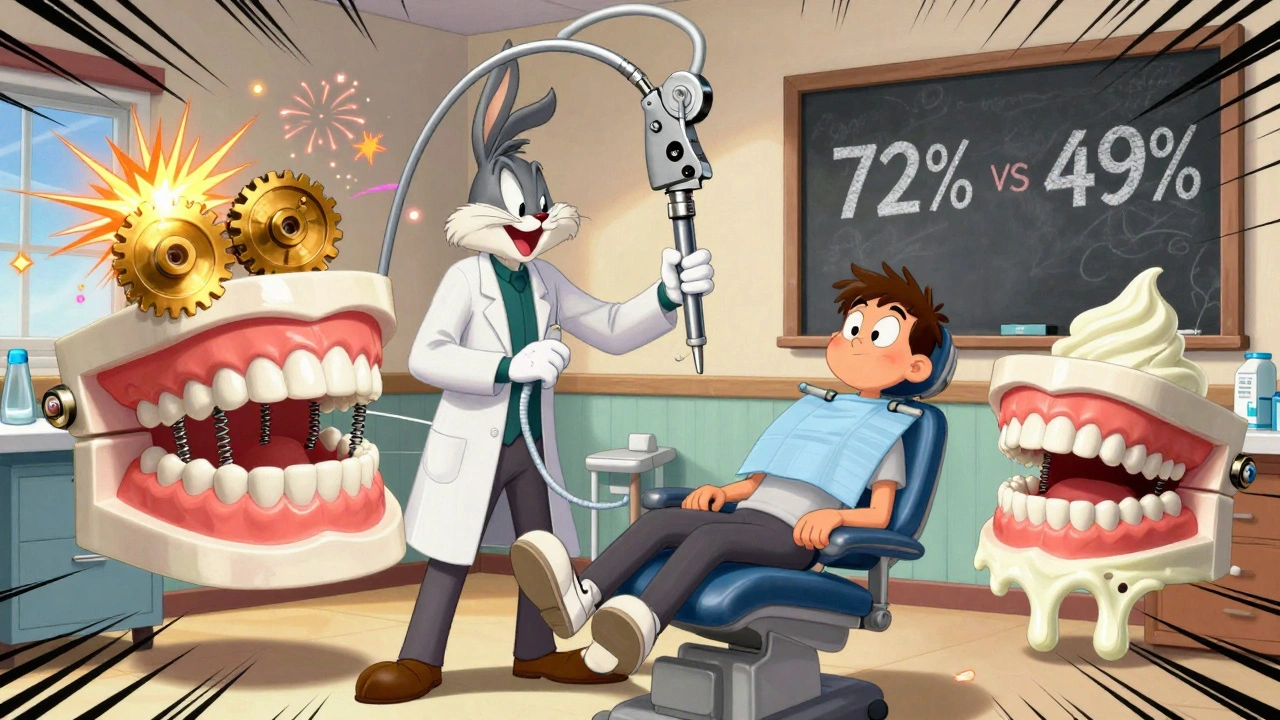
A 2015 AASM meta-analysis found custom MADs reduced snoring by 72.3%, while over-the-counter versions only managed 48.6%. Why? Because they’re tailored to your mouth and can be adjusted to the exact level of advancement that works for you. Too little, and snoring continues. Too much, and you risk jaw pain or tooth movement.
Who Benefits Most From Oral Appliance Therapy
Not everyone who snores is a good candidate. MADs work best for people with primary snoring or mild-to-moderate obstructive sleep apnea. They’re less effective for those with severe anatomical blockages, like a very large tongue or collapsed throat tissues (Mallampati Class IV).
Studies show that about 78-85% of users with mild-to-moderate snoring see clinically meaningful improvement. That means snoring drops from loud, disruptive levels-often 60-70 decibels-to quieter, more tolerable levels of 35-45 dB. One Reddit user tracked his snoring with a smartphone app: before the device, it hit 65dB; after, it dropped to 38dB. His wife said it was “life-changing.”
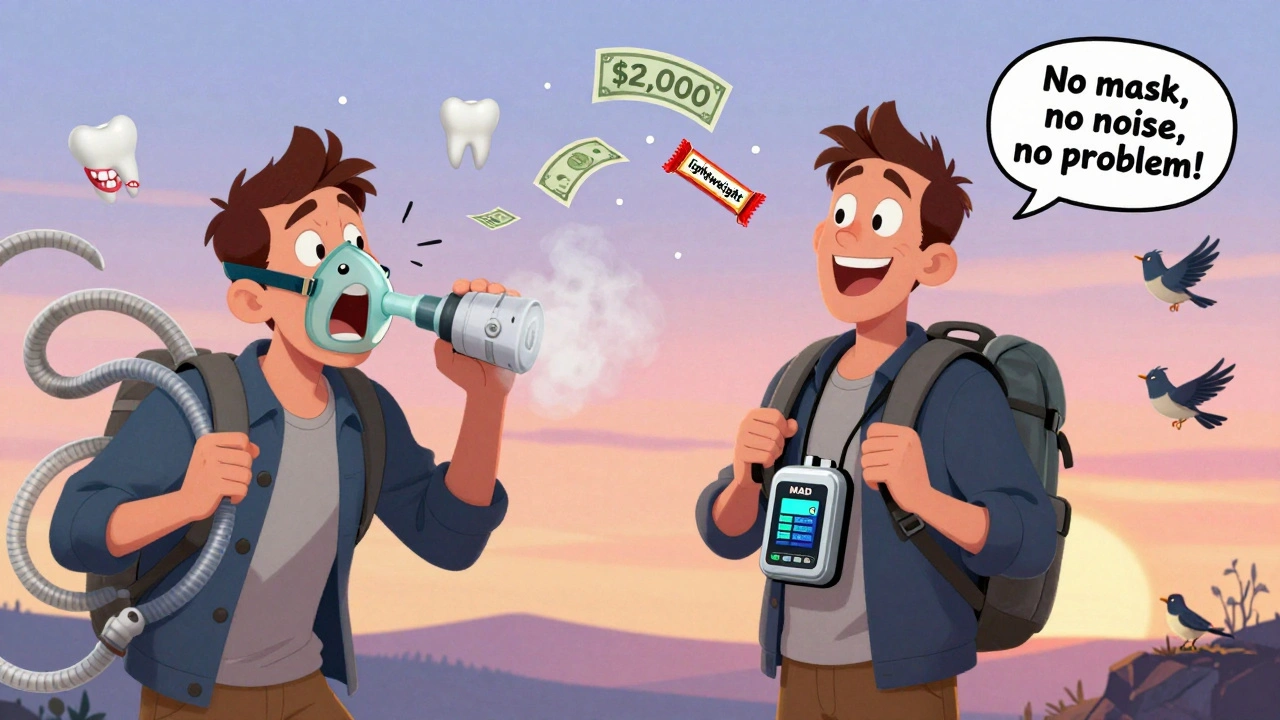
But it’s not just about snoring. MADs also reduce breathing pauses (apneas) and low-oxygen events (hypopneas). The American Academy of Sleep Medicine recognizes them as a first-line treatment for mild-to-moderate OSA, especially for people who can’t tolerate CPAP machines. Why? Because CPAP has a 55% long-term dropout rate. People hate the mask, the noise, the claustrophobia. MADs are small, quiet, and easy to travel with. They weigh less than a candy bar.
How They Compare to Other Treatments
Let’s put MADs in context. Here’s how they stack up against other common snoring solutions:
| Treatment | Snoring Reduction | Adherence Rate (12 Months) | Key Limitations |
|---|---|---|---|
| Mandibular Advancement Device (Custom) | 65-75% | 76.4% | Requires dental fit; possible jaw changes |
| Mandibular Advancement Device (OTC) | 30-50% | 62.1% | Fixed advancement; lower efficacy |
| CPAP Machine | 85-95% | 45.2% | Mask discomfort, noise, travel hassle |
| Nasal Dilators | 20-30% | 58.7% | Only helps if nose is the issue |
| Positional Therapy | 35-45% | 51.3% | Works only for back-sleepers |
| UPPP Surgery | 60-70% | 78.9% | Invasive, recovery time, risk of complications |
CPAP is still the gold standard for complete snoring elimination. But if you can’t stick with it, MADs are your next best bet. They’re not as powerful, but they’re far more tolerable. That’s why adherence is so much higher. People use them night after night because they don’t feel like a hospital device.
The Real Drawbacks: Dental Side Effects
There’s no free lunch. While MADs are non-invasive, they’re not harmless. About 25% of long-term users develop permanent changes to their bite. Teeth can shift. The jaw joint (TMJ) can become sore or inflamed. Some patients need braces or even crowns years later.
Dr. Avram Gold from SUNY warns that these changes are often irreversible. The American Academy of Dental Sleep Medicine recommends check-ups every six months to catch problems early. Still, many users don’t realize this risk until it’s too late.
Other common side effects include:
- Morning jaw pain (reported by 68% of new users)
- Excessive saliva (43%)
- Tooth discomfort (29%)
- Dry mouth or sore gums
Most of these fade after 2-4 weeks as your mouth adjusts. But if pain lasts longer, you need to see your dentist. Some people find relief by wearing the device for an hour during the day before bedtime to get used to the pressure.
Getting Started: What the Process Looks Like
You can’t just buy a MAD off Amazon and expect results. Proper use requires a structured approach:
- Get tested: Rule out severe sleep apnea with a home sleep test or overnight sleep study. MADs aren’t safe for untreated severe OSA.
- See a dentist: Not any dentist-look for one certified in dental sleep medicine. They’ll take digital impressions or scans. At-home kits are cheaper but 23% less accurate, according to a 2022 study.
- Wait for your device: Custom MADs take 2-4 weeks to make. OTC devices arrive in days.
- Titrate slowly: For custom devices, you’ll adjust the jaw position by 0.5-1mm every 3-5 days over 4-6 weeks. The goal is the maximum forward position you can tolerate without pain.
- Follow up: You’ll need 2-3 visits over the first few months. Each visit costs $150-$300.
Most people get used to the device within 10-14 days. By day 30, 76% are using it every night. Consistency is everything. If you skip a night, snoring usually comes back within 48 hours.
Cost, Insurance, and Market Trends
Custom MADs cost between $1,800 and $2,500. OTC versions run $50-$100. But here’s the problem: only 38% of U.S. insurance plans cover them. Medicare doesn’t cover them at all. That means most people pay out of pocket.
Despite the cost, the market is growing fast. The global oral appliance market hit $1.28 billion in 2022 and is projected to nearly double by 2030. In the U.S., 14.6% of snorers now use MADs-up from 5.2% in 2015. CPAP use is still higher at 28.3%, but its long-term failure rate keeps pushing people toward alternatives.
New tech is coming. The SomnoDent EVO 3, cleared by the FDA in 2023, has built-in sensors that connect to a smartphone app and show you how well you’re breathing each night. Sleep Solutions Inc. is launching an AI-driven MAD in 2024 that auto-adjusts based on your sleep patterns. And researchers are studying whether genetic markers can predict who’ll respond best to MADs.
Is It Worth It?
Ask yourself these questions:
- Do you snore loudly enough to disturb your partner-or wake yourself up?
- Have you tried lifestyle changes, nasal strips, or positional therapy without success?
- Are you willing to pay $2,000 and commit to regular dental visits?
- Are you okay with the possibility of minor dental changes down the road?
If you answered yes to most of these, then yes-it’s worth considering. For people who can’t stand CPAP, MADs offer real relief. They’re not perfect. But they’re the most effective non-surgical option for snoring that’s backed by solid science.
And for many, that’s enough.
Do mandibular advancement devices cure snoring?
No, they don’t cure snoring. They suppress it while you’re wearing the device. If you stop using it, snoring typically returns within 48 hours. They’re a management tool, not a permanent fix.
Can I use an over-the-counter MAD instead of a custom one?
You can, but they’re far less effective. OTC devices have fixed advancement and aren’t tailored to your mouth. Studies show custom MADs reduce snoring by 72% on average, while OTC versions only manage about 49%. If you’re serious about results, go custom.
Are MADs safe for people with crowns or bridges?
It depends. Most MADs require at least 6-8 natural teeth per arch to hold securely. Crowns and bridges can sometimes work, but they need to be in good condition. Your dentist will evaluate your dental structure before fitting you.
How long does it take to get used to a mandibular advancement device?
Most people adapt within 10-14 days. Some feel jaw soreness or excess saliva at first, but those symptoms usually fade. Wearing the device for an hour during the day before bed can help your jaw adjust faster.
Will my insurance cover a mandibular advancement device?
Only about 38% of U.S. commercial plans cover MADs. Medicare does not. You’ll need a diagnosis of sleep apnea or severe snoring from a sleep study to qualify. Always check with your insurer before purchasing.
Can MADs cause permanent jaw damage?
Yes, in about 25% of long-term users, MADs can cause irreversible changes to the bite, including tooth movement and TMJ issues. Regular dental check-ups every six months are critical to monitor for these changes and prevent serious problems.
What’s the difference between a MAD and a tongue-retaining device?
MADs move the lower jaw forward, which pulls the tongue along with it. Tongue-retaining devices hold the tongue in place with suction. MADs are more common, more effective, and better tolerated. Tongue-retaining devices are usually only used if someone has no teeth or can’t wear a jaw device.
Oral appliance therapy isn’t magic. But for millions of people who can’t sleep-or can’t let their partner sleep-it’s one of the few tools that actually works without surgery or a mask. If you’ve been living with snoring for years, it might be time to talk to a sleep dentist.


Elizabeth Grace
December 1, 2025 AT 20:56I tried one of those OTC gadgets after my husband started snoring like a chainsaw in the next room. It felt like a mouthguard from hell-saliva everywhere, jaw ached for days, and honestly? Still snored. I almost cried. Then we got the custom one. 3 weeks later, he slept through the night. I did too. Worth every penny, even if my dentist now calls me ‘the snore queen.’ 😅
Steve Enck
December 3, 2025 AT 02:54One must interrogate the epistemological foundation of the claim that MADs constitute a ‘first-line treatment.’ The meta-analytic data cited is predicated on self-reported outcomes, selection bias in clinical cohorts, and the absence of longitudinal neurophysiological tracking. Furthermore, the normalization of dental compromise as an acceptable trade-off reflects a pathological commodification of sleep health under late-stage capitalist healthcare paradigms. One does not simply ‘adjust’ the mandible without ontological consequences.
Jay Everett
December 4, 2025 AT 08:24Bro. I was skeptical too. Thought it was snake oil. But after 3 months of using my SomnoDent? My wife started kissing me again. 🤯 No joke. First night? Felt like I had a golf ball in my mouth. Day 7? Forgot I was wearing it. Day 30? I dreamt about it. 😴 The jaw pain? Totally faded. The $2,200 hurt-but not as much as waking up to her whispering, ‘Can you just… stop?’ for the 10th time. Also, the app that tracks your breathing? Mind-blowing. You see your oxygen levels climb like a stock chart. It’s like a superhero suit for your airway. Go get one. Your partner will thank you. And your future self won’t need a new set of teeth.
मनोज कुमार
December 5, 2025 AT 18:39Joel Deang
December 7, 2025 AT 05:34yo i got the zyppah thing off amazon for 60 bucks and honestly? it felt like chewing on a rubber duck. but my gf said i stopped snoring? so i keep wearing it even tho my tongue feels like its been in a blender. also i think i lost a filling? idk. my dentist looked at me like i just told her i bathed in glitter. 🤷♂️ but hey, she sleeps now. so… win? maybe?
Roger Leiton
December 8, 2025 AT 09:31Just got my custom MAD last week and I’m already obsessed. It’s like my jaw finally found its happy place. I didn’t realize how much I was waking myself up until I stopped. The first night, I woke up drooling like a puppy, but now? I forget I’m even wearing it. My sleep score on my Apple Watch jumped from 72 to 89. And the best part? My dog stopped barking at night because he finally got quiet. 🐶💤 I’ve been telling everyone I know. If you’re even considering it-do it. The dentist visits suck, but your future self will send you a thank-you note.
Laura Baur
December 10, 2025 AT 06:02It is deeply concerning that society has normalized the commodification of sleep health to the point where individuals are encouraged to insert foreign, irreversible dental apparatuses into their bodies as a first resort, rather than addressing root causes such as obesity, alcohol consumption, or poor sleep hygiene. The normalization of jaw displacement as a ‘solution’ reflects a cultural abandonment of preventative medicine in favor of mechanical band-aids. Moreover, the fact that insurance refuses to cover these devices-despite their documented long-term dental consequences-demonstrates a systemic failure to prioritize patient well-being over profit. One cannot simply ‘adjust’ the mandible without altering the biomechanical integrity of the entire craniofacial structure. This is not therapy. It is dental roulette.
Jack Dao
December 10, 2025 AT 20:59People who buy these things are just lazy. If you’re snoring that bad, maybe don’t eat pizza at midnight and drink three beers before bed. Or better yet-lose 30 pounds. I’ve seen guys spend $2,000 on a plastic mouthpiece while still ordering midnight wings. You can’t out-device bad habits. CPAP is the real deal. If you can’t handle it, maybe you’re not ready to sleep. 😒