
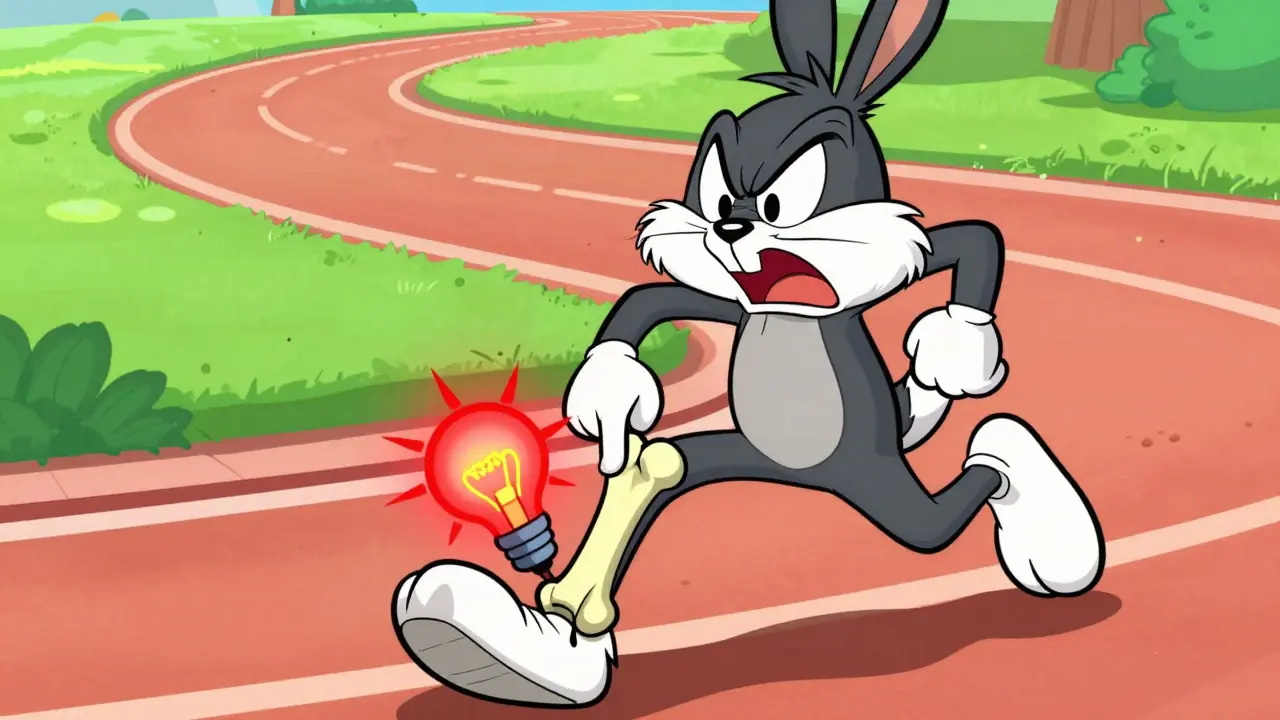
There is a massive difference between a dull ache in your shins and a bone that is literally cracking under pressure. Many runners mistake a stress fracture for a simple case of shin splints, and that mistake often leads to months of extra recovery time. If you've been told to "just rest it" without a clear map of how to get back on the pavement, you're playing a dangerous game with your long-term mobility. Whether you're dealing with Medial Tibial Stress Syndrome is an overuse injury characterized by pain along the inner edge of the shinbone (commonly known as shin splints) or a full-blown bone stress injury, the goal isn't just to stop the pain-it's to rebuild your bone's ability to handle the impact of every stride.
The Difference Between Shin Splints and Stress Fractures
Before you pick a plan, you need to know what you're actually treating. Shin splints, or MTSS, usually involve inflammation of the muscles and tendons around the tibia. It's a "warning light" on your dashboard. A Stress Fracture is a small crack in the bone caused by repetitive force and insufficient healing time. This is a structural failure.
If your pain is spread across a large area of your shin and eases up after a warm-up, it's more likely to be shin splints. However, if you can point to one specific spot on the bone that hurts intensely when touched, or if you have pain even while resting at night, you're likely looking at a stress fracture. According to data from Sports Medicine, female athletes see these injuries more often, with up to 21% of running injuries being tibial stress fractures compared to just 8% in men.
The Golden Rule of Bone Healing
You've probably heard the "10% rule"-the idea that you should only increase your weekly mileage by 10%. Forget it. For someone recovering from a bone stress injury, this rule is often too generic and can actually lead to re-injury. Bone remodeling cycles take anywhere from 90 to 120 days. Your calendar doesn't decide when you're ready; your biology does.
The modern approach uses a phased system. You don't just start running; you earn the right to run by passing specific physical benchmarks. If you feel a pain level higher than 2 out of 10 during an activity, you've gone too far. Stop, back off, and wait until the pain settles before trying again. This pain-guided approach is far more effective than following a rigid calendar.
| Feature | Shin Splints (MTSS) | Stress Fractures (BSI) |
|---|---|---|
| Initial Rest Period | 7-10 days of reduced load | 4-6 weeks of strict rest |
| Loading Start | Earlier gentle strengthening | Delayed until bone stabilizes |
| Total Recovery Window | Typically 2-6 weeks | Typically 8-12 weeks |
| Risk of Recurrence | Moderate | High (19-32%) |
Phase-by-Phase Strength Building
Running is essentially a series of single-leg hops. If your legs can't handle a hop in a controlled gym setting, they definitely can't handle a 5K. You need to progress through these stages of loading:
- Stage 1: Base Building. The goal here is pain-free walking. If you can't walk without a limp, you can't start strengthening. Focus on non-weight bearing activities like swimming or cycling to keep your heart healthy.
- Stage 2: Gentle Loading. Once walking is easy, start with Double-Leg Heel Raises. Aim for 3 sets of 15-20 reps daily. This wakes up the calf muscles that protect your tibia.
- Stage 3: Full Range Strength. Move to step-based heel raises. By dropping your heel off the edge of a step, you increase the range of motion and put a more functional load on the bone.
- Stage 4: Explosive Power. This is the final test. Start with double-leg hops, then progress to single-leg hops over 2-4 weeks. If you can't hop without pain, you aren't ready to run.

The Return-to-Run Blueprint
When you finally get the green light to run, do not just go for a 20-minute jog. Use a structured run-walk ratio. This method tricks the bone into adapting without overwhelming it. For those with low-risk sites (like the posterior medial tibia), a 6-week protocol is common. For high-risk sites like the anterior tibia or navicular, you'll need 8-12 weeks.
Here is a typical 6-week progression for low-grade injuries:
- Weeks 1-2: 1 minute of running followed by 4 minutes of walking. Total time: 20 minutes.
- Week 3: 1 minute of running followed by 3 minutes of walking. Total time: 25 minutes.
- Week 4: 1 minute of running followed by 2 minutes of walking. Total time: 30 minutes.
- Week 5: 1 minute of running followed by 1 minute of walking. Total time: 35 minutes.
- Week 6: 3 minutes of running followed by 1 minute of walking. Total time: 40 minutes.
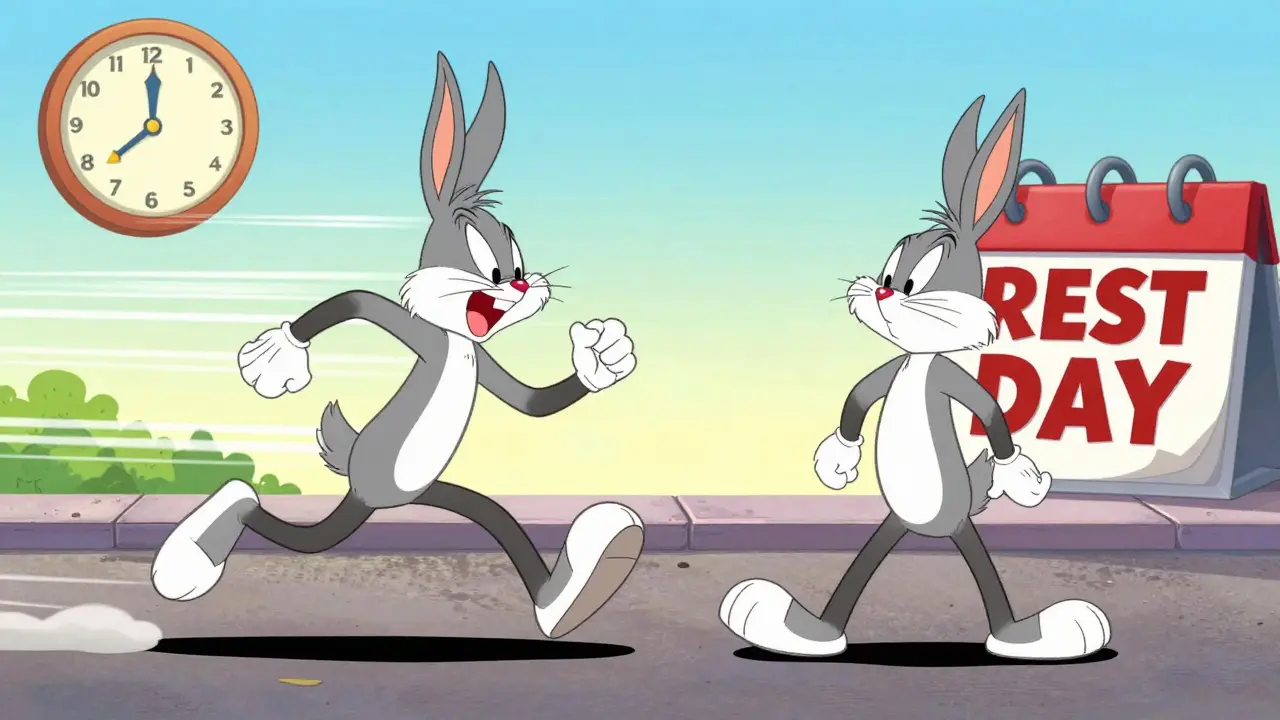
Crucially, you must have at least one full rest day between these sessions. Research shows that runners who include mandatory rest days have a 34% lower chance of re-injuring themselves.
Beyond the Bone: Why You Might Keep Getting Injured
If you've followed the plan perfectly and the pain keeps coming back, the problem might not be your running-it might be your fuel. Relative Energy Deficiency in Sport (or RED-S) is a syndrome where an athlete's energy intake is insufficient to support the energy expenditure required for health and athletic performance. This is incredibly common in endurance runners.
When your body doesn't have enough calories, it starts stealing minerals from your bones to fuel other systems. This leads to low bone mineral density. In fact, about 31% of female athletes with recurrent stress fractures have untreated RED-S. If you're cutting calories too aggressively or ignoring a massive increase in training volume, no amount of heel raises will fix the problem. You need to address nutrition and hormonal health alongside your physical therapy.
Additionally, don't ignore your hips. Many shin injuries are actually "hip problems manifesting in the ankle." If your glutes are weak, your lower leg takes more of the impact. Over 50% of runners who skip glute and hip strengthening report a recurrence within three months.
Pro Tips for a Faster Recovery
If you have access to an AlterG (anti-gravity treadmill), use it. By reducing your body weight to 40-60% of normal, you can maintain your running form and cardiovascular fitness without putting full stress on the bone. This has been shown to cut average recovery times by nearly a month.
You might also consider gait retraining. While many people buy heel lifts, they only reduce tibial strain by about 12-15%. In contrast, adjusting your cadence-taking shorter, quicker steps-can reduce strain by up to 38%. Increasing your steps per minute reduces the peak impact force on your shin with every hit.
How do I know if it's a stress fracture or just shin splints?
Shin splints usually feel like a diffuse ache along the inner side of the shin that might improve as you warm up. A stress fracture is usually pinpointed-you can touch one exact spot and feel sharp pain. If you have localized swelling or pain that keeps you awake at night, see a doctor for an MRI or DXA scan immediately.
Can I keep running if the pain is only a 2/10?
A pain level of 2/10 is generally the maximum acceptable threshold during a structured return-to-run plan. However, if the pain increases during the run or lingers the next morning, it means the load was too high and you need to drop back to the previous phase.
Should I use a walking boot or a cast?
This depends on the location of the fracture. High-risk sites (like the navicular or femoral neck) often require strict immobilization. Low-risk sites (like the posterior tibia) usually just require a period of non-weight bearing or modified activity. Your orthopedic surgeon will determine this based on imaging.
How long does a tibial stress fracture actually take to heal?
Bone healing is a slow process. While you might feel "fine" after 4 weeks, the bone is still remodeling. A full return to pre-injury mileage usually takes 8 to 12 weeks. Rushing this process is the primary reason why nearly a third of runners experience a recurrence.
Do I need special shoes for shin splints?
While supportive shoes help, the shoe isn't the cure. Focus more on your cadence and hip strength. Gait retraining to increase your step rate is significantly more effective at reducing tibial strain than simply switching shoe brands or adding inserts.
What to Do Next
If you are currently in pain, the first step is a professional diagnosis. An MRI is the gold standard for detecting early bone stress before it becomes a full fracture. Once diagnosed, don't jump straight into the run-walk plan. Spend at least two weeks focusing on the strengthening stages-specifically those heel raises and glute bridges.
If you have a history of multiple stress fractures, ask your doctor about a DXA scan to check your bone density. This will tell you if the problem is mechanical (how you run) or systemic (what you're eating or hormonal imbalances). Adjust your nutrition to ensure you're getting enough calcium and vitamin D, and keep a daily pain log to track your progress objectively.



Aaron McGrath
April 19, 2026 AT 03:39Absolute game changer on the cadence talk! Most people are just plodding along with a low RPM and wondering why their shins are screaming. Crank that cadence up, hit those glute bridges, and stop treating your recovery like a suggestion. If you aren't crushing the strength phase, you're just asking for another stress fracture. Let's get those gains and get back to peak performance!
dallia alaba
April 19, 2026 AT 20:20The section on RED-S is incredibly important. Many runners, especially in the distance community, push through an energy deficit thinking it's just 'discipline' when it's actually metabolic starvation. It's not just about calcium supplements; it's about total caloric availability to support the hormonal environment required for bone remodeling. Without adequate energy, the body simply cannot repair the micro-damage caused by running.
Brigid Prosser
April 19, 2026 AT 21:35Spot on with the hip strength bit. It's wild how many folks treat their legs like isolated pistons and ignore the powerhouse that's the glutes. If your hips are wobbly, your ankles are basically paying the tax for it. Absolute carnage for your shins if you don't sort that out first. Get your backside in gear before you hit the pavement again!
Lesley Wimbush
April 21, 2026 AT 18:33It's honestly adorable that people still believe in the 10% rule in this day and age. I mean, sure, it's a cute little guideline for beginners, but for anyone actually serious about the sport, it's practically ancient history. I've always used a much more intuitive, bio-feedback approach, and frankly, the results speak for themselves. Some people just lack the discipline to listen to their bodies without a chart.
Tanya Rogers
April 23, 2026 AT 03:06The fixation on 'structured plans' is a quintessential symptom of the modern obsession with quantification over qualification. While the provided run-walk ratios are logically sound, they fail to account for the metaphysical toll of injury-the psychological erosion that occurs when one's identity is tied to athletic output. Moreover, the insistence on an MRI as the 'gold standard' ignores the clinical utility of a seasoned practitioner's touch, though I concede that imaging provides a certainty that the human eye cannot.
Bob Collins
April 23, 2026 AT 15:59Just a friendly reminder to take the rest days seriously. It's tempting to skip them when you feel a bit better, but that's exactly when most people mess up. Just be patient with yourself.
julya tassi
April 24, 2026 AT 10:42I've tried the heel raises and they really help! 😊 It's a bit scary thinking about bone cracks, but the phased approach makes it feel way more manageable. Thanks for the tips! ✨
William Young
April 25, 2026 AT 11:40Walking is the foundation. If you can't do that without pain, nothing else matters. Glad to see that emphasized here.
Aman Tomar
April 27, 2026 AT 06:13This is so helpful... I have had this pain for months and I think I was just ignoring it because I wanted to run my first marathon. It is heartbreaking to realize I might have a real fracture and not just splints. I will try to find a doctor for a scan immediately!
Olushola Adedoyin
April 28, 2026 AT 19:51Why are they pushing these 'anti-gravity' treadmills? Sounds like some sci-fi nonsense to me. Probably just a way for clinics to overcharge you while they collect data on your movement patterns for some big corp. Trust your gut, not a machine that makes you float like a balloon!
Wendy Ajurín
April 29, 2026 AT 05:28I concur with the assessment regarding gait retraining. Increasing the step rate is a highly effective method for reducing peak impact forces. I would add that consistent monitoring of footwear wear-and-tear is also a critical, albeit secondary, component of a comprehensive injury prevention strategy.
Truman Media
April 29, 2026 AT 05:39It is a beautiful journey to heal the body. 🌟 We must be kind to ourselves and trust the time it takes for the bone to become strong again. Wishing everyone a peaceful recovery! 😊