

Getting bioequivalence (BE) studies right isn’t just about running trials-it’s about getting the statistics right from the start. Too few participants? You might miss a real difference and fail the study. Too many? You waste time, money, and expose more people to unnecessary procedures. The difference between success and failure often comes down to one thing: power and sample size.
Why Power and Sample Size Matter in Bioequivalence Studies
Bioequivalence studies compare a generic drug to its brand-name counterpart to prove they work the same way in the body. The goal isn’t to show one is better-it’s to prove they’re close enough in how they’re absorbed. That’s measured using two key numbers: Cmax (peak concentration) and AUC (total exposure over time). Both must fall within strict limits: 80% to 125% of the brand drug’s values, on a geometric mean ratio scale. But here’s the catch: biological variability is real. People absorb drugs differently. That’s why you can’t just pick a random number of volunteers. If you don’t account for that variation, your study will likely fail-even if the drugs are truly equivalent. Regulators like the FDA and EMA require studies to have at least 80% power. That means if the drugs are truly bioequivalent, your study has an 80% chance of proving it. Some regulators, especially for narrow therapeutic index drugs, expect 90% power. Alpha (the chance of a false positive) is always set at 0.05. No wiggle room.What Drives Sample Size in BE Studies?
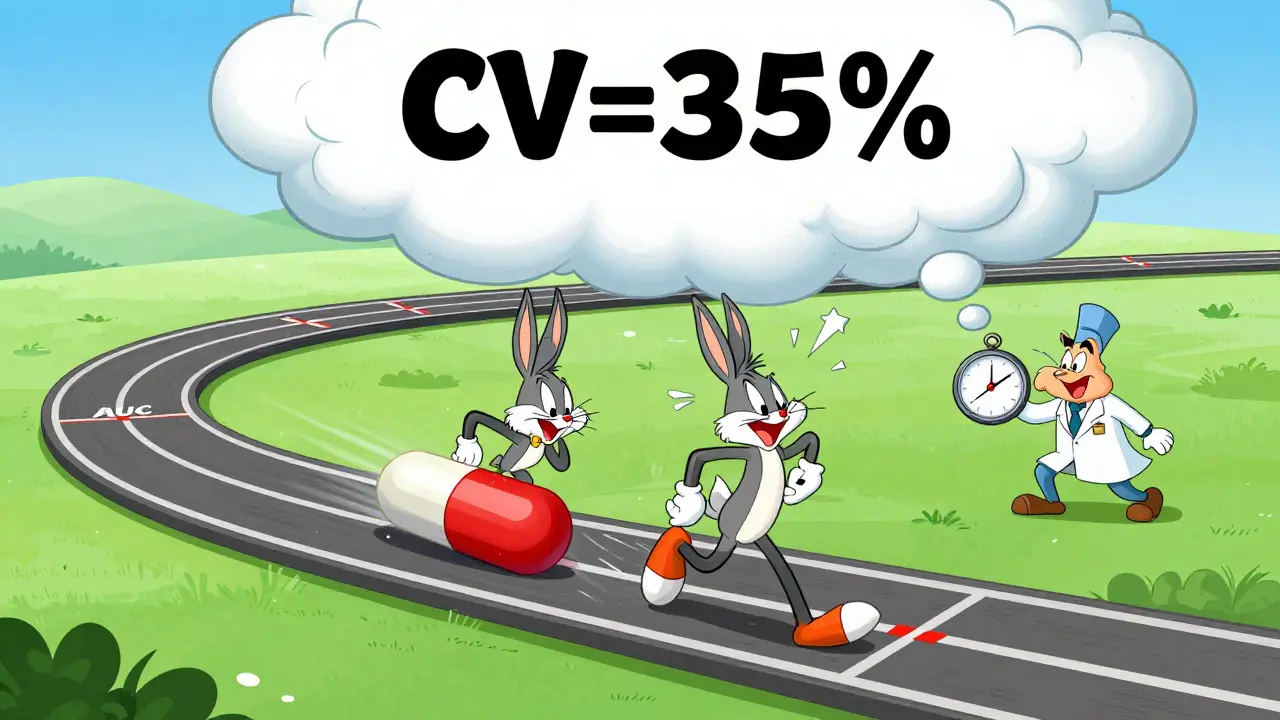
Sample size isn’t pulled from thin air. It’s calculated using four key inputs:- Within-subject coefficient of variation (CV%) - This is the biggest factor. If a drug has high variability (say, 35% CV), you’ll need far more people than if it’s low (10% CV). For example, with a 20% CV and 90% expected ratio, you need about 26 subjects. At 30% CV, that jumps to 52.
- Expected geometric mean ratio (GMR) - Most generic drugs aim for a 0.95-1.05 ratio. Assuming a perfect 1.00 ratio when the real one is 0.95 can increase your needed sample size by 32%.
- Equivalence margins - Standard is 80-125%. Some regulators allow wider margins for Cmax (like 75-133% at EMA), which can cut sample size by 15-20%.
- Study design - Crossover designs (same people get both drugs) are more efficient than parallel designs (different groups). Most BE studies use crossover because they reduce variability.
Highly variable drugs (CV > 30%) used to require 80-100+ subjects. Now, regulators allow reference-scaled average bioequivalence (RSABE), which adjusts the equivalence limits based on variability. This cuts sample sizes to 24-48 for drugs like warfarin or clopidogrel-making studies feasible without sacrificing rigor.
How to Calculate Sample Size: The Real Formula
You don’t need to memorize the math, but you should understand what goes into it. The standard formula for crossover designs is:N = 2 × (σ² × (Z₁₋α + Z₁₋β)²) / (ln(θ₁) - ln(μₜ/μᵣ))²
Where:
- σ = within-subject standard deviation (derived from CV%)
- Z₁₋α and Z₁₋β = statistical values for alpha (0.05) and power (0.80 or 0.90)
- θ₁ = lower equivalence limit (0.80)
- μₜ/μᵣ = expected test/reference ratio (e.g., 0.95)
Most people use software to do this. Tools like PASS, nQuery, FARTSSIE, or ClinCalc’s free online calculator handle the math. But here’s the problem: if you plug in the wrong numbers, you get the wrong answer.
Common Mistakes That Ruin Power Calculations
Even experienced teams mess this up. Here are the top errors:- Using literature CVs without checking reliability - The FDA found that published CVs underestimate true variability by 5-8 percentage points in 63% of cases. Always use pilot data if you can.
- Assuming a perfect 1.00 GMR - Real-world generics rarely hit exactly 1.00. Assuming it does can blow up your sample size requirement.
- Ignoring dropout rates - If you expect 10% dropouts, add 10-15% to your calculated sample size. Otherwise, your final power drops below 80%.
- Only calculating power for one endpoint - You must have adequate power for both Cmax and AUC. If you only plan for the more variable one, your joint power drops by 5-10%.
- Not documenting your inputs - Regulators now require full transparency: software used, version, all inputs, justifications. Missing this caused 18% of statistical deficiencies in 2021 submissions.
The FDA’s 2021 report showed 22% of Complete Response Letters cited inadequate sample size or power calculations. That’s not a small number-it’s a red flag for the whole industry.
Tools and Best Practices
You don’t have to be a statistician to get this right. But you do need to work with one.- Use validated tools - FARTSSIE is free and FDA-aligned. PASS 15 is the gold standard for regulatory submissions.
- Run sensitivity analyses - Test your sample size under different CV% and GMR scenarios. What if CV is 25% instead of 20%? What if GMR is 0.93?
- Document everything - Keep a log: “Calculated using PASS 15, CV=22%, GMR=0.96, power=90%, dropout=12%. Justification: pilot study (n=18) showed CV=21.7%.”
- Plan for multiple endpoints - Don’t just optimize for Cmax. Ensure power for AUC is also sufficient.
Some teams try to cut corners by using small pilot studies to estimate CV, then scaling up. That’s risky. The Generic Pharmaceutical Association found that optimistic CV estimates caused 37% of BE study failures in oncology generics between 2015-2020.

What’s Changing in 2026?
The field is evolving. The FDA’s 2023 draft guidance introduces adaptive designs, where sample size can be adjusted mid-study based on interim data. This could reduce overall participant burden but requires advanced statistical planning. Model-informed bioequivalence (MIBE) is another frontier. Instead of relying solely on traditional PK parameters, MIBE uses pharmacokinetic modeling to predict equivalence with fewer subjects-potentially cutting sample sizes by 30-50%. But it’s still rare: only 5% of submissions use it as of 2023 because regulators want more validation. For now, the standard approach still rules. And the message is clear: underpowered studies are the leading cause of BE study failure. Not bad chemistry. Not bad manufacturing. Bad statistics.Final Checklist for Your Next BE Study
Before you enroll a single participant, run through this:- Get real CV% data from a pilot study or reliable literature (preferably from your drug class).
- Set GMR conservatively (0.95-1.00, not 1.00).
- Use 80% power for standard drugs, 90% for narrow therapeutic index drugs.
- Apply RSABE if CV > 30%-it’s allowed by both FDA and EMA.
- Add 10-15% to your sample size for dropouts.
- Calculate power for both Cmax and AUC together.
- Use a validated tool (PASS, nQuery, FARTSSIE) and document every input.
- Have a biostatistician sign off before submitting to regulators.
There’s no shortcut. A well-powered BE study isn’t expensive-it’s cheap compared to the cost of a failed trial. One failed study can cost $2 million and delay a generic launch by 18 months. Get the sample size right the first time.
What is the minimum sample size for a bioequivalence study?
The minimum sample size depends on variability. For low-variability drugs (CV < 10%), as few as 12-18 subjects may be sufficient. For moderate variability (CV 20-30%), 24-40 subjects are typical. For highly variable drugs (CV > 30%), sample sizes can reach 50-100 without RSABE. With RSABE, even high-variability drugs can be studied with 24-48 subjects.
Why is 80% power the standard in BE studies?
Eighty percent power means there’s an 80% chance your study will correctly show bioequivalence if the drugs are truly equivalent. It’s a balance: higher power (like 90%) reduces risk of failure but increases cost and participant burden. Regulators accept 80% as a reasonable threshold for most drugs, though 90% is required for narrow therapeutic index drugs like warfarin or digoxin.
Can I use a sample size from a similar drug study?
Only as a starting point. Drug-specific variability matters. Two drugs in the same class can have wildly different CV%. Relying on literature values without pilot data is risky-the FDA found published CVs underestimate true variability by 5-8% in 63% of cases. Always validate with your own pilot data if possible.
What happens if my BE study is underpowered?
An underpowered study may fail to demonstrate bioequivalence even if the drugs are truly equivalent. This is called a Type II error. Regulators will reject the application. You’ll need to repeat the study with a larger sample size-costing months and hundreds of thousands of dollars. The FDA reported that 22% of Complete Response Letters cited inadequate power or sample size as the main issue.
Do I need to calculate power for both Cmax and AUC?
Yes. Both endpoints are required by regulators. If you only calculate power for Cmax (which is often more variable), your actual power for AUC may be lower. Simulations show joint power drops by 5-10% when only one endpoint is optimized. Always ensure adequate power for both, or explicitly justify why one is prioritized.
What is RSABE and when should I use it?
Reference-scaled average bioequivalence (RSABE) adjusts the equivalence limits based on the variability of the reference drug. It’s used for highly variable drugs (CV > 30%) where standard 80-125% limits would require impractically large sample sizes. RSABE allows wider limits (e.g., up to 69.8-143.2% for CV=50%), reducing sample size to 24-48 subjects. FDA and EMA both accept RSABE for qualifying drugs.
How do I account for dropouts in my sample size calculation?
Add 10-15% to your calculated sample size to account for participants who drop out, are excluded, or have protocol violations. For example, if your power calculation says you need 30 subjects, enroll 33-35. Failing to do this can drop your final power below 80%, invalidating your results.
What software should I use for sample size calculations?
Use validated tools designed for BE studies: PASS 15, nQuery, or FARTSSIE. Avoid general-purpose power calculators. FARTSSIE is free and FDA-aligned. Always document the software name, version, and exact inputs in your protocol. Regulators require this for audit purposes.


Carolyn Rose Meszaros
January 20, 2026 AT 11:40Wow, this is actually super helpful! I’ve been stressing over sample size for our latest generic project, and the RSABE tip? Game-changer. 🙌 Also, never thought about how much dropout rates mess with power-adding 15% now. Thanks for the checklist!
Greg Robertson
January 22, 2026 AT 06:57Really solid breakdown. I’ve seen too many teams just copy-paste sample sizes from old studies and wonder why they get rejected. Pilot data isn’t optional-it’s insurance. Glad someone laid this out clearly.
Jacob Cathro
January 23, 2026 AT 15:58so like... why do we even bother with all this math? i mean, if the pill looks the same and costs less, who cares if the CV is 32%? regulators are just scared of innovation. also, who uses PASS? i use excel and it works fine 😴
pragya mishra
January 25, 2026 AT 07:17Are you serious? You’re telling me we need 50+ subjects just because of variability? In India, we run BE studies with 24 and get approval. This whole system is biased toward Western labs and overcomplicated for no reason. Stop pretending this is science-it’s bureaucracy.
Manoj Kumar Billigunta
January 25, 2026 AT 15:15Good post. Let me add something: always check if your pilot study used the same formulation. I once saw a team use CV from a tablet but ran a capsule study-big mistake. Also, if you're new to this, don't skip the biostatistician. They’re not there to slow you down-they’re there to save your budget.
Andy Thompson
January 27, 2026 AT 08:1280% power? LOL. The FDA just wants to protect Big Pharma. If you’re a generic company, you’re being forced to spend millions on overpowered studies so the brand-name guys can keep their monopoly. This isn’t science-it’s corporate control. 🇺🇸
sagar sanadi
January 28, 2026 AT 21:46Oh wow, you actually believe this? "RSABE"? Sounds like a fancy word for "we didn’t want to do the math". And you think regulators care about your "pilot data"? Nah. They just want to see the same numbers as last time. Just copy the last study’s sample size and call it a day.
kumar kc
January 29, 2026 AT 04:06Stop wasting time with software. Just use 24. Everyone does.
Thomas Varner
January 30, 2026 AT 20:12Just a heads-up: I ran a study last year where we used FARTSSIE, but we forgot to log the version number. Got a deficiency letter. It’s not just about the numbers-it’s about the paper trail. Document. Everything. Seriously.
Arlene Mathison
January 31, 2026 AT 11:54THIS. This is why I love this community. You took the time to explain it like a human, not a textbook. I’m sharing this with my whole team tomorrow. Let’s stop guessing and start calculating. We’ve got this! 💪
Renee Stringer
February 1, 2026 AT 08:54It’s irresponsible to suggest using literature CVs without validation. I’ve reviewed submissions where teams cited papers from 2010 for a new salt form. The data is obsolete. The risk is real. And the consequences? Unacceptable.
Crystal August
February 1, 2026 AT 12:20Everyone’s acting like this is new. It’s not. We’ve known for a decade that underpowered studies fail. But no one listens. Until the FDA slaps you with a CRL, you’ll keep cutting corners. Then you’ll cry about "unfair regulations."
Nadia Watson
February 2, 2026 AT 00:07Thank you for this comprehensive overview. As a non-statistician working in regulatory affairs, I find clarity like this invaluable. I would only add: when documenting inputs, ensure that the software version is explicitly stated in the protocol appendix, and cross-reference the justification with the pilot study report ID. Minor typographical errors in documentation have led to significant delays in the past-precision matters, even in formatting.