
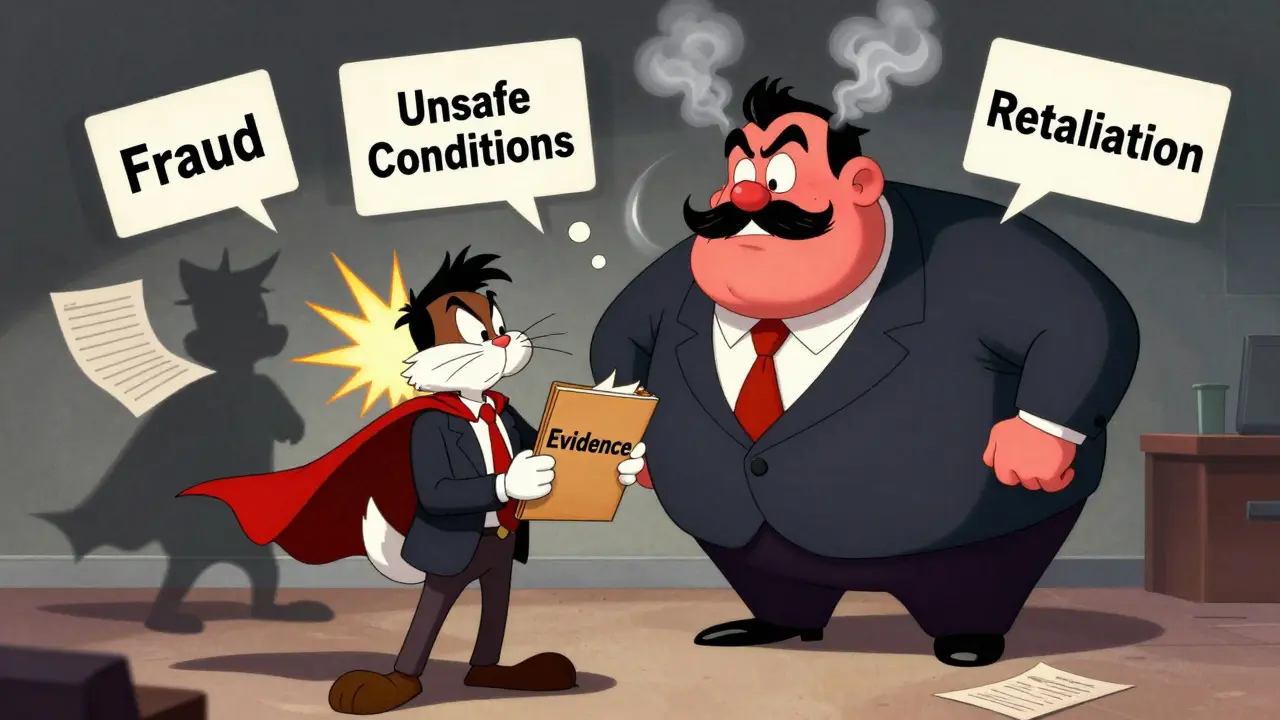
When someone speaks up about illegal or dangerous practices at work, they’re not just doing the right thing-they’re taking a huge risk. Whistleblower laws exist to protect those people. Without these protections, employees who report fraud, safety violations, or corruption would face firing, demotion, or being pushed out through hostile work environments. The truth is, whistleblower laws are one of the last lines of defense against corruption in workplaces-from hospitals and factories to tech firms and government agencies.
What Counts as Protected Reporting?
Not every complaint qualifies as protected under whistleblower laws. To be covered, the report must be about a violation of a law, rule, or regulation. This includes things like unsafe working conditions, financial fraud, environmental violations, or patient abuse. You don’t need proof-just a reasonable belief that something illegal is happening is enough.In California, Labor Code Section 1102.5 covers reports made to supervisors, government agencies, or even internal compliance teams. It doesn’t matter if the violation is against state or federal law. Even if you’re just a job applicant who raises concerns during the hiring process, you’re still protected. The law also protects people who are thought to be whistleblowers, even if they never actually reported anything. That means if your boss suspects you might report a violation and starts treating you differently, that’s still illegal retaliation.
What Counts as Retaliation?
Retaliation isn’t always obvious. It’s not just getting fired. It can be:- Being demoted or moved to a worse shift
- Having your hours cut or pay reduced
- Being denied promotions or training opportunities
- Being given unfair performance reviews
- Being isolated or excluded from meetings
- Being subjected to constant criticism or public humiliation
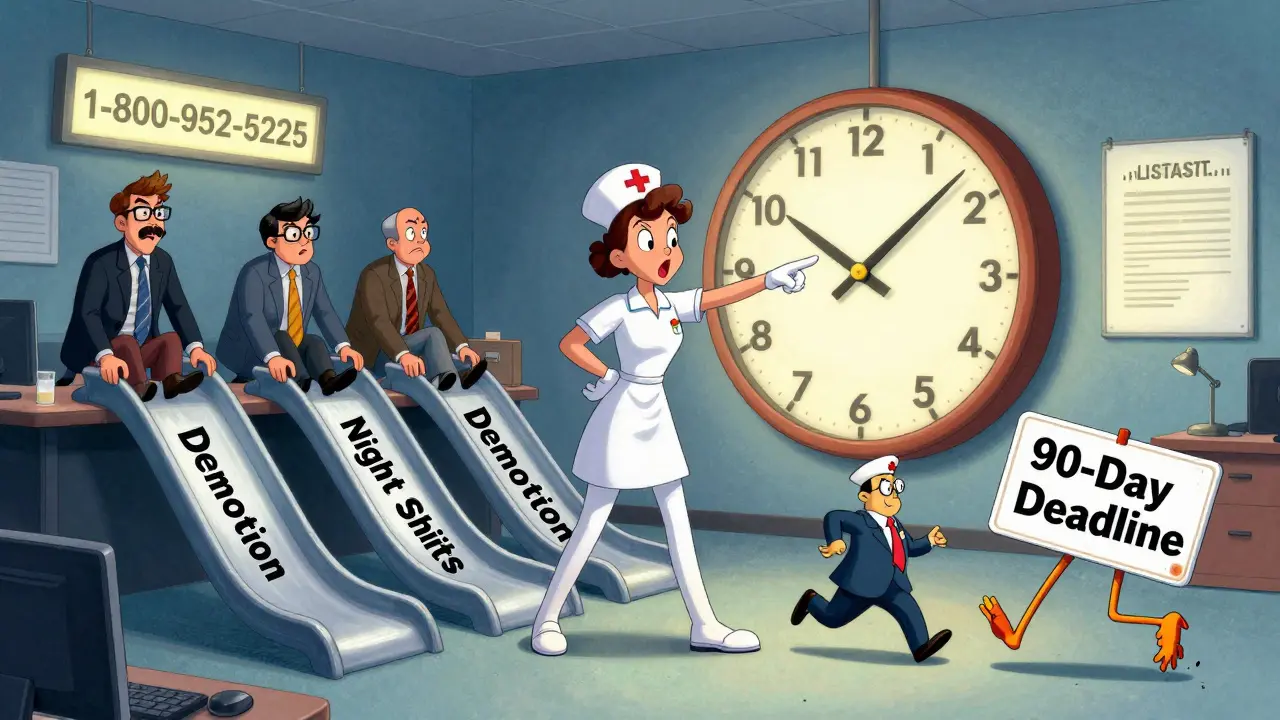
Some employers get creative. One nurse in Los Angeles reported unsafe patient ratios. A week later, she was assigned to night shifts every week, even though she had young children and no childcare. She quit after three months. That’s called constructive dismissal-making conditions so unbearable you feel forced out. Under California law, that’s still retaliation.
Federal vs. State Protections
The U.S. doesn’t have one single whistleblower law. Instead, there are over 25 federal statutes, each covering different industries and types of violations. The Department of Labor’s OSHA enforces all of them. But here’s the catch: each has its own rules.For example:
- The False Claims Act protects people reporting fraud against government programs like Medicare or defense contracts. It even lets whistleblowers keep 10-30% of recovered funds.
- The Dodd-Frank Act offers financial rewards for reporting securities fraud to the SEC. In 2023, the SEC paid out $637 million to 131 whistleblowers.
- The AIR21 Act covers airline workers who report safety issues-but there’s a loophole. OSHA often misses its 90-day deadline to investigate complaints, leaving workers stuck for years.
California’s law is broader. While federal laws often limit protection to specific industries, California’s law applies to any violation of any law. It also carries heavier penalties: up to $10,000 per retaliation incident. And starting January 1, 2025, every employer in California must post a visible notice about whistleblower rights-using at least 14-point font-along with the state’s hotline: 1-800-952-5225.
How to Protect Yourself Before Reporting
Legal protections mean nothing if you don’t know how to use them. Here’s what actually works:- Document everything. Save emails, text messages, performance reviews, and meeting notes. California’s Division of Labor Standards Enforcement requires “clear and convincing evidence” to prove retaliation.
- Know the deadlines. Federal claims have strict time limits. You have 30 days to file under the Clean Air Act, 90 days under the Anti-Money Laundering Act, and 180 days under the Consumer Financial Protection Act. Miss the window, and you lose your right to sue.
- Use official channels. Reporting to HR alone isn’t always enough. To get full protection, report to a government agency like OSHA or the California Labor Commissioner. Keep copies of your report.
- Get legal advice first. The National Whistleblower Center found that 78% of successful cases had legal representation. A single mistake-like speaking to the media before filing-can weaken your case.
What Happens After You Report?
Once you file a complaint, the process is slow. In California, the average whistleblower case takes 22 months to resolve. That’s over a year and a half of financial stress, emotional strain, and uncertainty.OSHA is supposed to investigate federal claims within 90 days. But a 2024 report showed they missed that deadline in 63% of cases. Meanwhile, California’s DLSE has a backlog of over 4,000 active whistleblower cases. If you’re waiting for justice, you’re also waiting for your paycheck.
Successful outcomes do happen. In 2023, a nurse in San Diego won $287,000 in back pay after being fired for reporting understaffing that led to two patient deaths. She got her job back, plus compensation for emotional distress. But she spent 18 months without income and had to sell her car.
Emerging Threats and New Protections
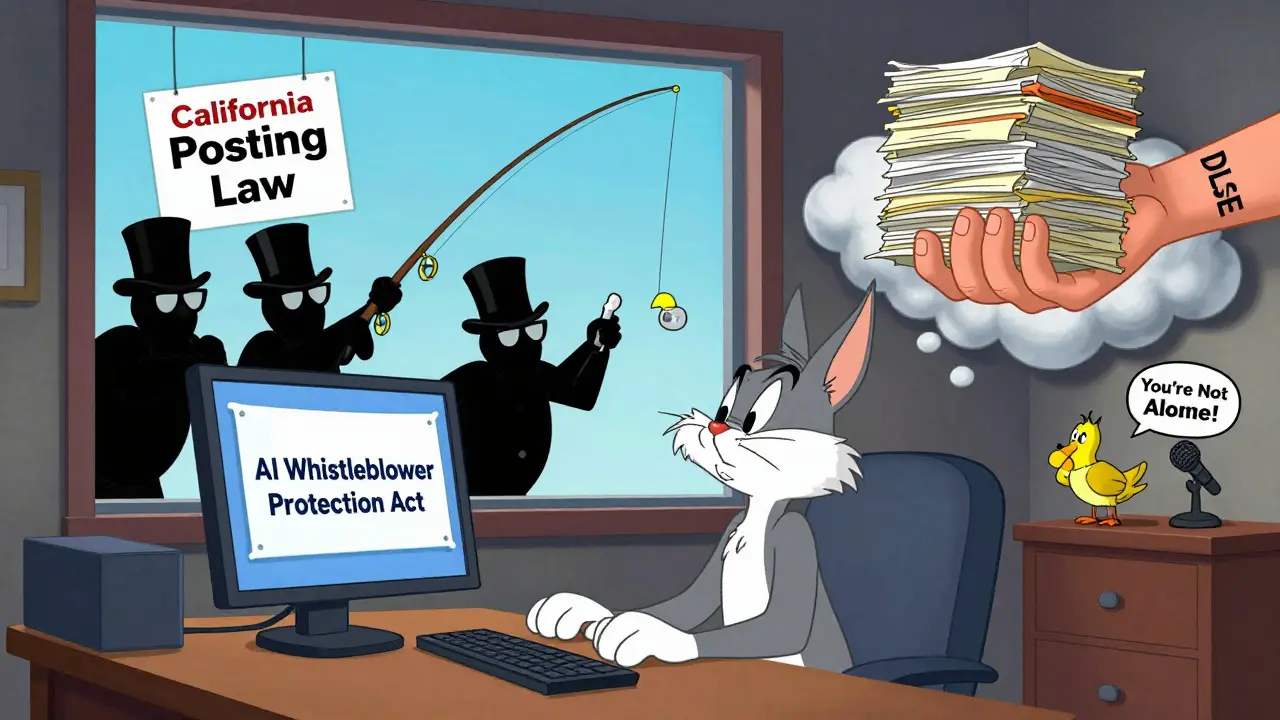
Whistleblower laws are catching up to modern workplaces. In May 2025, Senator Grassley introduced the AI Whistleblower Protection Act, which would protect tech workers who report unethical AI practices-like biased algorithms, hidden surveillance, or misuse of personal data. This is a direct response to recent leaks from AI companies that hid safety risks.Remote work has also created new gray areas. California’s law allows electronic posting of whistleblower notices, but doesn’t clarify how remote employees should access them. A 2025 advisory from Littler Mendelson says many companies are still using paper notices only, leaving teleworkers in the dark.
Even the European Union’s 2019 whistleblower directive has pushed U.S. lawmakers to tighten rules. California’s 2025 posting requirement is now the strictest in the nation-and likely a model for future federal laws.
Why These Laws Matter
Whistleblowers don’t just save money-they save lives. The Congressional Budget Office estimates that stronger whistleblower protections could prevent $12.7 billion in fraud each year. But the real value is harder to measure: a child who avoids exposure to toxic chemicals, a patient who gets proper care, a worker who doesn’t lose their job for speaking up.Still, the system is flawed. A 2024 survey by the National Whistleblower Center found that 68% of whistleblowers still faced retaliation, even with the law on their side. HR departments often dismiss reports as “not meeting legal thresholds.” Employers use performance reviews to mask punishment. The law exists, but enforcement doesn’t always follow.
If you’re thinking about reporting something wrong at work, know this: you’re not alone. Support networks exist. The California Attorney General’s hotline (1-800-952-5225) and OSHA’s whistleblower program (800-321-6742) offer free advice. Nonprofits like the National Whistleblower Center helped 1,247 people in 2024. And if you’re in California, your employer is now legally required to show you exactly what rights you have-right in your workplace.
Can I be fired for reporting a violation?
No. Federal and state whistleblower laws make it illegal to fire, demote, or punish someone for reporting violations. If you are, you can file a complaint with OSHA or your state labor agency. Remedies include reinstatement, back pay, and civil penalties against the employer.
Do I need proof to report something?
No. You only need a reasonable belief that a violation occurred. You don’t need documents, witnesses, or hard evidence to be protected. The law protects people who act in good faith, even if their report turns out to be wrong.
What if I report anonymously?
Anonymous reports are accepted by many agencies, but they’re harder to investigate. To get full legal protection, you should identify yourself when filing a formal complaint. You can still request confidentiality, and agencies are legally required to protect your identity.
How long do I have to file a complaint?
Deadlines vary. Federal laws range from 30 to 180 days depending on the statute. California’s Labor Code Section 1102.5 gives you three years to file a claim with the Labor Commissioner. Missing the deadline means you lose your right to sue.
Can I get paid for reporting fraud?
Yes-if you report fraud against the government under the False Claims Act or securities fraud under the Dodd-Frank Act. Whistleblowers can receive 10% to 30% of the money recovered. In 2023, the SEC paid $637 million to 131 whistleblowers.
Are remote workers protected?
Yes. California’s whistleblower law applies to all employees, regardless of location. However, the new 2025 posting requirement doesn’t clearly address how remote workers access the notice. Employers must still comply with reporting protections, but remote workers should document all communications and report violations directly to state or federal agencies.



Suchi G.
March 19, 2026 AT 06:24Let me tell you, I’ve seen this play out in my hospital in Mumbai. A nurse reported that they were reusing single-use syringes because of budget cuts. She got moved to the ER overnight shift, no notice, no explanation. Her kid has autism and needs her at home by 6 PM. They didn’t fire her, but they made her life unbearable. That’s retaliation. And yeah, California’s law is better than most, but here? You’re on your own. HR just says, ‘We’re not aware of any policy violation.’ Like that’s a defense. I cried for three days after she quit. No one even asked if she was okay.
Andrew Muchmore
March 19, 2026 AT 21:16Document everything. That’s it. No drama. No heroes. Just emails, screenshots, timestamps. If you don’t have it in writing, it didn’t happen. I’ve seen too many good people lose because they trusted HR. HR works for the company, not you. Save your stuff. File with OSHA directly. Don’t rely on your boss to forward your complaint. They’ll bury it.
Robin Hall
March 21, 2026 AT 05:48One must consider the systemic nature of institutional corruption. The whistleblower protections you describe are not safeguards-they are theatrical concessions designed to pacify the proletariat while maintaining the underlying power structure. The Department of Labor’s 63% missed deadline statistic? That’s not incompetence. That’s policy. The state’s 2025 posting requirement? A performative gesture. The real mechanism of control is the psychological burden of isolation, the financial precarity, the slow-motion destruction of reputation. You think a hotline helps? It’s a decoy. The system does not want truth. It wants compliance. And those who speak are not heroes. They are liabilities. And liabilities are eliminated. Not always with a termination letter. Sometimes with a promotion. Sometimes with a quiet relocation. Sometimes with a diagnosis of ‘anxiety.’
Prathamesh Ghodke
March 22, 2026 AT 14:43Hey, I work in tech in Bangalore, and I’ve had coworkers try to report shady data practices. They got ghosted by HR, then passed over for promotions. One guy started getting ‘performance improvement plans’ every quarter after he emailed a compliance form. But here’s the thing-he kept a folder. Screenshots. Timestamps. Slack logs. He filed with the SEC anonymously, and guess what? They called him back. Two years later, he got a payout. It’s slow. It’s brutal. But it can work. Don’t give up. And don’t go to HR first. Go straight to the feds. They’re the only ones who don’t have a vested interest in keeping things quiet.
becca roberts
March 22, 2026 AT 22:03Oh honey. You really think posting a notice in 14-point font is going to stop a manager who’s been quietly undermining someone for months? That’s like putting a ‘Do Not Litter’ sign on a landfill. The real protection? Knowing your rights. Documenting everything. And having a lawyer on speed dial. I’ve seen so many people get ‘restructured’ after reporting. One woman got moved to a closet-sized office with no windows. They called it ‘reassignment.’ I called it torture. And yeah, California’s law is better than most states. But unless you’re rich enough to outlast a 22-month legal battle? You’re just a footnote in a case file. So go ahead. Post the sign. But also? Get a lawyer. And a therapist. And a new resume.
Paul Ratliff
March 24, 2026 AT 03:06bro just save every text, email, and screenshot. dont trust hr. they dont work for you. i reported a safety thing at my warehouse and they gave me a ‘reassignment’ to the graveyard shift. i filed with osha. 180 days later they said ‘investigation ongoing.’ i quit. got a new job. still got paid back. the system sucks but it works if you dont give up. also dont tell anyone you’re reporting. not even your best friend. they’ll slip up.
Srividhya Srinivasan
March 24, 2026 AT 06:03THEY’RE ALL IN IT TOGETHER! HR, OSHA, THE GOVERNMENT-IT’S A COVER-UP! Did you know that the SEC whistleblower payouts? 637 MILLION? That’s just the tip of the iceberg! The real fraud? The ones that never get reported because the whistleblowers are ‘silenced’-by NDAs, by threats, by mysterious ‘accidents’! I know a woman who filed a report about toxic waste in a factory-three weeks later, she was in a car crash. The police report? ‘Mechanical failure.’ The company? ‘Sincere condolences.’ The whistleblower program? ‘No evidence of retaliation.’ But we know the truth! The AI Whistleblower Protection Act? It’s too late! They’ve already embedded the surveillance into the code! They’re watching you right now! The 1-800 number? It’s a trap! They record your voice! They cross-reference your IP! You think you’re safe? You’re not. You’re never safe. Unless you live off-grid. With no phone. No internet. No email. No… anything.
Stephen Habegger
March 25, 2026 AT 16:16You’ve got this. I know it feels like you’re fighting a machine, but people have won. I helped a friend file a claim after she was demoted for reporting unsafe chemical handling. Took 14 months. She got her job back, back pay, and a public apology. It wasn’t pretty. It wasn’t fast. But it happened. You’re not alone. Reach out to the National Whistleblower Center. They’re free. They’re real. And they’ve got your back. Don’t wait. Don’t second-guess. Just act. The system’s broken, but it’s not unbeatable.
Justin Archuletta
March 25, 2026 AT 19:09just file. dont wait. dont overthink. they’ll try to scare you. they’ll say ‘you dont have proof.’ but you dont need proof. you just need a belief. and a paper trail. i did it. lost 6 months of pay. got my job back. now i help others. you got this. seriously. you’re not crazy. they are.