
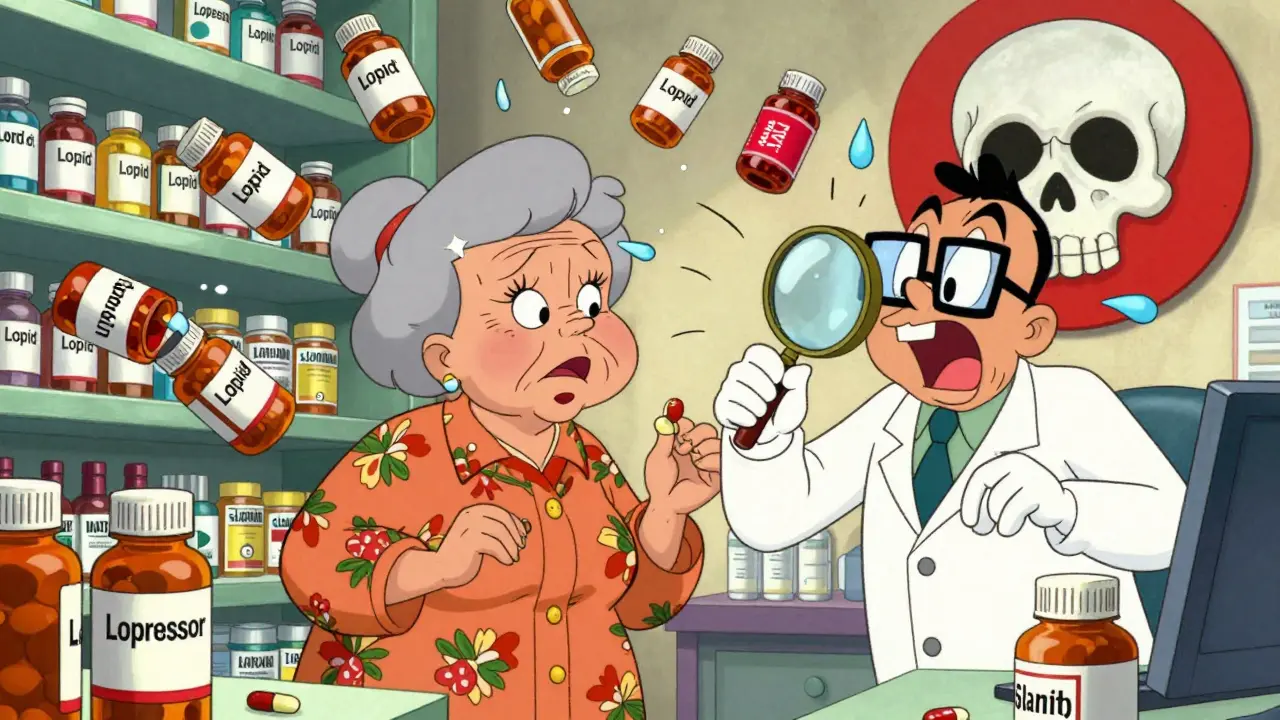
Every year, more than 1.5 million people in the U.S. end up in the emergency room because of medication mistakes. These aren’t rare accidents-they’re preventable failures in a system that’s supposed to keep us safe. Medication safety isn’t just about pharmacists double-checking labels or nurses scanning barcodes. It’s about whether your grandmother gets the right dose of blood pressure medicine after leaving the hospital, whether your teenager’s ADHD prescription isn’t mixed up with a similar-looking drug, and whether the painkiller you pick up at the pharmacy is real-or laced with fentanyl. This is public health in action, and it’s failing in plain sight.
Medication Errors Are a Silent Epidemic
The World Health Organization says 1 in 10 patients in wealthy countries suffer harm from unsafe medication use. That’s not a statistic-it’s your neighbor, your coworker, your parent. In the U.S. alone, medication errors cause over 125,000 deaths each year. Most of these aren’t from reckless doctors or careless nurses. They’re from broken systems: confusing drug names, poorly designed electronic health records, lack of communication between hospitals and pharmacies, and patients who don’t understand what they’re taking.
Look at the numbers: 215 billion days of drug therapy were used in 2024. That’s more than ever before. More prescriptions mean more chances for something to go wrong. And with 3,200 new drugs approved since 2000, the complexity has exploded. A 72-year-old on seven different medications might get a new prescription for something that interacts dangerously with one they’ve been taking for a decade. Without proper reconciliation-where every drug is reviewed at every transition of care-errors are guaranteed.
The Cost Isn’t Just in Lives-It’s in Billions
Medication errors don’t just hurt people. They break the bank. The global cost of these mistakes is $42 billion a year. In the U.S., medication non-adherence alone adds $300 billion to healthcare spending. That’s because when people don’t take their pills correctly-whether because they can’t afford them, don’t understand the instructions, or are overwhelmed by the number of pills-they end up back in the hospital. A study from ECRI found that 89% of these errors come from system failures, not human error. A nurse forgetting to scan a barcode? That’s rare. A computer system that lets two drugs with similar names be prescribed side by side? That’s the real problem.
And it’s getting worse. The DEA seized over 80 million fake fentanyl pills in 2023. These aren’t street drugs sold in alleys-they’re counterfeit pills made to look like legitimate painkillers or anxiety meds, sold online or even through compromised pharmacy supply chains. For young adults aged 18 to 45, fentanyl is now the leading cause of death. That’s not just a drug crisis. It’s a medication safety crisis.
Technology Can Help-But Only If It’s Done Right
There are tools that work. Barcode-assisted medication administration (BCMA) cuts administration errors by 86%. Electronic prescribing with clinical decision support reduces wrong-dose errors by 55%. AI systems are now predicting which patients are most at risk for adverse events with 73% accuracy. The Mayo Clinic used AI to cut post-discharge medication errors by 52%. Geisinger Health boosted adherence to 89% with pharmacist-led check-ins.
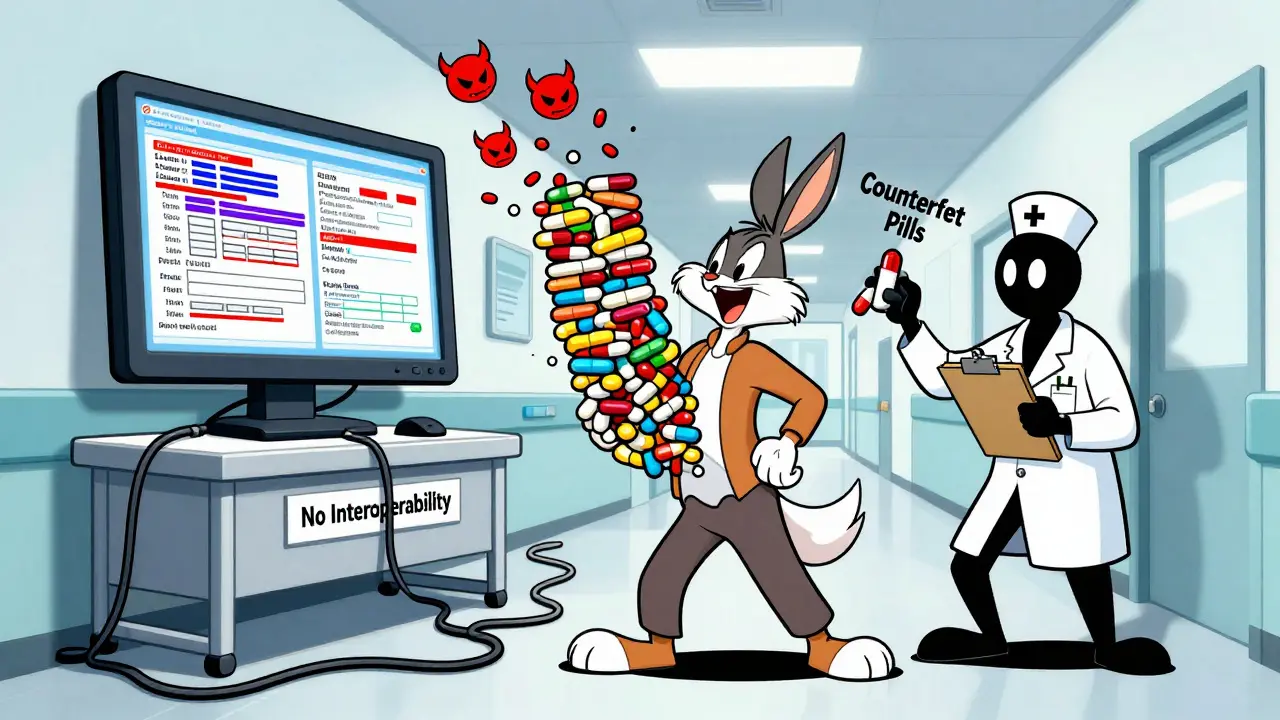
But technology alone won’t fix this. Many hospitals have these systems, but they’re poorly integrated. A 2024 study found that 67% of patients experience at least one unintentional medication change during a hospital transfer. Why? Because the pharmacy system doesn’t talk to the EHR, and the discharge summary doesn’t match what the patient actually received. The 21st Century Cures Act required EHRs to share data using open APIs-but only 63% of U.S. hospitals were fully compliant by the end of 2024. If the systems don’t talk to each other, the best technology is useless.
Who’s Doing It Right?
The Netherlands reduced medication errors by 44% by mandating electronic prescribing across all clinics and pharmacies. Their system is centralized, standardized, and enforced. In the U.K., the National Reporting and Learning System helped cut serious medication errors by 30% by making it easy for staff to report near-misses without fear of blame.
In the U.S., we have brilliant tools but no national coordination. Only 38 states require pharmacy technicians to be certified. There’s no mandatory national reporting for medication errors-so we don’t even know how bad it really is. ECRI estimates only 14% of errors are ever reported. That’s like trying to fix a leaky roof while blindfolded.
Meanwhile, CMS now tracks 16 medication safety measures in its Star Ratings system. Plans that hit 90%+ adherence on cholesterol or diabetes meds get extra payments. That’s a financial incentive to get it right. But it’s still patchwork. Independent doctors’ offices? Only 42% have comprehensive safety programs. Rural hospitals? Just 37% offer 24/7 pharmacist support. Urban hospitals? Nearly 90% do.
What Needs to Change
Real progress needs four things:
- Universal reporting. Every medication error-no matter how small-must be reported to a national database. Without data, we can’t fix the problem.
- Standardized training. Pharmacy technicians, nurses, and doctors need consistent, mandatory training on high-alert drugs, look-alike/sound-alike medications, and reconciliation.
- Integrated tech. EHRs, pharmacy systems, and patient portals must communicate seamlessly. No more copying and pasting prescriptions.
- Focus on patients. People need clear, simple instructions. Visual medication schedules, phone check-ins, and multilingual apps cut errors. A 2024 study showed patient-facing portals increased adherence by 29%.
Dr. Donald Berwick found that every $1 spent on medication safety returns $7.50 in savings. Pharmacist-led programs return $13.20. That’s not a cost-it’s an investment. And yet, many hospitals still treat medication safety as an afterthought, not a core function.
It’s Not About Blame-It’s About Design
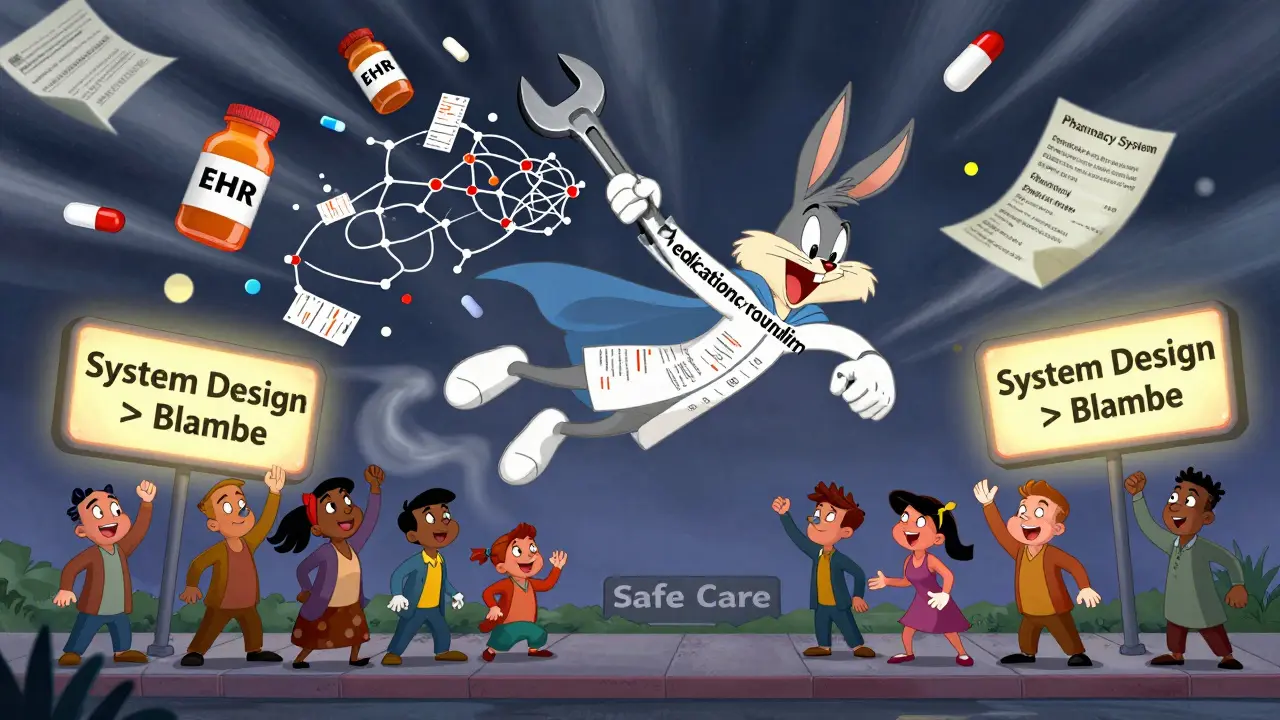
Too often, when a patient gets the wrong pill, someone gets fired. But as Dr. Roseanne Sayther pointed out in JAMA, 89% of errors come from system design, not individual negligence. A confusing interface. A missing alert. A rushed discharge. These aren’t moral failures. They’re engineering failures.
The solution isn’t more training or more rules. It’s better design. Simpler labels. Smarter alerts. Real-time drug interaction checks. Patient-centered communication. And above all-accountability at the system level, not the person level.
The good news? We know what works. We have the data. We have the tools. What we’re missing is the will to make it mandatory, universal, and non-negotiable. Medication safety isn’t a nice-to-have. It’s the foundation of every other medical intervention. If you can’t trust your pills, nothing else matters.
What You Can Do
You don’t need to wait for policymakers to act. Here’s how to protect yourself or a loved one:
- Keep a written list of every medication-including doses, times, and why you’re taking it. Update it every time your doctor changes something.
- Ask your pharmacist: “Is this new drug safe with what I’m already taking?” Don’t assume they know your full history.
- At discharge, ask for a clear, printed list of changes to your meds. If it’s not given to you, demand it.
- Use a pill organizer with alarms. Apps like Medisafe or MyTherapy can send reminders and track adherence.
- If you’re on high-risk drugs (blood thinners, insulin, opioids), ask for a follow-up call from a pharmacist within 72 hours after leaving the hospital.
Medication safety isn’t just the job of doctors and nurses. It’s everyone’s responsibility. Because in healthcare, the smallest mistake can have the biggest consequences.
What is the most common cause of medication errors in hospitals?
The most common cause isn’t human error-it’s system failure. Poorly designed electronic health records, lack of interoperability between pharmacy and hospital systems, look-alike/sound-alike drug names, and incomplete medication reconciliation during patient transfers are the top culprits. Studies show 89% of errors stem from these systemic flaws, not from nurses or doctors making careless mistakes.
How many people die each year from medication errors in the U.S.?
Approximately 125,000 people die each year in the U.S. from preventable medication errors, according to data from the National Community Pharmacists Association. These include wrong doses, drug interactions, allergic reactions, and counterfeit medications. Many of these deaths occur after hospital discharge, when medication changes aren’t properly communicated.
Are generic drugs less safe than brand-name drugs?
No. Generic drugs are required by the FDA to be identical in active ingredient, strength, dosage form, and route of administration to their brand-name counterparts. The real risk comes from substandard or falsified drugs-counterfeit pills sold online or through unregulated supply chains. These aren’t legitimate generics; they’re dangerous fakes, often laced with fentanyl or other toxic substances.
What role do pharmacists play in medication safety?
Pharmacists are the last line of defense. They catch 90% of prescribing errors before they reach the patient. Pharmacist-led medication therapy management programs improve adherence by 40% and save $1,200 per patient annually. In hospitals with 24/7 pharmacist coverage, medication error rates drop significantly. Yet, only 37% of rural U.S. hospitals offer this service, compared to 89% of large urban systems.
Is medication safety improving in the U.S.?
Slowly, and unevenly. Some hospitals have cut errors dramatically using AI, barcode scanning, and pharmacist interventions. But nationally, progress is stalled. Only 63% of hospitals meet basic EHR interoperability standards. Reporting rates remain below 15%. And counterfeit drug threats are rising. Without mandatory national reporting and standardized training, gains remain localized, not systemic.
Next Steps: What’s Coming in 2026
The FDA’s Safer Technologies Program will launch in 2026, fast-tracking review of tools that can reduce medication errors by 30% or more. The Drug Supply Chain Security Act will be fully enforced by November 2025, requiring every prescription to be traceable from manufacturer to patient. CMS will expand its Star Ratings to include more adherence metrics, pushing insurers to invest in pharmacist outreach.
But the real turning point won’t be a new law or a new app. It’ll be when healthcare stops treating medication safety as a compliance checkbox-and starts treating it like the life-or-death priority it is. Because in the end, a pill is only as safe as the system that delivers it.

Kevin Waters
January 22, 2026 AT 13:49Love how this breaks down the real issue: it’s not nurses forgetting barcodes, it’s systems that don’t talk to each other. I work in a rural clinic-we got BCMA last year, but our EHR still can’t sync with the pharmacy’s portal. We’re printing lists by hand. It’s 2025. We shouldn’t be doing this. The tech exists. We just need to force integration.
Also, the 89% stat from ECRI? That’s the key. Stop blaming people. Fix the damn interface.
Darren Links
January 24, 2026 AT 08:18Oh here we go again. Another ‘system failure’ sob story. Let me guess-next you’ll say the real problem is capitalism? Wake up. It’s not the EHR. It’s the fact that half these people can’t even read the labels. My uncle took his wife’s blood thinner because the bottle looked similar. He’s fine now. But he didn’t die because he’s a tough old coot. Stop infantilizing patients. Teach them to read. Stop blaming tech companies.
Also, fentanyl pills? That’s a drug war failure. Not a ‘medication safety’ issue. Stop rebranding crime as healthcare policy.
Helen Leite
January 24, 2026 AT 18:05THEY’RE PUTTING FENTANYL IN PILLS AND NO ONE TALKS ABOUT IT?? 😱
My cousin died last year. She thought she was taking Xanax. It was a fake. The pharmacy? ‘We didn’t know.’
THEY’RE LYING TO US. THE GOVERNMENT KNOWS. THEY LET THIS HAPPEN. 🤡💊
Kat Peterson
January 26, 2026 AT 06:54OMG I’m literally crying rn 😭 this is the most important thing I’ve read all year. Like, imagine your grandma getting the wrong pill and POOF-gone. It’s not just numbers, it’s people. I just called my mom to make her update her med list. She’s 78. She’s got 9 pills. She didn’t even know one was expired. I’m starting a #MedicationSafetyCheck campaign. Who’s in?? 💪❤️
Also, the part about AI predicting risk? That’s like sci-fi but real. I’m obsessed. Someone send me the Mayo Clinic link. I need to share this with my book club.
Izzy Hadala
January 27, 2026 AT 07:33While the systemic failures are well-documented, the assertion that 89% of errors originate from system design lacks granular validation. The ECRI report cited references a meta-analysis with significant heterogeneity across institutional contexts. Moreover, the 125,000 annual deaths figure conflates attributable mortality with correlation-many patients have multi-morbidity, and medication error is often a contributing factor, not the primary cause. The data is compelling but requires more precise epidemiological framing to avoid overgeneralization.
Karen Conlin
January 27, 2026 AT 09:11Let’s not forget: this isn’t just a U.S. problem-it’s a global one. I’m from a small town in Alabama, but I’ve seen this in India too. My sister works in a hospital in Kerala. They don’t have EHRs. They use handwritten scripts. Nurses guess doses. But guess what? They have the highest medication adherence rates in the country. Why? Because they have community health workers who visit homes. They talk to patients. They listen.
Technology helps-but human connection saves lives. We need both. Not one or the other.
Husain Atther
January 27, 2026 AT 22:39Very thoughtful analysis. In India, we face similar challenges but with different roots-lack of trained pharmacists, counterfeit drugs in rural markets, and language barriers in instructions. Still, the core issue remains: systems over individuals. We’ve started a pilot in Bangalore where pharmacists conduct home visits for elderly patients on polypharmacy. Adherence improved by 41% in six months. Simple, low-tech, high-impact. Perhaps the West can learn from the Global South in some areas.
Sushrita Chakraborty
January 28, 2026 AT 15:40While systemic failures are undeniably prevalent, it is imperative to acknowledge that human factors-such as cognitive overload, fatigue, and inadequate training-still contribute significantly to error rates; thus, a purely technological solution is insufficient. Furthermore, the assertion that 89% of errors stem from system design, while compelling, is not universally supported by peer-reviewed literature across all healthcare settings. A balanced, multi-layered approach-integrating both human-centered design and robust procedural safeguards-is not only preferable, but necessary.
asa MNG
January 28, 2026 AT 19:31bro i just found out my dad’s heart med was mixed up with his blood pressure one for 3 months 😭
he’s fine now but i’m so mad
why is this even a thing??
they let this happen??
someone get me a lawyer 🤬
also i saw a fake oxycodone on instagram yesterday… it looked exactly like the real one… i’m scared to take anything now 😵💫
Jamie Hooper
January 29, 2026 AT 08:53mate, i’ve worked in pharmacy for 12 years. barcodes? yeah they help. but half the time the barcode scanner’s broke, or the script’s been copied wrong by the doc’s secretary, or the patient’s got 12 different meds from 5 different docs and no one’s checked ‘em. we’re not robots. we’re just trying not to kill someone while being yelled at by a diabetic who wants his insulin at 2pm on a saturday.
tech ain’t the answer. communication is. and no one’s got time for that anymore.
Sawyer Vitela
January 29, 2026 AT 12:54125,000 deaths? Where’s the source? ECRI doesn’t publish that number. CDC says 250,000 annual deaths from all medical errors-medication is a subset. You’re inflating. Also, ‘89% system failure’ is a misinterpretation of ECRI’s ‘89% preventable’-not ‘89% system’. Big difference. Fix your stats before you preach.
Heather McCubbin
January 30, 2026 AT 05:19It’s not about pills
It’s about control
They want you dependent
They want you silent
They want you to take what they give you without asking
And when you die? They call it ‘an unfortunate outcome’
But it’s not fate
It’s design
And someone’s making money off your confusion
Wake up
They’re not healing you
They’re managing you
Josh McEvoy
January 30, 2026 AT 23:21my cousin’s a nurse. she said the worst part? they get praised for catching errors… but never for preventing them.
like… we reward heroics but ignore the system that makes heroes necessary.
we’re all just waiting for someone to notice before someone dies.
that’s not healthcare. that’s russian roulette with pills 💊🔫