
Serotonin Syndrome Risk Calculator
Risk Assessment Tool
This tool estimates your risk of serotonin syndrome based on FDA guidelines and medical research. It is not medical advice. Always consult your healthcare provider before changing medications.
Risk Assessment Results
Enter your medication details above to see your risk assessment.
Important: If you experience any symptoms, seek emergency medical attention immediately. Do not delay.
Combining 5-HTP with SSRIs isn't just a bad idea-it's a medical emergency waiting to happen. Thousands of people take 5-HTP supplements hoping to boost mood, sleep, or reduce anxiety, often without realizing they’re mixing it with antidepressants like fluoxetine, sertraline, or escitalopram. What they don’t know is that this combo can trigger serotonin syndrome, a condition that can turn deadly in hours.
What Exactly Is Serotonin Syndrome?
Serotonin syndrome isn’t just a side effect. It’s a toxic overload of serotonin in your brain and nervous system. Think of serotonin as a chemical messenger that helps regulate mood, sleep, and digestion. When it’s in the right amount, it works fine. But when too much builds up-especially from two different sources-it overwhelms your system. The symptoms start mild: shivering, sweating, diarrhea, or a slight tremor in your hands. But they can quickly escalate. High fever above 104°F, muscle rigidity, confusion, seizures, and irregular heartbeat follow. In severe cases, it can cause organ failure. About 2% to 12% of people who develop severe serotonin syndrome die from it, according to the Journal of Medical Toxicology. Doctors use the Hunter Criteria to diagnose it-this system is 97% accurate. If you’re on an SSRI and develop tremors, overactive reflexes, or unexplained fever, it’s not just anxiety. It’s serotonin syndrome. And it needs immediate treatment.Why 5-HTP Is So Risky with SSRIs
SSRIs work by blocking serotonin from being reabsorbed. That means more serotonin stays in your brain, helping with depression. But 5-HTP does something completely different: it’s the direct building block your body uses to make serotonin. When you take 5-HTP, your body cranks out serotonin faster-no limits, no regulation. Put them together, and you’ve got a perfect storm. SSRIs keep serotonin in your system. 5-HTP floods your body with more. The result? Serotonin levels can spike past 400 ng/mL. Normal levels are between 101 and 283 ng/mL. At that point, your brain starts overstimulating receptors, triggering the dangerous symptoms of serotonin syndrome. This isn’t theoretical. Between 2015 and 2019, the FDA logged 127 adverse events linked to 5-HTP and SSRI combinations, including nine deaths. A 2021 study in CNS Drugs reviewed all available evidence and concluded: there’s no safe way to combine them.It’s Not Just Prescription Drugs-Supplements Are the Problem
Here’s the scary part: 5-HTP is sold as a supplement. That means it’s not regulated like medicine. The FDA doesn’t test it for safety or purity before it hits shelves. A 2022 ConsumerLab.com analysis found that 31% of 5-HTP products didn’t even contain the amount listed on the label. Some had too little. Others had double or triple the dose. People think “natural” means safe. But that’s a myth. St. John’s Wort, another supplement people use with antidepressants, has a 2.3% risk of causing serotonin syndrome. Tramadol, a painkiller, carries a 4.6% risk. But 5-HTP? When combined with SSRIs, the risk jumps to levels similar to mixing SSRIs with MAOIs-the most dangerous drug combo known for serotonin syndrome, with a 16.4% risk. And doctors often don’t ask about supplements. A 2020 survey by the American Society of Health-System Pharmacists found only 38% of primary care doctors even know 5-HTP is a risk. Patients assume their doctor knows what they’re taking. But unless you say it, they won’t think to ask.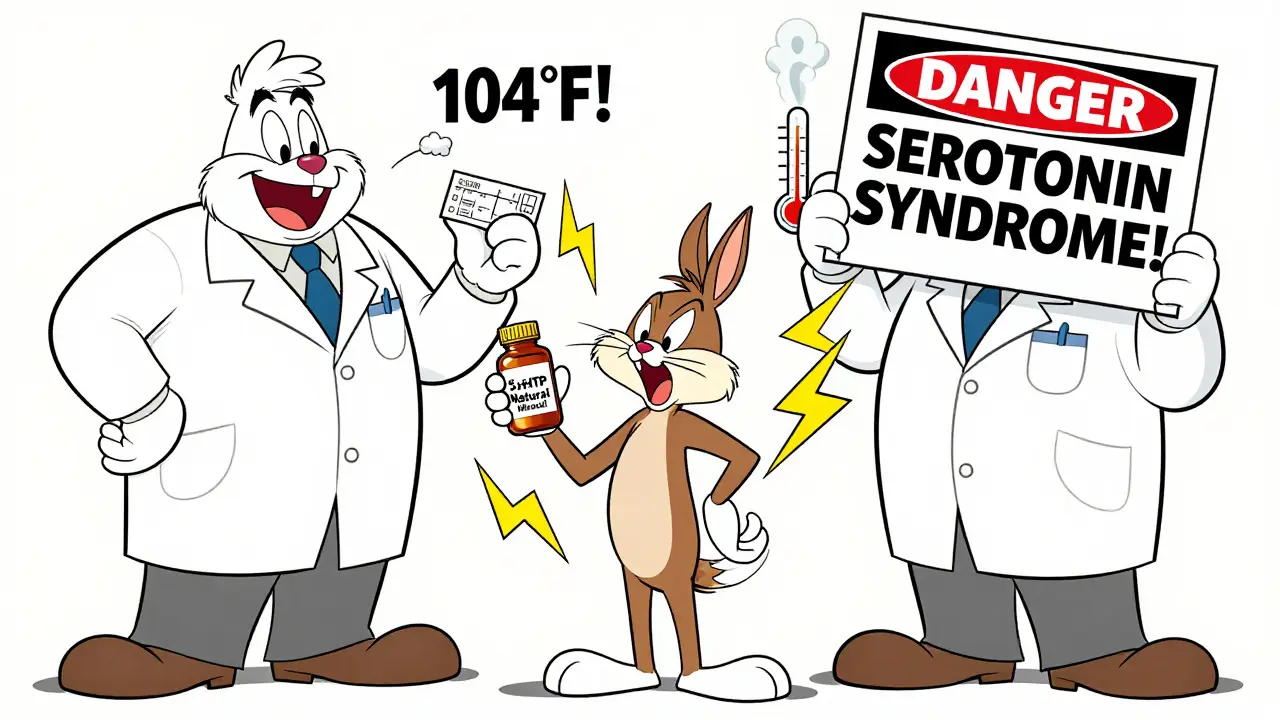
Who’s Most at Risk?
Data from the 2022 National Health Interview Survey shows that 12.8% of people taking antidepressants also use 5-HTP. That’s over 4 million Americans. The highest users? Women between 35 and 54. Many are trying to manage anxiety, depression, or insomnia without increasing their SSRI dose. Reddit’s r/SSRI community has over 140,000 members. A review of 1,247 posts between 2020 and 2022 showed that 62% of users added 5-HTP without telling their doctor. One user wrote: “I added 100mg of 5-HTP to my 20mg fluoxetine. Three hours later, I was shaking, sweating, and my body felt like it was on fire. I called 911.” That’s not an outlier. It’s a pattern. Even more alarming: 41% of supplement users believe “natural supplements can’t cause dangerous interactions.” That belief is killing people.What If I Want to Stop My SSRI and Switch to 5-HTP?
Some people think switching from an SSRI to 5-HTP is a safer, more natural option. It’s not. Stopping SSRIs suddenly can cause withdrawal-dizziness, nausea, brain zaps, mood swings. And starting 5-HTP too soon after can trigger serotonin syndrome. The Mayo Clinic recommends waiting at least two weeks after stopping an SSRI before starting 5-HTP. But that’s not enough for everyone. Paroxetine, for example, stays in your system for up to four weeks. If you start 5-HTP too early, you’re still at risk. There’s no clinical evidence that 5-HTP can safely replace SSRIs. Some holistic practitioners claim it can reduce SSRI doses by 30-50%, but those claims aren’t backed by peer-reviewed studies. The few small trials suggesting safety are experimental, poorly controlled, and not repeatable.

Napoleon Huere
January 26, 2026 AT 02:35Man, this whole thing hits like a哲学课 on neurochemistry. We treat supplements like tea, but 5-HTP? It’s a serotonin sledgehammer. The body doesn’t care if it’s ‘natural’-it just sees molecules. And when you stack them like Jenga blocks with SSRIs, the tower doesn’t wobble-it collapses. We’ve outsourced our mental health to Amazon and Instagram gurus while ignoring pharmacology 101. It’s not about willpower. It’s about chemistry. And chemistry doesn’t negotiate.
Our culture’s obsession with ‘quick fixes’ is literally killing people. We’d rather pop a pill than sit with our pain. But you can’t out-supplement your trauma. The real cure isn’t in a bottle-it’s in therapy, sleep, movement, connection. Yet we’re too busy chasing biochemical shortcuts to see that.
I’m not anti-supplement. I’m pro-awareness. If you’re going to mess with your brain chemistry, at least do it with eyes open. Not because some influencer said so. Because science says so.
And yeah, the FDA’s late to the party. But at least they’re showing up now. The supplement industry’s been running a Ponzi scheme on hope for decades. Time to shut it down.
Also-why do we assume ‘natural’ equals ‘safe’? Poison ivy is natural. Botulinum toxin is natural. So is arsenic. Context matters. Always.
TL;DR: Your brain isn’t a vending machine. Don’t insert coins and expect enlightenment.
-Napoleon, 3am, after reading this at 2am while drinking chamomile tea that definitely doesn’t have 5-HTP in it.
Shweta Deshpande
January 26, 2026 AT 23:06Oh my goodness, this post made me cry-thank you for writing this with so much care! I used to take 5-HTP for my anxiety and sleep, and honestly, I had no idea it could be dangerous with my sertraline. I just thought, ‘It’s herbal, so it’s gentle!’ But then I started getting these weird tremors at night, like my hands were vibrating, and I thought it was just stress. I didn’t tell my doctor because I didn’t want to seem ‘crazy’ or like I was overdoing it.
But after reading this, I went straight to my pharmacy and threw away my bottle. I made an appointment with my psychiatrist next week. I’m so grateful for people like you who speak up. We need more voices like yours in this space-kind, clear, and full of truth without shame.
Also, I just wanted to say to all the women out there-especially moms, caregivers, and overworked souls-we don’t have to ‘fix’ ourselves with supplements. We deserve rest, support, and real medical care. You’re not broken. You’re just tired. And that’s okay.
Let’s normalize asking for help. Let’s normalize saying, ‘I don’t know what I’m doing, but I want to learn.’ That’s courage, not weakness.
With love from India, where we still call supplements ‘herbal tonics’ and trust them more than doctors sometimes… but maybe, just maybe, we’re starting to wake up.
Shweta 🌸
Aishah Bango
January 27, 2026 AT 18:16You people are so naive. You think this is about ‘natural’ vs ‘chemical’? No. It’s about responsibility. You take a drug that alters your brain chemistry? Then you owe it to yourself and everyone around you to know what you’re doing. You don’t get to be lazy and then blame the FDA when your body starts seizing.
People who take 5-HTP with SSRIs are either ignorant or arrogant. Maybe both. And now they want sympathy? No. They want consequences. The supplement industry preys on the emotionally vulnerable. That’s not ‘holistic healing.’ That’s predatory capitalism dressed in bamboo packaging.
And don’t give me that ‘I didn’t know’ crap. Google exists. The FDA website exists. Your doctor exists. You chose not to ask. Now you get what you deserve.
Stop romanticizing ignorance. Stop pretending supplements are ‘gentle.’ They’re not. They’re unregulated chemicals with unknown long-term effects. And if you can’t handle that truth, maybe you shouldn’t be tinkering with your serotonin at all.
-Aishah, who’s seen too many people die because they thought ‘it’s just a pill.’
Simran Kaur
January 27, 2026 AT 18:42I’m from Chennai, and in our culture, we’ve always used herbs-ashwagandha, tulsi, turmeric-for balance. But I never thought 5-HTP was one of them. When I moved to the US, I saw it everywhere-in juice bars, yoga studios, even Whole Foods. Everyone was like, ‘Oh, it’s like nature’s Prozac!’
Then my cousin in Mumbai had a seizure after taking it with her antidepressant. She was fine after treatment, but she’s scared to even say the word ‘supplement’ now. I cried when I read this. Because I used to give it to my sister for her insomnia. I thought I was helping.
Now I carry a printed copy of this post in my bag. I show it to every woman I know who’s struggling. I say: ‘Your pain matters. But your life matters more.’
And yes, I know this isn’t the ‘Indian way.’ But maybe the Indian way needs to evolve. Maybe we don’t have to choose between tradition and science. Maybe we can honor both by being careful.
Thank you for this. I’m sharing it with my entire family.
With tears and hope,
Simran
Curtis Younker
January 28, 2026 AT 16:05Okay real talk-I was one of those people. Took 5-HTP with my Lexapro for like 8 months. Thought I was ‘optimizing’ my mood. Got the shakes, the diarrhea, the brain fog. Thought it was just ‘detoxing.’ Then I passed out at work. Got rushed to the ER. Turns out my serotonin level was off the charts. They gave me cyproheptadine and told me to never touch 5-HTP again.
Now I do therapy. I walk every morning. I sleep 8 hours. I drink water. I don’t need a magic pill. I just needed to stop being a dumbass.
Also-side note: if you’re taking 5-HTP because you hate your SSRI, maybe the problem isn’t the med. Maybe it’s the dose. Or the therapist you haven’t seen yet. Or the fact you haven’t slept in three days.
Don’t be that guy. Talk to someone. Not Reddit. Not a guy in a hemp hat at the farmers market.
-Curtis, 34, sober, alive, and finally happy without chemicals I didn’t understand.
Dan Nichols
January 29, 2026 AT 22:30Wrong. 5-HTP isn't dangerous if you titrate properly. The FDA data is cherry picked. Studies show low dose 5-HTP with SSRIs can be safe under supervision. You're fearmongering. Also serotonin syndrome is extremely rare. You're making it sound like a plague. It's not. Most people who get it are polydrug users or overdose. Single supplement + SSRI? Unlikely. Also why are you blaming supplements? The real problem is doctors who don't monitor patients. And why do you think people use 5-HTP? Because SSRIs don't work for everyone. You're ignoring the millions who benefit from alternatives. You're not helping. You're silencing. And that's dangerous too.
-Dan
Renia Pyles
January 30, 2026 AT 21:03Wow. So now we’re supposed to trust doctors? The same ones who prescribed me 3 different SSRIs that made me suicidal? The same ones who didn’t ask about my supplements because they were too busy checking their phone? You think I’m the problem because I tried to fix myself? No. You’re the problem. You’re the one who thinks a blog post can replace real care.
I didn’t die. I’m still here. And I’m not sorry I tried 5-HTP. I’m sorry I didn’t find a doctor who listened.
So go ahead. Scare people. But don’t pretend you’re the hero. You’re just another person with a keyboard and a martyr complex.
Renia
Nicholas Miter
February 1, 2026 AT 16:32Been on sertraline for 7 years. Took 5-HTP for 3 weeks last winter. Didn’t feel anything weird. No tremors, no fever. Just… better sleep. Maybe I got lucky. Or maybe my body’s just chill.
But honestly? I didn’t tell my doctor. I didn’t want to get lectured. I just thought… maybe it’s fine?
Now I’m gonna stop it. Just in case. Not because I’m scared. Because I respect the science.
Also-side note: if you’re reading this and you’re on SSRIs and thinking about 5-HTP… just talk to your doctor. Even if you think they’ll judge you. They’ve probably heard it all before.
-Nick, Portland, 41, still alive, still trying.
Suresh Kumar Govindan
February 2, 2026 AT 16:34It is not merely a pharmacological concern. It is a systemic failure of epistemological integrity in Western bioethics. The commodification of neurochemical self-regulation via unregulated nutraceuticals represents a postmodern collapse of medical authority into consumerist pseudoscience. The FDA’s belated regulatory response is insufficient. The underlying pathology is cultural: the epistemic arrogance of the individual who believes their subjective experience supersedes peer-reviewed pharmacokinetic data. The deaths cited are not accidents. They are the inevitable outcome of a society that confuses autonomy with ignorance. The solution is not more warnings. It is the reestablishment of epistemic hierarchy. The physician, not the influencer, must be the gatekeeper of the soma. The market must not dictate neurochemistry.
-Suresh, PhD, Neurophilosophy, IIT Madras