
Antihistamine Cross-Reactivity Checker
Step 1: Select Your Known Allergy
Click on the medication that causes you a reaction.
Step 2: Analyze Risks
View potential cross-reactivity with other classes.
Select a medication above to see cross-reactivity analysis.
Selected:
Class:
Cross-Reactivity Analysis
Imagine taking a pill meant to stop your itching, only to find yourself breaking out in hives an hour later. It sounds like a cruel joke, but for a small number of people, this is their reality. This condition, known as antihistamine hypersensitivity or paradoxical reaction, turns the standard treatment for allergies into the very cause of them. If you have tried multiple allergy medications and felt worse instead of better, you might be dealing with a rare immune response where your body attacks the cure.
This isn't just about having a sensitive stomach or mild side effects. We are talking about genuine allergic reactions-rashes, swelling, and even breathing issues-triggered by drugs designed to block histamine. Understanding why this happens and how to spot it can save you from unnecessary suffering and dangerous medication errors. Here is what you need to know about this complex medical puzzle.
The Paradox of Antihistamine Hypersensitivity
To understand why someone would be allergic to an antihistamine is a medication that blocks the action of histamine in the body to treat allergic symptoms, we first need to look at how these drugs normally work. Typically, when you are exposed to an allergen like pollen or pet dander, your body releases histamine. This chemical binds to H1 receptors are proteins on cell surfaces that trigger allergic symptoms like itching and swelling when activated by histamine located on your cells, causing inflammation and itching. Antihistamines usually act as "inverse agonists." Think of them as keys that fit into the lock (the receptor) but jam it shut, preventing histamine from turning the ignition. They stabilize the receptor in an inactive state.
In cases of antihistamine allergy, however, the mechanism flips. Research published in Allergologia Selecta suggests that in some individuals, the drug might actually stabilize the receptor in its active form instead. Essentially, the medicine acts like histamine rather than blocking it. This phenomenon is called hyperresponsiveness. A documented case study highlighted a patient who developed chronic spontaneous urticaria (hives) not because of environmental allergens, but because the antihistamines they took to treat the hives were triggering them further. The reaction was so severe that avoiding all standard antihistamines was the only way to resolve the skin eruptions.
Understanding Cross-Reactivity Patterns
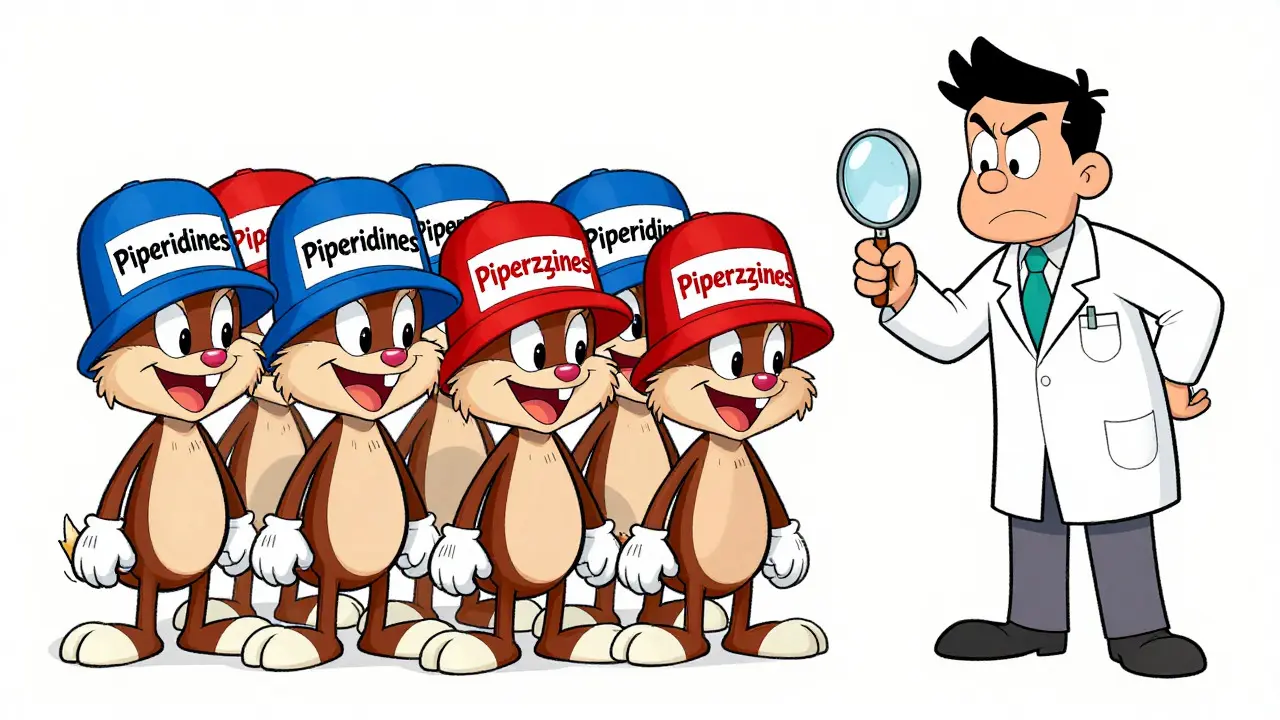
One of the most frustrating aspects of this condition is cross-reactivity. You might assume that if you react to one brand or type, another will be safe. Unfortunately, the chemistry doesn't always work that way simply. Antihistamines are grouped into chemical classes, primarily piperidines are a class of second-generation antihistamines including fexofenadine and loratadine and piperazines are a class of antihistamines including cetirizine and hydroxyzine.
Logic dictates that if you are allergic to a piperazine like cetirizine, you should avoid other piperazines. But clinical evidence shows this rule has exceptions. Studies have shown patients reacting to both piperidines (like fexofenadine and loratadine) and piperazines (like cetirizine). This broad reactivity suggests the issue may not be with the specific chemical structure of the drug molecule alone, but potentially with how the drug interacts with the patient's unique H1 receptor polymorphisms. Genetic variations in your receptors might make them misinterpret any antihistamine binding event as a signal to activate, regardless of the drug's family.
| Class | Common Examples | Typical Duration | Cross-Reactivity Risk |
|---|---|---|---|
| First-Generation | Diphenhydramine, Pheniramine | 4-6 hours | High risk of sedation; rare but documented immediate hypersensitivity |
| Second-Generation (Piperidines) | Fexofenadine, Loratadine | 12-24 hours | Lower sedation; potential cross-reaction with other classes in hypersensitive patients |
| Second-Generation (Piperazines) | Cetirizine, Levocetirizine | 12-24 hours | Lower sedation; potential cross-reaction with other classes in hypersensitive patients |
Symptoms: How to Spot a Reaction
If you are experiencing an allergy to an antihistamine, the symptoms often mirror the very conditions the drug is supposed to treat. This makes diagnosis incredibly tricky. The most common sign is urticaria is a skin condition characterized by raised, itchy welts known as hives. You might notice red, swollen patches appearing shortly after taking the medication. In more severe cases, patients report angioedema (swelling deeper in the skin, often around eyes or lips) or even respiratory distress.
Timing is a key clue. Unlike typical side effects like drowsiness which happen gradually, allergic reactions can be immediate or delayed. Some patients experience reactions within minutes, while others see symptoms emerge up to two hours post-ingestion. A critical detail from recent pediatric case studies is that oral provocative testing revealed dose-dependent reactions. This means taking a higher dose led to worse symptoms, confirming the drug itself was the trigger. If your "allergy" gets worse when you increase your allergy medication dose, take note.
Diagnosis Challenges and Testing Limits
Getting a confirmed diagnosis is harder than it should be. Standard allergy tests, such as skin prick tests, often fail to detect antihistamine hypersensitivity. Why? Because the mechanism involves receptor stabilization rather than a classic IgE-mediated antibody response. A patient might test negative for ketotifen on a skin prick test but still develop a full-blown rash when taking it orally.
This discrepancy highlights the limitation of relying solely on skin testing. Experts emphasize that the presence of a wheal (the bump in a skin test) is important, but a negative result does not guarantee safety. In many documented cases, the gold standard for diagnosis remains the oral challenge test, conducted under strict medical supervision. Doctors administer a small amount of the suspected drug and monitor the patient for up to 120 minutes. While risky, this method provides the clearest answer. If you suspect this condition, keep a detailed log of every medication taken and the timing of any subsequent rashes or swelling. Bring this to an allergist who specializes in drug hypersensitivity.

Management and Alternative Strategies
So, what do you do when the cure causes the disease? The primary strategy is strict avoidance. If you identify a triggering class, you must avoid all drugs within that group and potentially others, depending on your cross-reactivity profile. However, living without antihistamines can be difficult if you suffer from chronic allergies or hives.
Medical management shifts toward non-antihistamine therapies. For chronic urticaria, doctors may prescribe leukotriene receptor antagonists (such as montelukast), corticosteroids for short-term flare-ups, or immunosuppressants like cyclosporine in severe cases. Another crucial step is investigating underlying triggers. In the case study mentioned earlier, the patient’s symptoms only fully resolved after treating an underlying chronic infection alongside stopping the antihistamines. Sometimes, the body’s heightened sensitivity is fueled by hidden inflammatory sources.
It is also vital to review your entire medication list. Many over-the-counter cold and sleep aids contain first-generation antihistamines like diphenhydramine. Reading labels carefully becomes a daily necessity. Always consult your provider before switching brands, assuming that different colors or names mean different chemicals. Generic versions contain the same active ingredients and carry the same risks for hypersensitive individuals.
Future Directions in Treatment
Science is catching up to this rare problem. Recent structural studies using cryo-electron microscopy have mapped the H1 receptor in unprecedented detail. Researchers have identified not just the main binding site, but secondary ligand-binding sites. This knowledge opens the door for designing next-generation antihistamines that bind differently, potentially bypassing the mechanisms that cause paradoxical activation in sensitive patients.
While these new drugs are not yet available, understanding the molecular basis gives hope. It confirms that antihistamine allergy is a real, biological phenomenon rooted in genetics and protein structure, not just "sensitive skin." As research continues, personalized medicine approaches may allow doctors to screen for H1 receptor polymorphisms before prescribing, sparing patients from trial-and-error cycles that lead to frustration and health risks.
Can you be allergic to all antihistamines?
Yes, although it is rare. Cases have been documented where patients reacted to both first-generation and second-generation antihistamines across different chemical classes (piperidines and piperazines). This suggests a systemic issue with how their H1 receptors respond to any blockade attempt, rather than an allergy to a specific chemical structure.
How long does it take for an antihistamine allergy to show symptoms?
Symptoms can appear rapidly or be delayed. Immediate reactions may occur within minutes, presenting as hives or swelling. However, some patients experience delayed reactions up to 120 minutes after ingestion. Monitoring yourself for two hours after taking a new medication is advisable if you suspect hypersensitivity.
Is skin prick testing reliable for diagnosing antihistamine allergy?
Skin prick testing has limited reliability for this condition. Because the reaction mechanism may involve receptor stabilization rather than typical IgE antibodies, a patient can test negative on a skin prick but still have a positive reaction during an oral challenge. Oral provocative testing under medical supervision is considered more accurate.
What are the alternatives to antihistamines for hives?
If antihistamines are ineffective or harmful, doctors may recommend leukotriene receptor antagonists (like montelukast), short courses of oral corticosteroids, or immunomodulators such as cyclosporine. Treating any underlying infections or inflammatory conditions is also a critical part of management.
Why do some people get hives from allergy meds?
This is likely due to genetic variations in H1 receptors. In most people, antihistamines lock the receptor in an "off" position. In hypersensitive individuals, the drug may inadvertently stabilize the receptor in an "on" position, mimicking histamine and triggering hives. This paradoxical activation is the leading theory behind antihistamine-induced urticaria.