
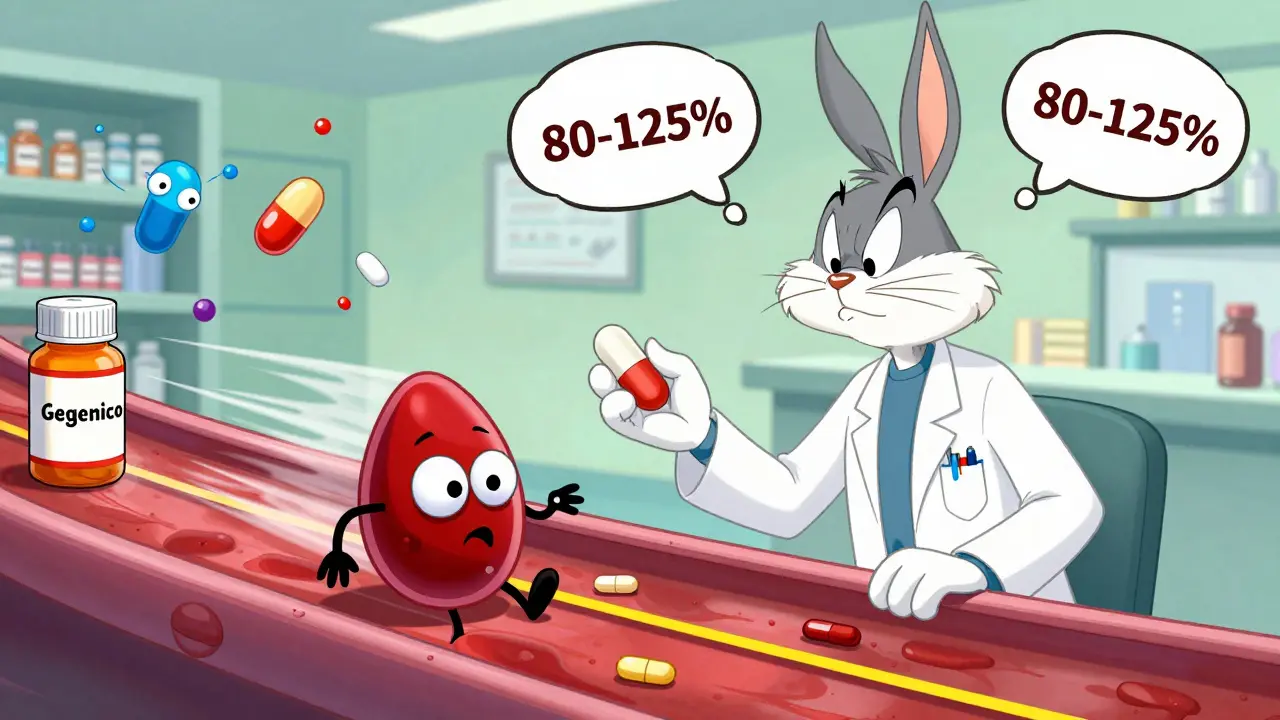
When you pick up a prescription at the pharmacy and see a different name on the bottle than what your doctor wrote, it’s natural to wonder: is this the same medicine? The answer lies in bioequivalence - a scientific process that ensures generic drugs work just like their brand-name counterparts. This isn’t just bureaucracy. It’s the invisible safety net that keeps millions of patients protected every day.
What Bioequivalence Really Means
Bioequivalence isn’t about looking the same. Two pills can look completely different - different color, shape, or filler - and still be bioequivalent. What matters is how your body absorbs and uses the active ingredient. If a generic drug delivers the same amount of medicine into your bloodstream at the same speed as the brand-name version, it’s bioequivalent.
The standard? The 90% confidence interval for the drug’s absorption must fall between 80% and 125% compared to the original. That means if the brand-name drug gets 100 units of medicine into your blood, the generic must get between 80 and 125 units. This isn’t a guess. It’s measured through blood tests in controlled studies with healthy volunteers. The data is then analyzed using strict statistical rules.
This standard was created in the 1980s under the Hatch-Waxman Act in the U.S., and it’s now used globally by agencies like the FDA and EMA. The goal? Let patients save money without risking their health.
Why This Testing Saves Lives
Imagine you’re taking warfarin, a blood thinner. Too little, and you risk a clot. Too much, and you could bleed internally. The difference between life and death is tiny - a fraction of a milligram. For drugs like this, with a narrow therapeutic index, the 80-125% range isn’t enough. Regulators use tighter limits: 90-111%. That’s because even a small drop in effectiveness or a spike in concentration can be dangerous.
That’s why bioequivalence testing matters. Without it, a generic version could be slightly slower to absorb, or peak at a higher level. A patient switching from brand to generic might not notice anything - until they have a stroke, or a bleed. Bioequivalence studies catch those risks before the drug hits the shelf.
And it works. The FDA’s adverse event database shows only 0.07% of all reported drug problems involve generic medications that passed bioequivalence testing. Compare that to 2.3% for brand-name drugs. That’s not a coincidence. It’s proof the system works.
When Bioequivalence Isn’t Enough
Not all drugs are created equal. Some, like levothyroxine for thyroid disease, are extremely sensitive to tiny changes. In 2012, the FDA tightened bioequivalence standards for this drug after reports of patients having symptoms after switching generics. Now, every batch of generic levothyroxine must meet stricter criteria - and patients report better stability as a result.
Then there are complex drugs: inhalers, creams, eye drops. These don’t just enter the bloodstream. They act locally. A cream might need to penetrate the skin just right. An inhaler must deliver the right particle size to the lungs. Standard blood tests can’t measure that. So regulators now use advanced methods - in-vitro tests, imaging, and even computer modeling - to prove these products behave the same way.
Even then, challenges remain. Dr. Lawrence Yu, former FDA deputy director, called topical dermatological products one of the hardest areas to test. Why? Because skin absorption varies wildly between people. What works for one person might not work for another. That’s why regulators keep refining the rules - not because the system is broken, but because science keeps getting better.
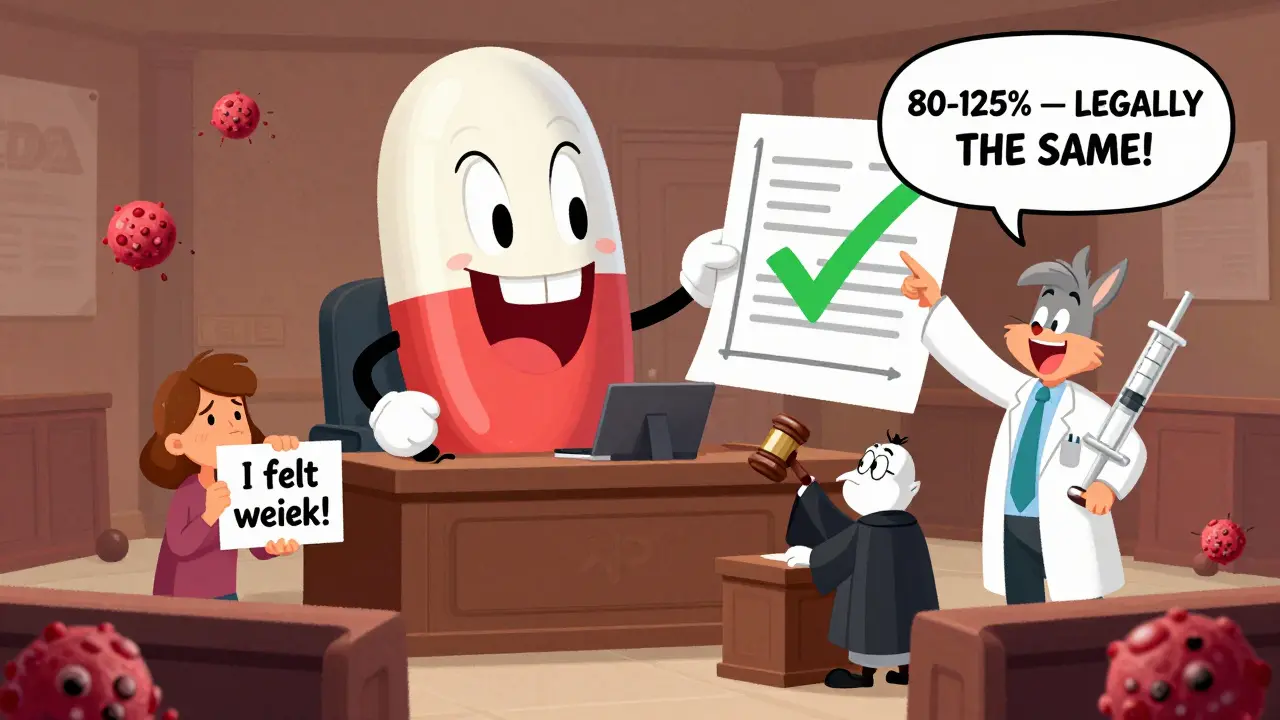
What About Patient Stories?
You’ve probably heard stories online: “I switched to generic sertraline and felt awful.” “My blood pressure spiked after the switch.” These aren’t made up. People feel real changes.
But here’s the catch: most of these reports don’t hold up under scrutiny. In a 2023 Reddit thread with over 300 comments about sertraline generics, only 37 users claimed problems. Pharmacists in the thread pointed out that if the generic were truly unsafe, the FDA would have pulled it. And they didn’t. In fact, the FDA’s tracking system shows no pattern of increased adverse events linked to approved generics.
What’s really happening? Sometimes, it’s the placebo effect in reverse - people expect the generic to be worse, so they feel worse. Other times, it’s a change in fillers or coating that affects how the pill tastes or dissolves, leading to anxiety. Rarely, it’s a manufacturing flaw - but those are caught by routine inspections, not bioequivalence tests.
Bottom line: bioequivalence doesn’t guarantee every single person will feel identical. But it guarantees the medicine will work the same way for the population as a whole. That’s what matters for public health.
Who Pays for This?
Running a bioequivalence study isn’t cheap. It costs between $1 million and $2 million per drug. It takes 12 to 18 months. Teams need pharmacokinetic experts, statisticians, clinical staff, and labs with high-precision equipment like LC-MS/MS to measure drug levels in blood.
Companies hire contract research organizations (CROs) like PPD or WuXi AppTec to run these studies. These firms make billions each year from bioequivalence work. Why? Because the market is huge. Generic drugs make up 90% of prescriptions in the U.S., but only 23% of total drug spending. In 2020 alone, they saved the American healthcare system $313 billion.
That’s why the system survives. The savings are massive. The safety record is strong. And the science? It’s constantly improving.

The Future of Bioequivalence
Science is moving beyond blood tests. The FDA is now accepting computer models - called PBPK (physiologically-based pharmacokinetic) models - to predict how a drug will behave in the body. In 2022, they approved 17 such models for complex generics. That’s up from just 3 in 2018.
Why does this matter? Because running human studies for every single version of a drug isn’t sustainable. If a computer can reliably predict whether two formulations are bioequivalent, we can approve more generics faster - and cheaper.
Artificial intelligence is next. Researchers are training AI to predict bioequivalence based on how a drug dissolves in lab conditions. If successful, this could cut study times in half and reduce costs dramatically.
Meanwhile, global harmonization is growing. In 2015, only 89 countries had formal bioequivalence rules. Today, 134 do. The WHO and the International Pharmaceutical Regulators Programme are working to make standards consistent across borders. That means a generic drug approved in the U.S. can more easily be trusted in India, Brazil, or South Africa.
What You Should Know as a Patient
You don’t need to understand pharmacokinetics to use generics safely. But you should know this: if your generic drug is approved by the FDA, EMA, or another major regulator, it has passed the same safety tests as the brand-name version. The only difference? The price.
If you notice a change in how you feel after switching - fatigue, dizziness, worsening symptoms - talk to your doctor or pharmacist. Don’t assume it’s the generic. It might be something else. But don’t assume it’s safe just because it’s cheap either. Your body is your best indicator.
And if you’re worried about switching? Ask your pharmacist: “Is this generic approved under current bioequivalence standards?” They can tell you if it’s on the FDA’s Orange Book or the EMA’s public assessment report. That’s your proof.
Generic drugs aren’t second-rate. They’re the result of rigorous science, strict oversight, and decades of refinement. They’re how millions of people afford their medicines. And bioequivalence testing? It’s the reason you can trust them.
Are generic drugs as safe as brand-name drugs?
Yes, if they’ve passed bioequivalence testing. Regulatory agencies like the FDA and EMA require generics to prove they deliver the same amount of active ingredient at the same rate as the brand-name version. This ensures they work the same way in your body. The safety record of approved generics is strong, with adverse event rates far lower than brand-name drugs in FDA tracking systems.
Why do some people say generics don’t work for them?
Some patients report changes in how they feel after switching - like increased anxiety or side effects. These are often due to psychological factors, differences in inactive ingredients (like fillers), or unrelated health changes. Rarely, it’s a manufacturing issue. But if a generic consistently caused harm, regulators would recall it. The FDA monitors adverse events closely and has found no widespread pattern of failure in bioequivalent generics.
Do all generic drugs need bioequivalence testing?
Yes, for small-molecule drugs - the most common type of prescription medicine. This includes pills, capsules, and liquids. But biosimilars - which are copies of biologic drugs like insulin or cancer treatments - require different testing. They’re more complex and need additional studies on structure, immune response, and clinical outcomes.
What’s the difference between bioequivalence and therapeutic equivalence?
Bioequivalence means the drug enters your bloodstream the same way. Therapeutic equivalence means it works the same way in your body to treat your condition. Bioequivalence is a scientific requirement for approval. Therapeutic equivalence is the real-world result - and it’s what matters to patients. When a generic passes bioequivalence, regulators assume therapeutic equivalence unless proven otherwise.
Can I trust a generic drug from another country?
It depends. If the drug is approved by a trusted regulator like the FDA, EMA, Health Canada, or WHO, then yes. Many countries now follow the same bioequivalence standards. But if it’s imported without regulatory approval - especially from unverified online sources - you can’t be sure. Always get your medicine from licensed pharmacies and check if it’s listed in official databases like the FDA’s Orange Book.
Why do some generics cost more than others?
Price differences come from manufacturing costs, market competition, and whether the drug is newer to the market. A generic that just entered the market might cost more because there’s only one manufacturer. Once others join, prices drop. It has nothing to do with quality. Two generics with the same active ingredient, even at different prices, must both meet the same bioequivalence standards.
Fabian Riewe
December 29, 2025 AT 23:42Really appreciate this breakdown. I work in rural clinics where generics are the only option for most patients, and seeing the science behind bioequivalence makes me feel way more confident explaining it to folks. It’s not magic-it’s math, rigor, and decades of regulatory refinement. People just need to know it’s not a gamble.
Henriette Barrows
December 30, 2025 AT 22:43I switched my dad’s blood pressure med to generic last year and he swore it wasn’t working. Turned out he was mixing up the pill colors. Funny how our brains invent problems when things look different. This post nailed it.
Nisha Marwaha
December 31, 2025 AT 03:17From a pharmacokinetic standpoint, the 80-125% AUC and Cmax confidence interval is not arbitrary-it’s rooted in the log-normal distribution of absorption kinetics and the assumption of bioequivalence as a non-inferiority test. The 90% CI framework was derived from the FDA’s 1992 guidance, which itself was informed by the work of Westlake and Schuirmann on equivalence testing. The statistical power is calibrated to detect clinically meaningful deviations while avoiding over-rejection of safe generics. This is why the system has a false-positive rate below 0.1% in FDA audits.
David Chase
January 1, 2026 AT 13:40So let me get this straight-some guy in India makes a pill that looks like a neon green gumball, and somehow it’s JUST AS GOOD as Pfizer’s? 🤯 I don’t care what your stats say-I’ve seen what happens when people switch. My cousin had a seizure after switching generics. The FDA is asleep at the wheel. #MakeAmericaSafeAgain 🇺🇸
Kevin Lopez
January 1, 2026 AT 20:33Statistical equivalence ≠ clinical equivalence. You’re conflating population-level metrics with individual outcomes. If 99.9% of patients are fine, that doesn’t mean the 0.1% who aren’t don’t matter. Your ‘system works’ narrative ignores lived experience. That’s dangerous.
Jasmine Yule
January 3, 2026 AT 15:35I get why people panic when the pill changes color. I did too, after switching to generic sertraline. But talking to my pharmacist helped. She showed me the Orange Book listing and explained the testing. Turns out my anxiety was the real culprit. Thanks for the clarity.
Jim Rice
January 4, 2026 AT 08:26Oh wow, so you’re saying the FDA approves generics based on blood tests in healthy volunteers? What about elderly patients? Diabetics? People with liver disease? You’re treating people like lab rats. This isn’t science-it’s corporate convenience. The real goal is to kill brand-name profits, not protect patients.
Lisa Dore
January 5, 2026 AT 07:24Love how you mentioned levothyroxine. My mom’s TSH levels went haywire after a generic switch-her endocrinologist had to switch her back. It’s not about fear-it’s about precision. Some drugs just need tighter controls, and regulators are finally catching on. Progress!
Greg Quinn
January 6, 2026 AT 00:12It’s fascinating how we’ve moved from trusting doctors’ intuition to trusting statistical models. But what does ‘trust’ even mean in this context? Is it faith in the system, or faith in the math? And who gets to define ‘safe enough’ for a population? These aren’t just regulatory questions-they’re ethical ones.
Amy Cannon
January 7, 2026 AT 13:09While I appreciate the empirical rigor underpinning the bioequivalence paradigm, I must express my profound concern regarding the sociopolitical implications of pharmaceutical commodification. The hegemony of cost-efficiency as the primary metric for drug approval subtly erodes patient autonomy, particularly among marginalized populations who are systematically disincentivized from advocating for brand-name therapeutics. Moreover, the reliance on contract research organizations, which are often headquartered in jurisdictions with lax labor and data integrity standards, introduces a latent epistemic vulnerability into the regulatory framework. The illusion of safety, perpetuated by opaque statistical thresholds, may ultimately undermine the very public trust it purports to safeguard.
Himanshu Singh
January 8, 2026 AT 09:06Hey, I’m from India and we use a lot of generics here. My uncle takes generic warfarin and he’s fine. The FDA standards are good, but we need more testing in real populations, not just healthy volunteers. Maybe next time, test on people who actually have the disease? Just a thought 😊
Alex Ronald
January 9, 2026 AT 00:40For complex formulations like inhalers or topical creams, bioequivalence gets messy fast. That’s why the FDA now uses in vitro dissolution profiling and IVIVC models-linking lab results to in vivo performance. It’s not perfect, but it’s better than guessing. The real win? AI-driven predictive modeling is cutting study times by 40%. That’s huge for global access.
Paige Shipe
January 10, 2026 AT 05:33Generic drugs are a scam. The active ingredient is the same, sure-but the fillers are cheap, the coating is inferior, and the tablets dissolve differently. I’ve been a nurse for 22 years. I’ve seen the results. You think your stats mean something? I’ve seen patients crash because of generics. And no, I don’t believe in placebo effects. People aren’t lying. They’re just ignored.