
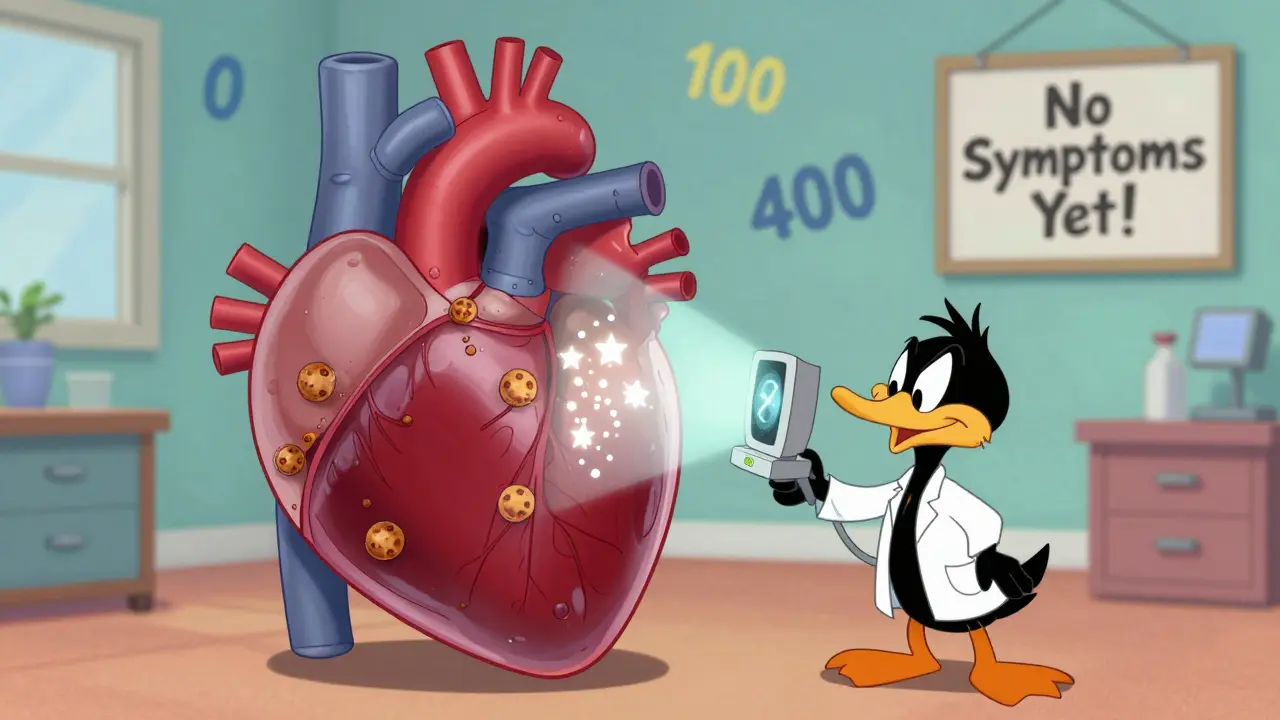
Most people think heart disease shows up with chest pain or shortness of breath. But by the time those symptoms appear, the damage is often already advanced. That’s where a simple, non-invasive CT scan comes in - it can reveal hidden plaque in your heart’s arteries long before you feel anything. This test, called a coronary calcium score, doesn’t need needles, dyes, or stress tests. Just a quick scan, no preparation needed beyond avoiding caffeine and smoking for a few hours beforehand.
What the Scan Actually Shows
Every time you get a CT scan of your heart, the machine takes hundreds of pictures in seconds. It’s not looking for blockages like a heart catheter does. Instead, it’s hunting for calcium - a mineral that builds up inside artery walls as part of plaque. Think of it like rust on a pipe: it doesn’t stop the flow right away, but it’s a clear sign something’s deteriorating inside.
The scan finds calcified plaque, which makes up about 70-80% of total plaque buildup. The rest - soft, fatty deposits - won’t show up here. That’s not a flaw. Calcium is the most stable, long-lasting marker of heart disease. If it’s there, you’ve had years of inflammation and damage. If it’s not, your arteries are likely still clean.
The result? A number - your calcium score. A score of zero means no detectable calcium. That’s great news. It suggests your risk of a heart attack in the next five years is very low. Anything above zero? That’s evidence of coronary artery disease, even if you feel fine. A score of 1 to 10 is minimal. 11 to 100? Mild. 101 to 400? Moderate. And above 400? That’s extensive plaque with a high chance of future events.
How the Score Is Calculated
The number isn’t random. It’s based on the Agatston Score, developed in 1990 by Dr. Arthur Agatston. The system looks at each calcium spot, measures its size and how dense it is (on a scale from 1 to 4), then adds them all up. A small, bright spot might be a 4. A larger, fainter one might be a 2. Multiply those by the area, and you get your total.
But here’s the key: your score alone doesn’t tell the full story. A 300 score for a 65-year-old man might be average. For a 45-year-old woman? That’s alarming. That’s why most clinics now report your score as a percentile - how you compare to others your age, sex, and ethnicity. The MESA study (Multi-Ethnic Study of Atherosclerosis) created those reference groups. If you’re in the 75th percentile or higher, your risk is elevated enough to warrant stronger action.
Why It Matters More Than Blood Tests
Doctors often use risk calculators like the Pooled Cohort Equations. They look at cholesterol, blood pressure, smoking, diabetes - all important. But they get it wrong about 20-30% of the time. Someone with normal cholesterol and no family history might still have heavy plaque. And someone with high cholesterol might have clean arteries.
Studies show the coronary calcium scan reclassifies risk in 40-50% of people who are labeled “intermediate risk.” That means it finds hidden danger in people who thought they were safe - and it clears the name of people who were unnecessarily scared. In one JAMA Internal Medicine study, CAC scoring helped start statin therapy in 35% of patients who would’ve been missed otherwise.
It’s not magic. But it’s real. A 2022 study in the Journal of the American College of Cardiology found that adding a calcium score to traditional risk factors improved prediction accuracy from 73% to 81%. That’s a big jump.
Who Should Get It?
The American College of Cardiology and American Heart Association recommend it for adults aged 40 to 75 who are at intermediate risk - meaning a 7.5% to 20% chance of a heart attack in the next ten years. That includes people with borderline high cholesterol, mild high blood pressure, or a family history of early heart disease.
It’s not for everyone. If you’re already on a statin, have known heart disease, or are at very low or very high risk, it won’t change your plan. But if you’re stuck in the middle - unsure whether you need medication or just lifestyle changes - this test cuts through the noise.
Even better: the 2023 guidelines from the Society of Cardiovascular Computed Tomography now suggest it for anyone over 40 with an LDL cholesterol of 160 mg/dL or higher, regardless of other factors. That’s a major shift.
What Happens After the Scan?
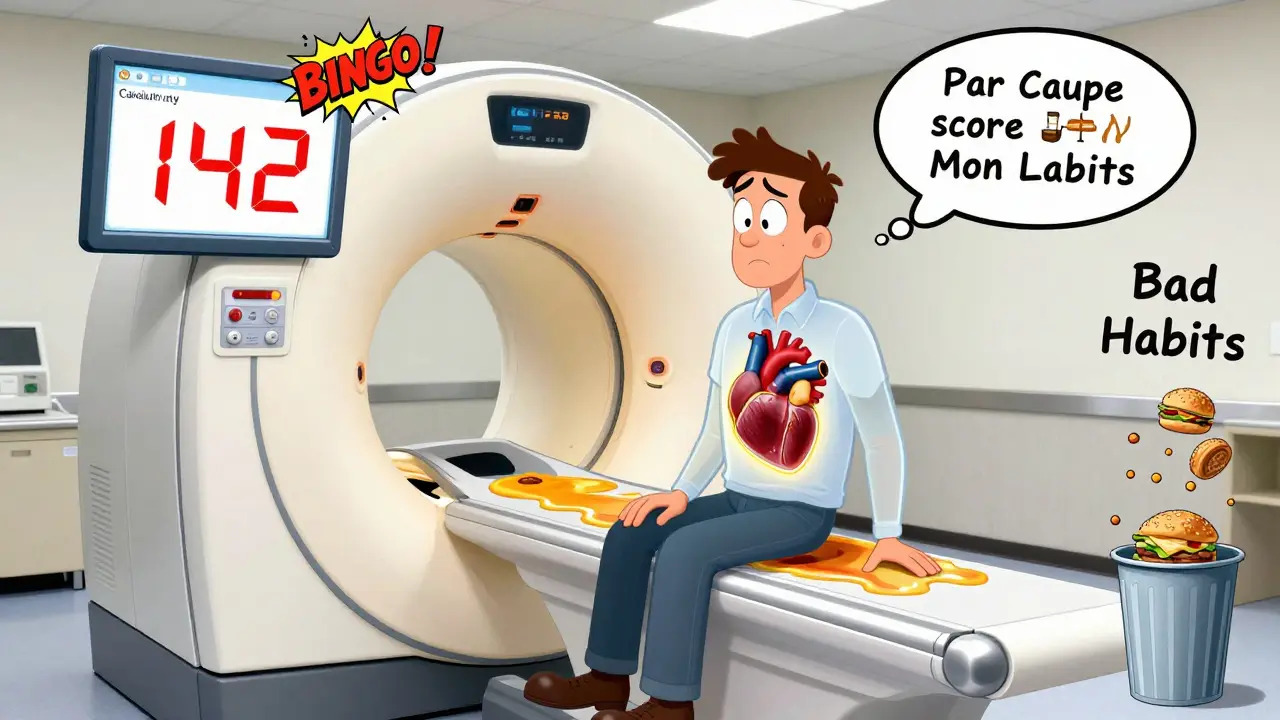
Getting your score is just the start. A score of 142, like one Reddit user shared, might scare you - but it also gives you clarity. That person quit smoking, started statins, and began walking daily. That’s the power of this test. It doesn’t just diagnose - it motivates.
If your score is low (under 100), lifestyle changes are usually enough: more movement, less sugar, better sleep, no smoking. If it’s moderate (100-300), most doctors recommend a moderate-intensity statin. Above 300? High-intensity statins, tighter control of blood pressure and cholesterol, and often more frequent follow-ups.
And it’s not just about drugs. One study found that people who got their calcium score were 68% more likely to make lasting lifestyle changes than those who only got general advice.

Limitations and Risks
No test is perfect. This one can’t see non-calcified plaque - the kind that’s more likely to rupture and cause sudden heart attacks. For that, you’d need a coronary CT angiogram (CCTA), which uses contrast dye and exposes you to more radiation. But CCTA is more expensive, more complex, and usually not needed unless symptoms are present.
Another issue? Radiation. A calcium scan gives you about 1-3 mSv - roughly the same as a mammogram or a few cross-country flights. It’s low. But it’s not zero. That’s why it’s not recommended for young, low-risk people without symptoms.
And it can be misleading in people with kidney disease. Their blood vessels calcify for reasons unrelated to heart disease. A high score there doesn’t mean the same thing.
Insurance coverage is another hurdle. Medicare doesn’t cover it yet. Private insurers vary. Out-of-pocket costs range from $100 to $300. That’s why only 15% of eligible patients get the test - not because it’s not useful, but because access is patchy.
Real Stories, Real Impact
On HealthUnlocked, 78% of users who got the scan rated it positively. Most said it was quick, painless, and worth it. One woman, 58, had a score of 217. She’d been told her cholesterol was “only borderline.” The scan proved otherwise. She started a statin, changed her diet, and lost 35 pounds. Her next scan, two years later, showed no growth.
On Reddit, users called it a “wake-up call.” A 52-year-old man with a score of 142 said he’d ignored his doctor’s advice for years. The number made it real. He quit smoking. He started exercising. He didn’t wait for a heart attack to act.
What’s Next?
AI is making the scans faster and safer. New algorithms cut radiation by 40% without losing detail. The NIH is running a 10,000-patient study to set clearer treatment thresholds. More cardiologists are pushing for broader coverage.
The goal isn’t to scare people. It’s to give them information - real, personal, measurable data - so they can act before it’s too late. If you’re in your 40s or 50s, have a family history, or just want to know where you really stand, this scan might be the clearest window into your heart’s health you’ll ever get.
Is a coronary calcium scan the same as a stress test?
No. A stress test checks how your heart responds to physical exertion, often by monitoring your EKG or using imaging during exercise. It can miss early plaque buildup. A calcium scan looks directly at the arteries and finds calcified plaque, even if you’re not having symptoms. It’s more about anatomy than function.
Can a calcium score be too high?
There’s no upper limit that’s dangerous - but a score over 400 means you have extensive plaque and a significantly higher risk of heart attack or stroke. It doesn’t mean you’re doomed, but it does mean you need aggressive treatment: statins, blood pressure control, and lifestyle changes. Many people with scores over 1,000 live healthy lives with proper management.
Does a zero calcium score mean I’m completely safe from heart disease?
Not entirely. A zero score means no detectable calcified plaque, which is excellent. But it doesn’t rule out non-calcified plaque, which can still cause problems. It also doesn’t protect you from sudden events like blood clots. Still, people with zero scores have among the lowest long-term heart attack risks - often less than 1% over 10 years.
How often should I get a calcium scan?
If your score is zero and you have no risk factors, you may not need another for 10 years. If it’s above zero, especially over 100, your doctor may suggest a repeat scan in 3 to 5 years to track progression. Most people don’t need yearly scans - it’s about monitoring change, not checking every year.
Can I get this scan without a doctor’s referral?
In many places, yes - especially at private imaging centers. Some clinics offer it as a direct-to-consumer test. But it’s best done with a doctor’s input. Your doctor can interpret the score in context of your full health picture and help you decide what to do next. Without guidance, a high score can cause unnecessary anxiety.


Mike Hammer
February 15, 2026 AT 09:14Charlotte Dacre
February 16, 2026 AT 16:33Josiah Demara
February 17, 2026 AT 23:38Virginia Kimball
February 19, 2026 AT 02:46Chiruvella Pardha Krishna
February 19, 2026 AT 08:32Daniel Dover
February 19, 2026 AT 22:07Sarah Barrett
February 21, 2026 AT 10:04Kapil Verma
February 22, 2026 AT 00:55Joe Grushkin
February 22, 2026 AT 04:35Betty Kirby
February 23, 2026 AT 23:38