
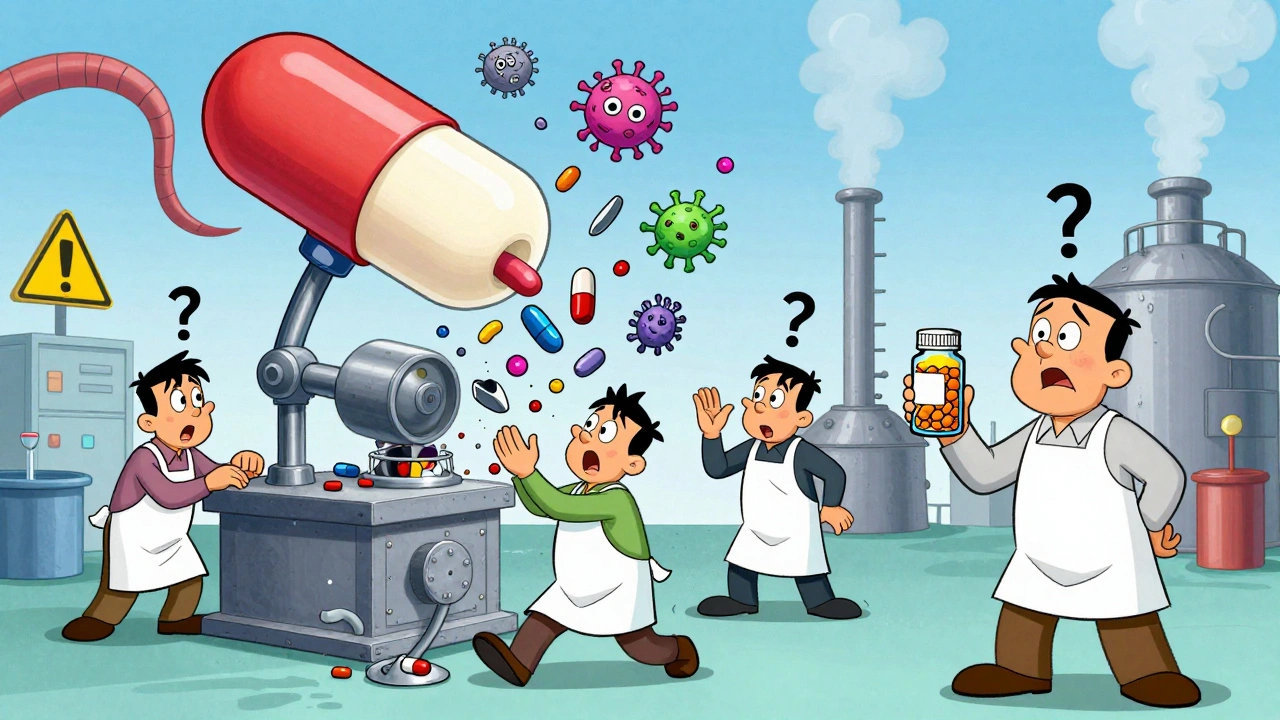
Every year, millions of people rely on generic drugs to manage chronic conditions, treat infections, or control pain. These medications are cheaper, widely available, and legally required to work the same as brand-name versions. But behind the low price tag lies a hidden risk: contamination. In 2022, generic drug contamination was behind nearly 4 out of every 10 drug recalls in the U.S. - and many of these weren’t caught until patients got sick.
What Exactly Is Generic Drug Contamination?
Contamination means something unwanted ended up in your medicine. It could be tiny bits of another drug left behind from the same machine, harmful chemicals like nitrosamines, bacteria, mold, or even metal particles. The FDA defines it as any impurity that gets into a drug during manufacturing - from the air, the equipment, or even the people handling it. These aren’t random mistakes. They happen because of how generic drugs are made. Unlike brand-name companies that often own their own factories, many generic manufacturers outsource parts of production across the globe. About 80% of the active ingredients in U.S. generic drugs come from just two countries: India and China. Each step - from making the raw chemical to filling pills into bottles - adds a chance for something to go wrong.How Contamination Happens: The Real-World Pathways
Contamination doesn’t happen overnight. It builds up through small failures that add up. One major source is cross-contamination. Imagine a machine that makes blood pressure pills one day, then gets used the next day for antibiotics without being cleaned properly. Even a tiny leftover amount of the first drug can mix into the second. The FDA requires manufacturers to remove at least 10 parts per million (ppm) of previous residue. But for powerful drugs like cancer treatments or steroids, even 1 ppm can be dangerous. Then there’s microbial contamination. Dust, skin cells, and bacteria from workers can get into products. A single person sheds about 40,000 skin cells per minute. In a cleanroom, that’s enough to release 100,000 particles into the air every minute just by standing still. If the room isn’t properly filtered or staff don’t wear proper gowns, microbes can grow in pills or creams. Even simple actions like piercing a vial with a needle or breaking an ampule can spread contamination. OSHA found that 62% of hazardous drug incidents involved needle use. That’s not just a pharmacy issue - it’s a manufacturing one too.Why Generic Drugs Are More at Risk
You might think all drugs are held to the same standard. And technically, they are. But the pressure to cut costs changes how companies follow those rules. Brand-name drugmakers typically make 60-70% profit margins. Generic manufacturers? Often 20-25%. That tight margin means fewer dollars for clean rooms, new equipment, or staff training. In 2022, FDA inspections found that 8.3% of generic drug facilities had contamination control issues - compared to just 5.1% for brand-name facilities. The problem gets worse overseas. Indian manufacturing sites had 12.7% of inspections flag contamination problems - more than double the rate of U.S.-based plants. Older factories, built before 2000, are 34% more likely to have contamination issues. Many still use open systems where products are exposed to air during filling - a major risk. But not all generics are risky. Companies like Teva and Mylan have invested heavily in closed manufacturing systems and real-time monitoring. Teva’s plant in Italy cut contamination incidents by 78% in just four years. Mylan’s facility in West Virginia reduced problems by 82% using sensors that detect particles as they form.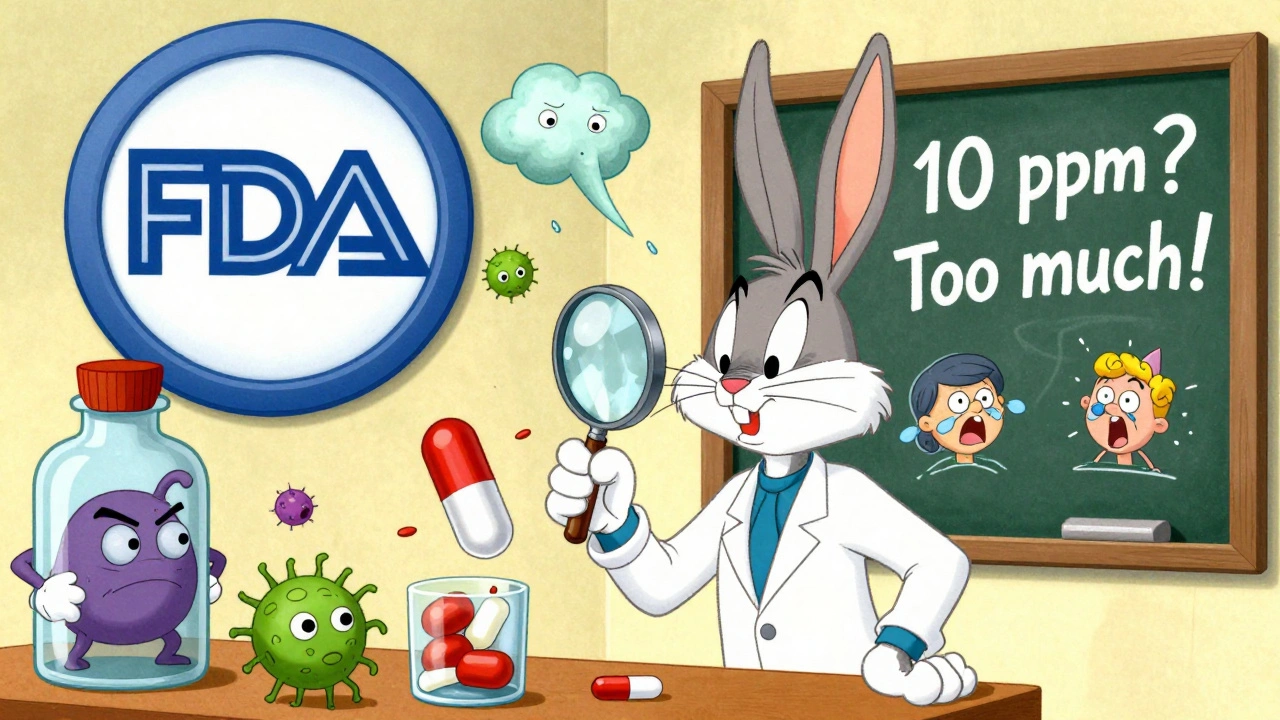
What’s Being Done to Stop It?
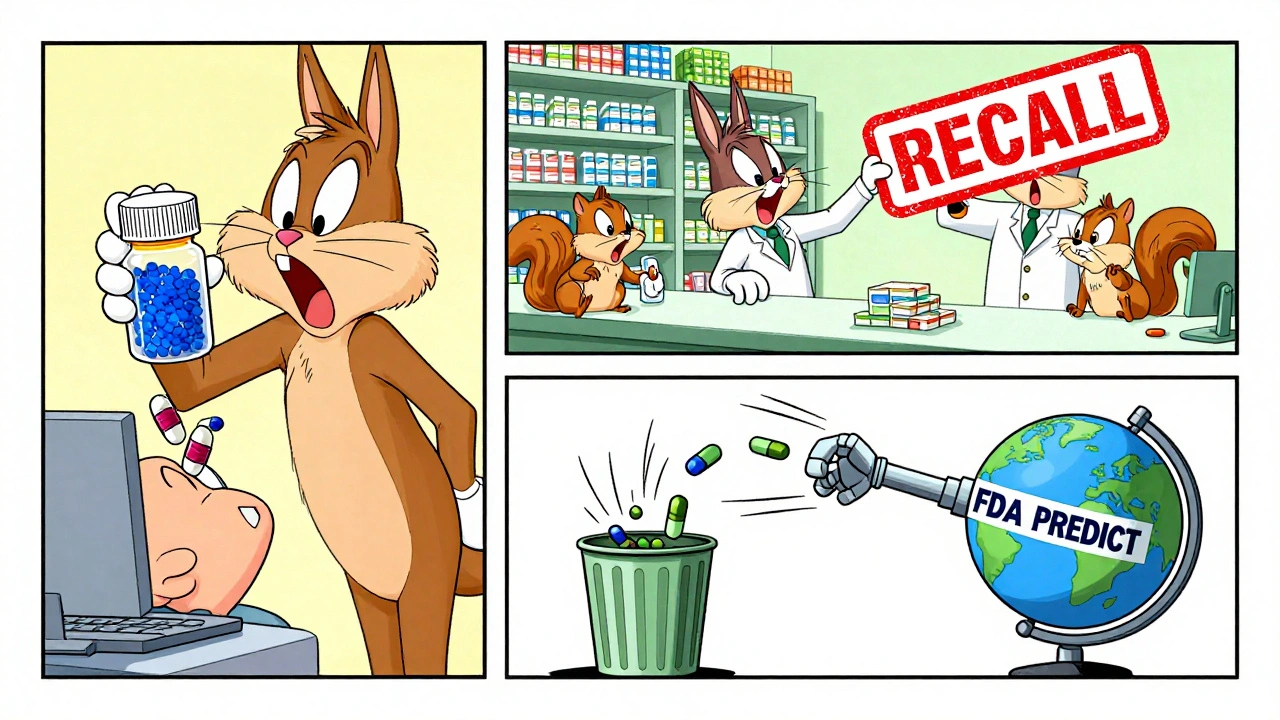
Regulators aren’t sitting idle. The FDA’s 2023 Drug Competition Action Plan now requires mandatory testing for nitrosamines - cancer-causing impurities - in all sartan-class blood pressure drugs. That’s a direct response to the 2018-2019 valsartan recall, which affected over 2,300 products across eight countries and cost $1.2 billion. New technology is helping too. Rapid microbiological testing, which used to take 7 days to detect bacteria, now gives results in just 4 hours. Over 60% of top generic manufacturers have adopted these tools. The FDA’s new PREDICT system uses data to flag high-risk shipments before they even reach U.S. ports - catching 37% more contaminated imports than before. Cleaning validation is getting stricter too. Instead of using one-size-fits-all limits, manufacturers now must prove their cleaning methods remove enough residue based on the drug’s toxicity. For example, a cancer drug might need a 100x stricter standard than a common painkiller.What You Can Do: Prevention and Response
As a patient, you can’t inspect your pills for metal flakes or mold. But you can stay alert.- Check for recalls. The FDA’s MedWatch database lists all drug recalls. Sign up for email alerts or check the site monthly if you take long-term meds.
- Watch for changes. If your generic pill looks different - new color, shape, smell, or specks - don’t ignore it. Contact your pharmacist. One Reddit user spotted blue specks in metronidazole pills that later tested positive for copper contamination.
- Report anything suspicious. If you or someone you know has an unexplained reaction after starting a new generic, file a report with MedWatch. Between 2020 and 2022, over 1,200 reports were filed - and 387 mentioned actual harm.
- Ask your pharmacist. About 63% of independent pharmacists say they can’t test drugs themselves. But they can tell you which manufacturers are known for quality. Some pharmacies even track which batches caused issues in the past.
What Happens When Contamination Is Found?
When contamination is confirmed, the FDA can force a recall. The manufacturer must pull the product from stores and notify patients. But here’s the catch: recalls aren’t always fast. Some drugs stay on shelves for weeks while the company investigates. In the meantime, patients may be stuck without their medication. Hospitals and pharmacies often scramble to find alternatives. A 2022 ASHP survey found that 14% of contamination incidents led to patient harm - including allergic reactions, organ damage, or treatment failure. The cost to manufacturers is steep: an average of $18.7 million per recall. But the real cost is to patients. One documented case involved a woman who developed severe skin burns from a contaminated generic hydrocortisone cream. Her condition worsened because the contamination wasn’t detected until after she’d used it for weeks.The Future: Can We Fix This?
The good news? The industry is changing. AI-powered monitoring systems are being tested to predict contamination before it happens. These systems track temperature, humidity, particle counts, and even airflow patterns across 15,000 data points per facility. Early results show 89% accuracy in spotting risks. By 2027, experts predict contamination-related recalls will drop by 40% thanks to better tech and stricter rules. But the biggest challenge remains the global supply chain. No amount of testing can fully replace having strong, consistent oversight at every stage - from the chemical plant in India to the pharmacy shelf in Ohio. The bottom line: generic drugs are safe - most of the time. But safety isn’t guaranteed. It’s earned through constant vigilance, investment, and accountability. As a patient, you’re not powerless. You’re part of the system. Knowing the risks and speaking up when something seems off isn’t just smart - it’s necessary.Are generic drugs less safe than brand-name drugs?
Legally, generic drugs must meet the same safety and effectiveness standards as brand-name drugs. But in practice, contamination risks are higher in some generic manufacturers due to cost pressures, older facilities, and complex global supply chains. While most generics are safe, the rate of contamination-related recalls is higher for generics than for brand-name drugs.
How can I tell if my generic drug is contaminated?
You usually can’t see, smell, or taste contamination. But signs include unusual discoloration, strange particles, odd odor, or pills that crumble easily. If your medication looks different from previous batches - especially if it’s from a new manufacturer - contact your pharmacist. Also, watch for unexplained side effects after switching to a new generic.
What should I do if I suspect my medication is contaminated?
Stop taking the medication immediately. Keep the bottle and any remaining pills. Contact your pharmacist or doctor to report the issue. Then file a report with the FDA’s MedWatch system. Even if you’re unsure, your report helps regulators spot patterns. Don’t wait for others to get sick - your report could prevent harm.
Are recalls the only way contamination is found?
No. Many cases are caught during routine FDA inspections, lab testing, or by pharmacists who notice unusual batches. Some contamination is found through patient reports. In fact, over 30% of contamination cases in 2022 started with a pharmacist or patient raising a red flag - not through official testing.
Which generic drug manufacturers have the best safety record?
Companies like Teva, Mylan (now Viatris), and Sandoz have invested heavily in modern facilities, closed manufacturing systems, and real-time monitoring. Their contamination rates are significantly lower than industry averages. Independent pharmacies often track which manufacturers have fewer issues - ask yours for recommendations.
Can I ask my pharmacy to use a specific generic manufacturer?
Yes. While insurance may limit options, many pharmacies can source from preferred manufacturers if you ask. If you’ve had a bad experience with one brand of generic, say so. Pharmacists can often switch you to a different manufacturer - especially if they’ve seen contamination issues with the current one.
Is it safer to buy brand-name drugs to avoid contamination?
Not necessarily. Brand-name drugs aren’t immune to contamination. But they often have more resources for quality control. If cost isn’t a barrier and you’ve had issues with generics, switching may be worth it. But for most people, choosing a well-regarded generic manufacturer is a safer and more affordable option than assuming all brand-name drugs are contamination-free.

Michael Robinson
December 10, 2025 AT 08:47It's wild to think we trust our lives to pills made in factories we've never seen, by people we'll never meet. We don't even know what's in them beyond the label. If your blood pressure med suddenly tastes weird, you just take it anyway because you're scared to stop. That's not healthcare-that's gambling with your body.
Kathy Haverly
December 10, 2025 AT 11:15Oh please. The FDA is a joke. They inspect one factory a year and call it ‘due diligence.’ Meanwhile, your grandma’s generic metformin probably has more metal shavings than actual medicine. And don’t even get me started on how they let Indian plants ship stuff that would get shut down in a third-world junkyard.
Evelyn Pastrana
December 12, 2025 AT 08:13Y’all are acting like contamination is new. Back in '98, my cousin got sick from a contaminated generic antibiotic. We thought it was food poisoning. Turned out it was mold in the capsules. Fast forward 25 years, and nothing changed-just now we have TikTok to scream about it. Honestly? If you’re on meds long-term, just buy the brand name if you can. It’s cheaper than an ER visit. 😅
Nikhil Pattni
December 13, 2025 AT 15:55As someone from India, I feel this deeply. Yes, we make 80% of the world’s generics-but we’re not all bad. My uncle works in a GMP-certified plant in Gujarat. They have robotic arms, HEPA filters, and even AI cameras that scan each pill for defects. The problem isn’t India-it’s the companies that cut corners to win contracts. Big pharma in the US buys the cheapest bid, then blames us when things go wrong. We’re not the villains-we’re the pawns. 🙏
Arun Kumar Raut
December 14, 2025 AT 02:39Hey, I get the fear-but don’t throw the baby out with the bathwater. Most generics are fine. I’ve been on them for 12 years. The key is knowing your manufacturer. My pharmacist switched me from a sketchy batch to Teva’s version and I haven’t had a single issue. Talk to your pharmacist. Ask who makes it. They know. And if you’re lucky, they’ll even give you a sample to compare. Small steps matter.
precious amzy
December 15, 2025 AT 21:03One must interrogate the epistemological foundations of pharmaceutical trust. The very notion that a pill’s efficacy can be reduced to a bioequivalence metric-ignoring the ontological rupture caused by contamination-is a symptom of late-stage capitalist commodification of the human body. The FDA’s regulatory framework is not merely inadequate-it is an ideological apparatus designed to obscure systemic violence under the guise of ‘affordability.’
William Umstattd
December 17, 2025 AT 01:18If you’re not checking the lot number every time you refill your prescription, you’re not just negligent-you’re reckless. I’ve seen people die because they didn’t notice a new manufacturer on their thyroid med. This isn’t ‘being cautious.’ This is basic survival. The FDA doesn’t care. Your pharmacist doesn’t care. So you better care. Write down the manufacturer. Take a picture of the bottle. Report anything weird. Your life is worth more than $5.
Elliot Barrett
December 17, 2025 AT 08:45Why are we even talking about this? Just switch to brand name if you’re scared. Problem solved. Nobody’s forcing you to risk your health for $3 savings. If you can’t afford it, get on assistance. But don’t pretend you’re being ‘smart’ by playing Russian roulette with your meds.
Tejas Bubane
December 18, 2025 AT 02:25lol at people panicking over specks in pills. The real contamination is the fear-mongering. 99% of generics are fine. The FDA catches 90% of bad batches before they ship. You think your $100 brand-name pill is pure? Nah. Same factories, same rules. Just more marketing. Stop being a sheep.