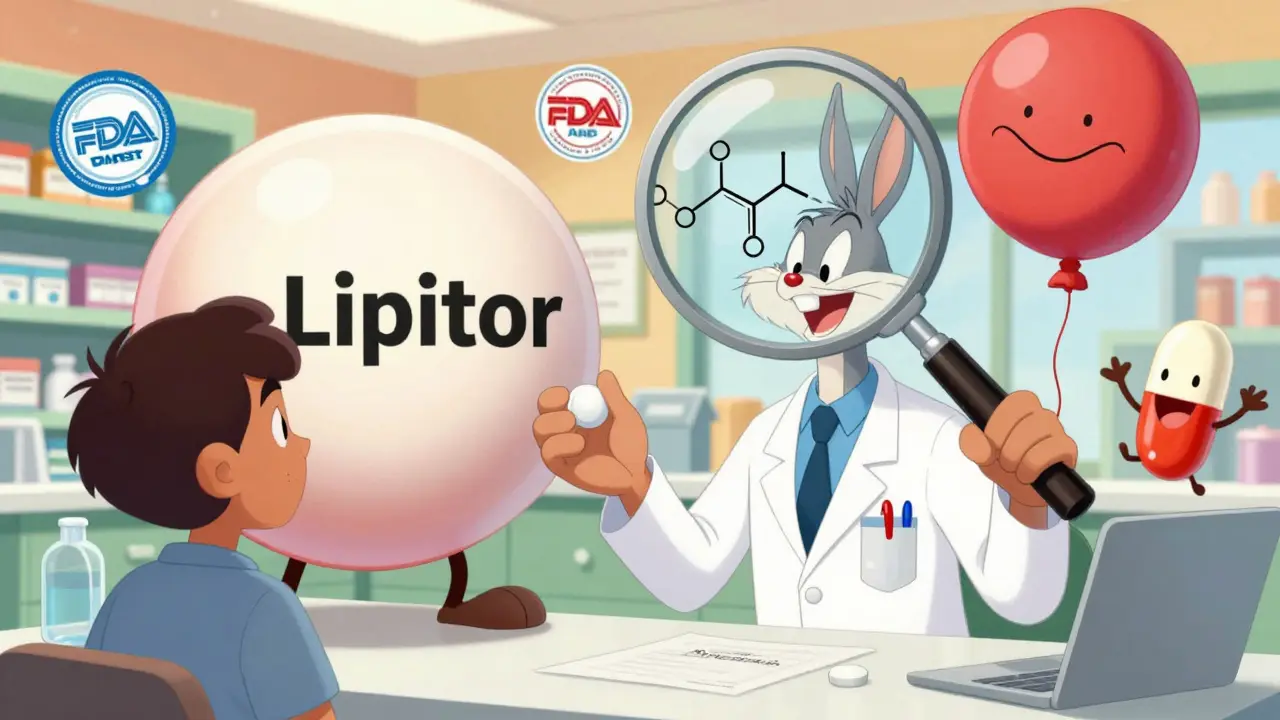
When you pick up a prescription, you might see two names on the label: one you recognize, like Lipitor or Advil, and another that looks unfamiliar, like atorvastatin or ibuprofen. The second one is a generic drug. It’s not a lesser version. It’s not a copy. It’s the same medicine, made to the same strict standards, but at a fraction of the price.
What Exactly Is a Generic Drug?
A generic drug is a pharmaceutical product that contains the exact same active ingredient as a brand-name drug. It works the same way in your body, treats the same condition, and has the same risks and benefits. The only differences are in the name, color, shape, or flavor-things that don’t affect how the drug works.The U.S. Food and Drug Administration (FDA) defines it clearly: a generic drug must be identical or bioequivalent to the brand-name version in dosage form, safety, strength, route of administration, quality, performance characteristics, and intended use. That means if you take a generic version of metformin for diabetes, it will lower your blood sugar just as effectively as the brand-name Glucophage.
Generics become available only after the original patent expires. Most patents last 20 years from the date they’re filed. Once that clock runs out, other companies can apply to make the same drug without having to start from scratch. This system was created by the Hatch-Waxman Act of 1984, which gave manufacturers a faster, cheaper path to approval called the Abbreviated New Drug Application (ANDA). Instead of repeating expensive clinical trials, they only need to prove their version performs the same in the body.
How Do Generic Drugs Prove They Work the Same?
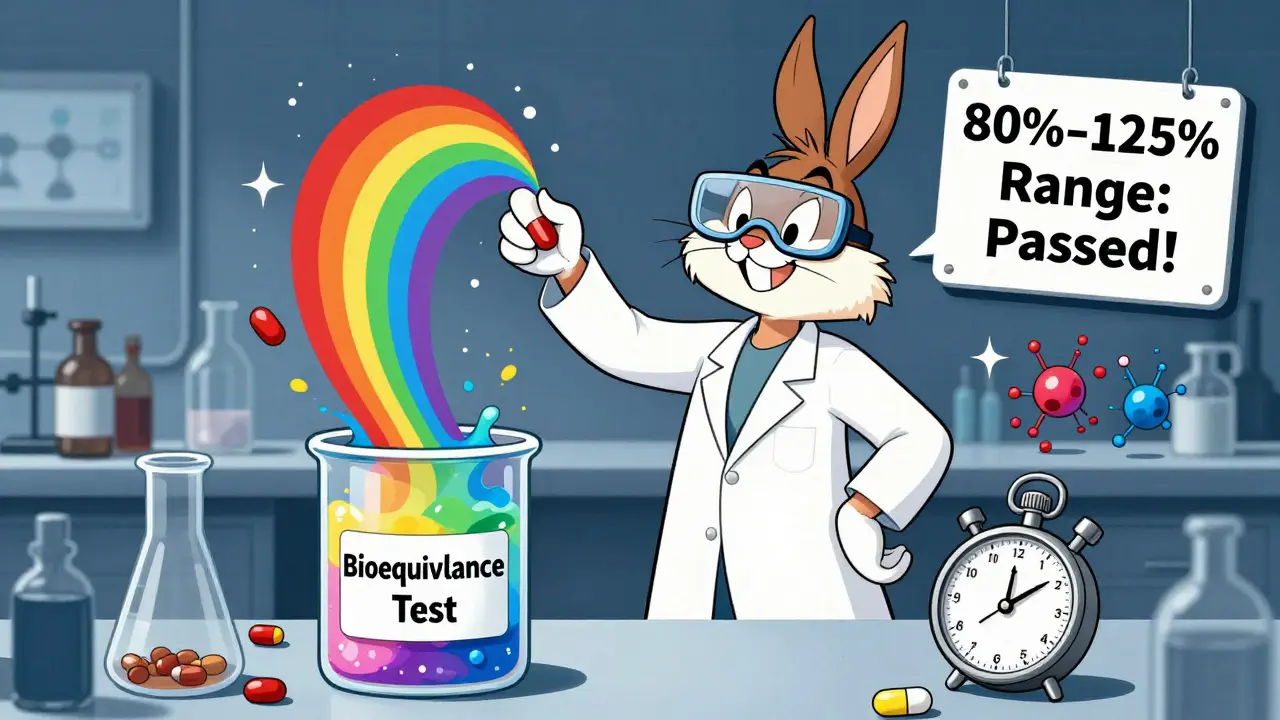
The key requirement is bioequivalence. This isn’t just a buzzword-it’s a rigorous scientific test. Generic manufacturers must show that their drug delivers the same amount of active ingredient into your bloodstream at the same rate as the brand-name version. They do this by testing it in 24 to 36 healthy volunteers, measuring how quickly the drug is absorbed and how long it stays in your system.The FDA requires that the 90% confidence interval for two critical measurements-AUC (total exposure) and Cmax (peak concentration)-falls between 80% and 125% of the brand-name drug’s values. In plain terms, your body absorbs the generic drug within a very narrow range of how it absorbs the original. That’s not a guess. That’s science backed by data.
Even the manufacturing process is held to the same standard. Every facility that makes generics, whether in the U.S., India, or China, must follow Current Good Manufacturing Practices (cGMP). The FDA inspects over 3,500 of these facilities every year-same as for brand-name drugs. There’s no separate rule for generics. If a brand-name pill must be 98% pure, so must the generic. The FDA allows no more than a 5% variation in active ingredient content for either type.
Why Are Generic Drugs So Much Cheaper?
The price difference is staggering. Generics typically cost 80% to 85% less than their brand-name counterparts. In some cases, after five or more companies start making the same drug, prices drop to just 9% of the original. In 2022, generics made up 90.5% of all prescriptions filled in the U.S., but only 13.1% of total drug spending. That’s a $2.18 trillion savings over the past decade.Why? Because brand-name companies spend an average of $2.6 billion to develop a new drug-funding years of research, clinical trials, and marketing. Generics skip all that. They don’t need to prove safety or effectiveness from scratch. They just need to show they match the original. That cuts development costs dramatically.
It’s not about cutting corners. It’s about removing duplication. Think of it like this: if someone builds a car and patents the design, another company can’t copy the exact model. But once the patent expires, they can build the same car using the same blueprints. They don’t have to reinvent the engine. They just have to make sure it runs the same way.
Are Inactive Ingredients Different? Does That Matter?
Yes, the inactive ingredients-like fillers, dyes, or flavorings-are often different. That’s why a generic pill might be white and oval, while the brand version is blue and round. These differences are required by law to avoid trademark infringement. But they don’t change how the drug works.The FDA requires that these inactive ingredients be safe and not affect absorption, stability, or performance. All generics go through months of stability testing to ensure they last just as long on the shelf. If the brand-name drug lasts three years, the generic must prove it does too.
Some people worry that changing the filler might cause side effects. In rare cases, someone might have a sensitivity to a dye or preservative in one version. But that’s not because the generic is inferior-it’s because their body reacts to a specific chemical, not the active ingredient. If you’ve had a reaction, talk to your doctor or pharmacist. They can switch you to a different generic or the brand version.
What About Complex Drugs Like Biologics?
Not all drugs are easy to copy. Biologics-drugs made from living cells, like insulin or Humira-are too complex to replicate exactly. That’s why we have something called biosimilars, not generics. Biosimilars are highly similar to the original but not identical. They still require more testing, and their price discounts are smaller-usually 20% to 30% instead of 80%.The FDA approved the first biosimilar in 2015, but adoption has been slow. By 2022, biosimilars had captured only 31% of their potential market. Why? Insurance policies, doctor habits, and patient confusion still play a role. But that’s changing. More biosimilars are coming online, and prices are starting to drop.
Can Pharmacists Substitute Generics Automatically?
In 49 U.S. states, pharmacists can swap a brand-name drug for a generic unless the doctor writes “dispense as written” on the prescription. This is called therapeutic substitution. It’s legal, safe, and common.There are exceptions. For drugs with a narrow therapeutic index-like warfarin, levothyroxine, or lithium-even tiny changes in blood levels can cause problems. Doctors often prefer to stick with one version in these cases. But even here, studies show that switching between generics and brands doesn’t increase risk when monitored properly. The American College of Physicians says generics are safe for nearly all patients, including those on these sensitive medications.
Pharmacists are trained to explain the difference. If you pick up a new pill that looks different, ask them. They’ll tell you it’s the same medicine, just made by a different company. No need to panic.
What Do Experts Really Say?
Major medical organizations agree: generics are safe and effective.The Institute of Medicine reviewed 38 clinical studies on cardiovascular generics and found no meaningful difference in outcomes compared to brand-name drugs. The American Medical Association encourages doctors to prescribe generics whenever possible. Dr. Janet Woodcock, former head of the FDA’s drug division, said: “The FDA would not allow generics to be marketed unless they were therapeutically equivalent.”
Even critics like Dr. Aaron Kesselheim from Harvard acknowledge that while most generics are fine, a few drugs-especially those with narrow therapeutic windows-need extra attention. But he also says: “The evidence overwhelmingly supports substitution.”
The bottom line? Generics aren’t second-rate. They’re the same medicine, tested just as hard, made in the same kind of factories, and held to the same standards.
What’s Next for Generic Drugs?
Between 2023 and 2027, 350 brand-name drugs with $138 billion in annual sales will lose patent protection. That means a wave of new generics is coming-drugs for cancer, heart disease, mental health, and more.The FDA is speeding up approvals under GDUFA III, aiming to review 90% of applications in 10 months. At the same time, they’re cracking down on quality issues. In 2022, drug shortages rose 22%, partly because some generic manufacturers failed inspections. The agency is now inspecting more facilities in India and China, where 80% of active ingredients are made.
Some big pharma companies are even making their own generics-called authorized generics-to stay competitive. Others are developing complex generics for inhalers, eye drops, and topical creams, where bioequivalence is harder to prove.
One thing won’t change: generics will keep saving patients and the system billions every year. They’re not a compromise. They’re the smart, science-backed choice.
Are generic drugs as effective as brand-name drugs?
Yes. Generic drugs are required by the FDA to have the same active ingredient, strength, dosage form, and route of administration as the brand-name version. They must also prove bioequivalence, meaning they deliver the same amount of medicine into your bloodstream at the same rate. Studies show no meaningful difference in how well they work.
Why do generic drugs look different?
Generic drugs can’t look exactly like the brand-name version because of trademark laws. That’s why the color, shape, or flavor might be different. These changes are only in inactive ingredients like dyes or fillers, which don’t affect how the drug works. The active ingredient is identical.
Can I switch from a brand-name drug to a generic safely?
For most medications, yes. Over 90% of prescriptions in the U.S. are filled with generics, and millions of people switch without issue. For drugs with a narrow therapeutic index-like warfarin or levothyroxine-your doctor may prefer you stick with one version, but switching is still safe under proper monitoring. Always talk to your doctor or pharmacist before switching.
Are generic drugs made in lower-quality facilities?
No. The FDA inspects generic drug manufacturing facilities using the same standards as brand-name ones. Over 3,500 inspections are done each year worldwide. Many generic drugs are made in the same plants as brand-name versions. Quality isn’t determined by the name on the bottle-it’s determined by compliance with cGMP rules.
Why are some generic drugs more expensive than others?
Price depends on competition. If only one company makes a generic, it may cost more. Once five or more manufacturers enter the market, prices drop sharply. Supply chain issues, raw material shortages, or manufacturing problems can also cause temporary price spikes. But overall, generics are still far cheaper than brand-name drugs.
Do generic drugs expire faster than brand-name drugs?
No. Generics must prove they have the same shelf life as the brand-name version. They undergo stability testing for months to ensure they remain effective and safe until the expiration date printed on the package. If the brand lasts three years, the generic must too.
Is it true that generic drugs cause more side effects?
No. Side effects come from the active ingredient, which is identical in both versions. If you experience a reaction, it’s likely due to an inactive ingredient you’re sensitive to-not because the generic is weaker or poorly made. Talk to your pharmacist. They can help you find a different generic or the brand version if needed.
What’s the difference between a generic and a biosimilar?
Generics are exact copies of small-molecule drugs made from chemicals. Biosimilars are highly similar versions of complex biologic drugs made from living cells. Because biologics are harder to replicate, biosimilars aren’t identical, and they require more testing. They’re also usually more expensive than traditional generics, with price discounts of 20-30% instead of 80-85%.