
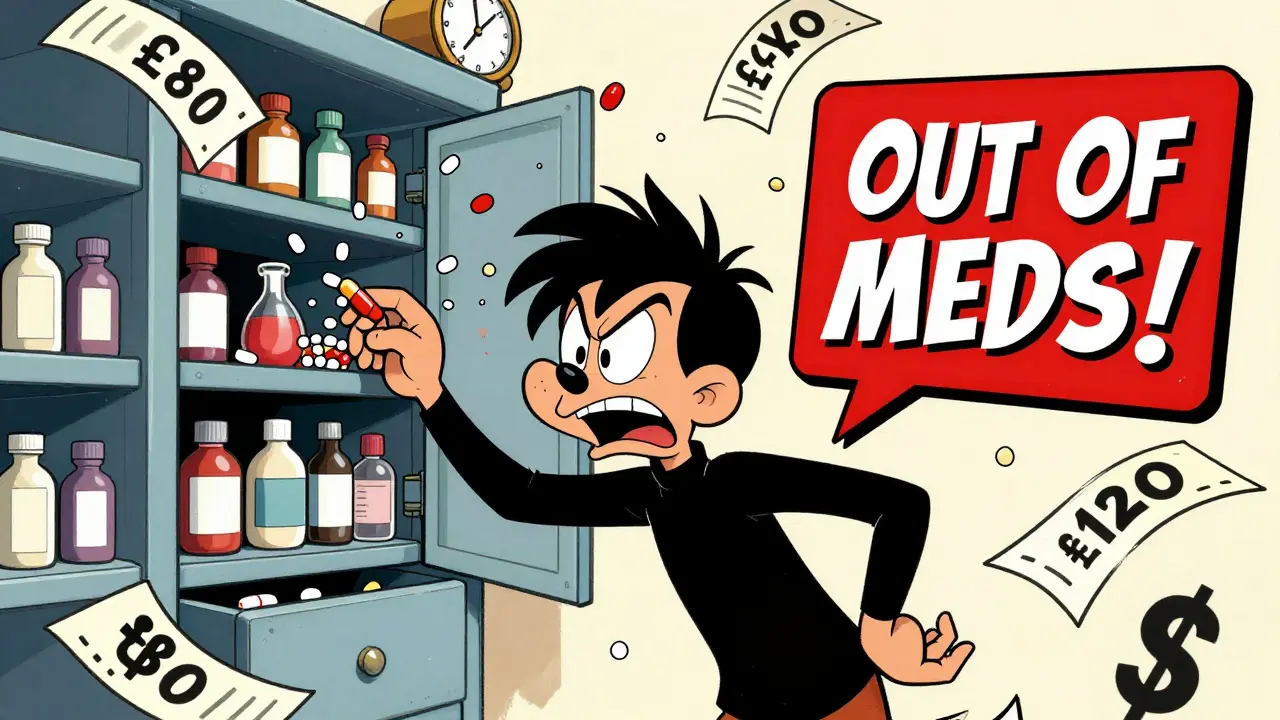
Running out of medication isn’t just inconvenient-it can be dangerous. And if you’re paying out of pocket, seeing your monthly drug costs spike without warning can hurt your budget. The good news? You don’t have to guess or scramble. Setting up a simple medication budgeting system with auto-refill alerts can save you money, reduce stress, and keep you on track with your treatment. This isn’t just for hospitals or big clinics. It works for anyone taking regular prescriptions-especially if you’re managing multiple drugs, chronic conditions, or high-cost specialty medications.
Start by tracking exactly what you’re spending
Before you can budget, you need to know where your money’s going. Write down every prescription you take, how often you refill it, and how much you pay each time. Don’t guess. Look at your pharmacy receipts, your insurance portal, or your bank statements. If you’re on Medicare Part D or private insurance, log in and download your claims history for the last six months. You’ll see patterns: maybe you’re paying £80 for insulin every 30 days, £45 for blood pressure pills every two weeks, and £120 for a specialty drug every 90 days. Add those up. That’s your baseline.Now, break it down by type. Are these medications covered under your insurance? Do you have a copay? Are any of them going generic soon? For example, if your brand-name statin is set to lose patent protection in six months, you could save up to 70% by switching early. Many pharmacies will notify you when generics become available, but you need to ask. Don’t wait for them to reach out.
Choose your tools: apps, pharmacy portals, or manual spreadsheets
You don’t need fancy software to start. But you do need consistency. Here are your three best options:- Pharmacy apps: Boots, Superdrug, and your local pharmacy’s app often let you set refill reminders and track spending. Some even show you how much you’ve saved compared to cash price.
- Spreadsheet: Use Google Sheets or Excel. Columns: Medication Name, Dose, Frequency, Cost per Refill, Next Due Date, Insurance Status. Update it every time you refill. It’s low-tech, but it works-and you own the data.
- Health apps: MyTherapy, Medisafe, or even Apple Health can sync with your prescriptions and send alerts. Some connect directly to your pharmacy’s system to auto-request refills.
Pro tip: If you’re on long-term medication, ask your pharmacist if they offer a repeat dispensing service. In the UK, this lets you collect up to 12 months’ supply without needing a new prescription each time. It cuts down on trips and helps you budget better.
Set up auto-refill alerts that actually work
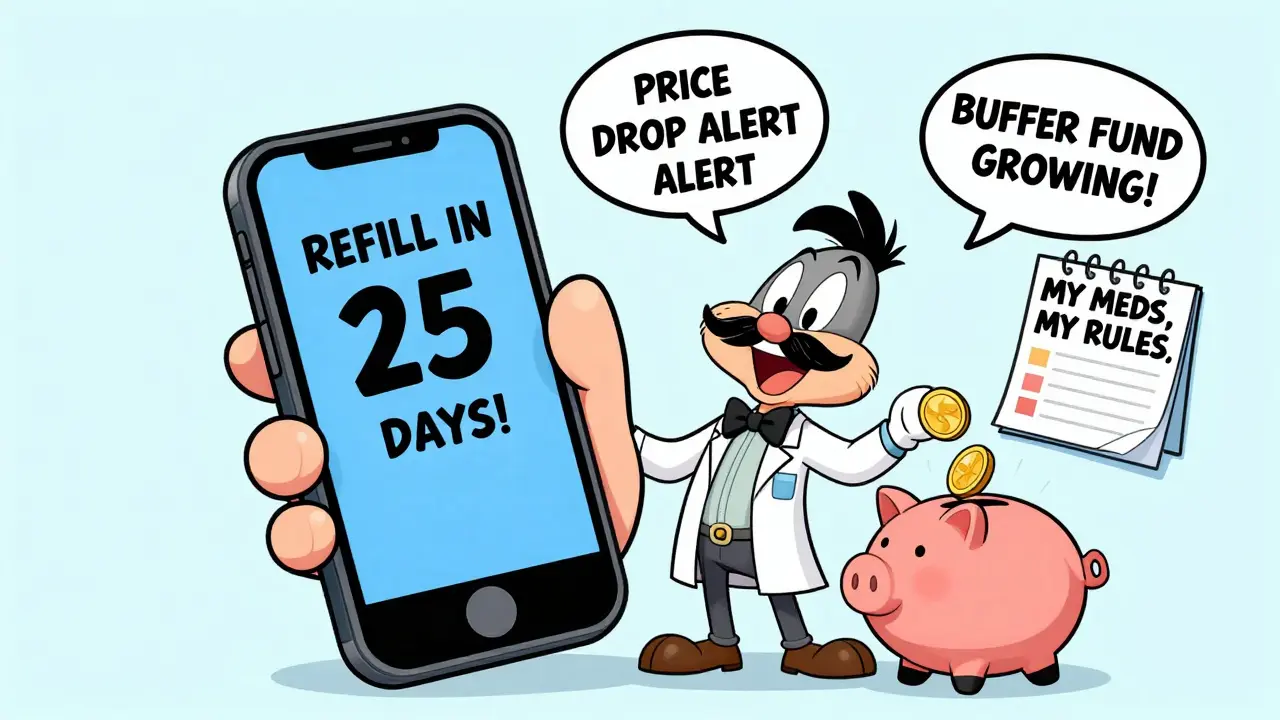
Auto-refill alerts sound simple, but most people set them up wrong. Don’t just pick ‘refill every 30 days.’ That’s too rigid. You might not use your pills at the same rate every month. Instead, set alerts based on your actual usage.Example: You take two pills a day. A 30-day supply is 60 pills. You refill on the 1st. But last month, you ran out on the 25th because you missed a few doses and then doubled up on weekends. So your real cycle is 25 days. Set your alert for 25 days after your last refill. That way, you’re not overstocking or running dry.
Use your pharmacy’s app to set the alert. If they don’t offer it, use a calendar app. Create a recurring event: ‘Refill Lisinopril’ every 25 days. Add a note: ‘Check with GP if cost has changed.’
For high-cost drugs, set two alerts: one at 7 days before refill (to check price), and one at 2 days before (to confirm delivery or pickup). That gives you time to call your insurer or switch to a cheaper alternative if needed.
Build a buffer into your budget
Medication prices don’t stay still. In 2024, the UK saw 12% price increases on 47 essential drugs due to supply chain issues and currency shifts. That’s why your budget needs a cushion. Add 10-15% to your monthly drug spending total. That’s your safety net.For example, if your meds cost £210 a month, budget £240. That £30 covers:
- A price hike on your asthma inhaler
- Emergency replacement if you lose a bottle
- Switching to a cheaper generic mid-month
When you have leftover money at the end of the month, don’t just spend it. Roll it into a ‘medication emergency fund.’ Even £20 a month adds up to £240 a year. That’s enough to cover a surprise co-pay or a non-covered drug.
Watch for hidden costs and waste
It’s easy to think your only cost is the prescription price. But there are others:- Delivery fees: Some pharmacies charge £3-£5 for home delivery. If you’re refilling monthly, that’s £36-£60 a year. Pick up in person if you can.
- Unused meds: If you’ve got expired or unopened bottles in your cabinet, you’re wasting money. Return them to your pharmacy for safe disposal. Some even offer credit for unopened sealed packages.
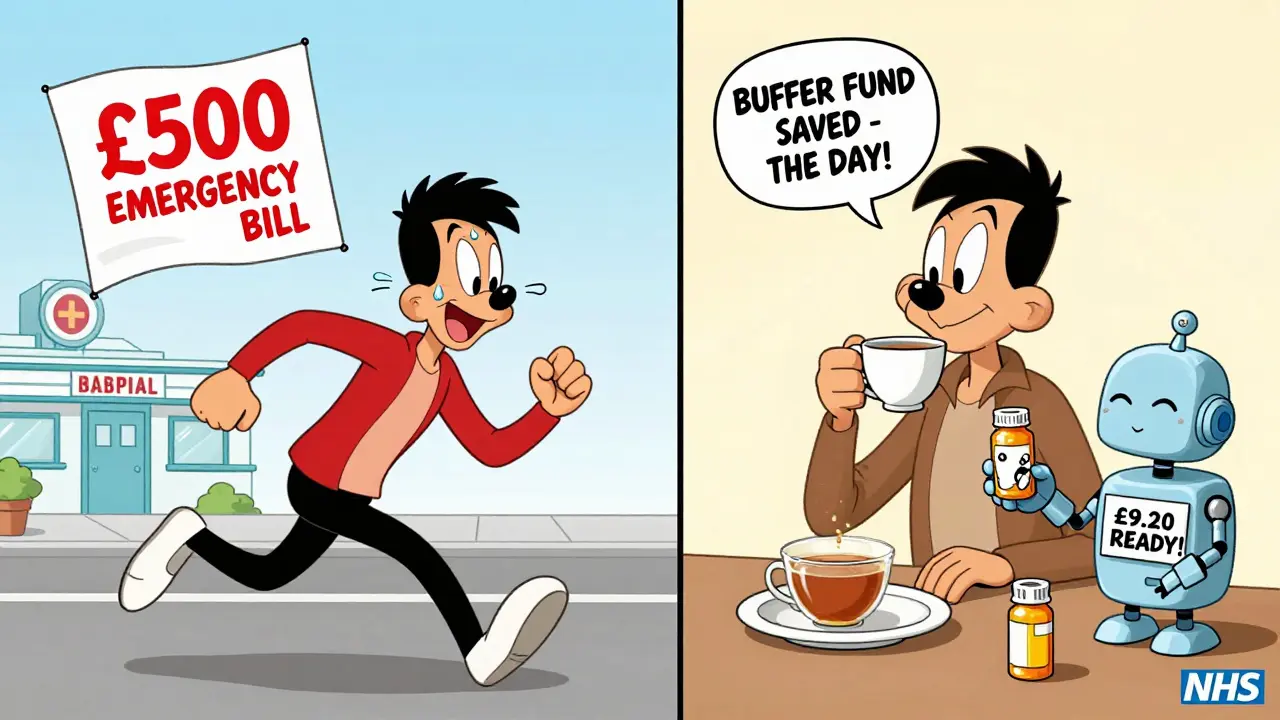
- Emergency visits: Skipping a dose because you ran out? That could land you in A&E. A £120 prescription that’s not refilled might cost £500 in emergency care.
One patient in Bristol saved £800 in a year just by tracking when their blood thinner was running low. They caught a 3-day gap before it hit zero and called their GP. No hospital trip. No bill.
Connect your system to your doctor and pharmacist
Your budgeting system only works if it’s aligned with your care team. Tell your GP or pharmacist you’re setting up a refill and budget plan. Ask:- ‘Can you flag any upcoming price changes on my meds?’
- ‘Is there a therapeutic alternative that’s cheaper but just as effective?’
- ‘Can you send refill reminders directly to my phone?’
Many practices now use systems like EMIS or SystmOne that sync with pharmacy networks. If yours does, you can get automated alerts that say: ‘Your Metformin refill is ready. Cost: £9.20. Next due: 12/04/2026.’
Don’t be shy. Pharmacists are trained to help you save money. In 2023, NHS pharmacists in England saved patients over £1.2 billion through smarter prescribing and substitution.
Review every three months
Your needs change. So should your budget.Every quarter, sit down with your spreadsheet or app and ask:
- Did I refill all my meds on time?
- Did any prices go up? Any new generics?
- Did I pay for anything I didn’t use?
- Is my buffer still enough?
If you started a new medication, added a dose, or stopped one-update everything immediately. Outdated data is worse than no data.
One man in Bristol adjusted his budget after his diabetes meds were switched from a branded version to a generic. He saved £45 a month. He didn’t know until he checked his receipt. Now he checks every refill.
What if you can’t afford your meds?
If your budget is tight and you’re skipping doses, you’re not alone. In 2024, 1 in 5 UK adults reported cutting pills to save money. But there are options:- Prescription Prepayment Certificate (PPC): If you need more than 3 prescriptions a month, a 3-month PPC (£30.25) or 12-month PPC (£111.60) covers unlimited prescriptions. It pays for itself fast.
- Low Income Scheme: If you’re on benefits or have low income, you may qualify for free prescriptions. Apply via the NHS website.
- Charities: Organizations like Turn2us and the British Heart Foundation offer grants for medication costs.
Never stop taking your meds because of cost. Talk to your pharmacist first. They know the options.
Can I set up auto-refill alerts without a smartphone?
Yes. Many pharmacies offer phone-based refill services. Call your pharmacy and ask to be enrolled in their automated refill reminder system. They’ll call or text you when your prescription is ready. Some even mail refill slips. You don’t need an app-just a phone number.
Do auto-refill alerts work with NHS prescriptions?
Yes. NHS prescriptions are fully supported by most pharmacy systems. When you register with a pharmacy, you can opt into automatic refills. Your GP’s electronic prescription service (EPS) sends the refill request directly to the pharmacy. You’ll get a text or call when it’s ready. Just make sure your contact details are up to date with both your GP and pharmacy.
What if my medication price changes after I’ve budgeted?
That’s why you have a buffer. If the price jumps, check if a cheaper generic is available. Ask your pharmacist to suggest alternatives. If you’re on a fixed income, ask about the Prescription Prepayment Certificate or the NHS Low Income Scheme. Never assume the price won’t change-plan for it.
How often should I update my medication list?
Update it every time you get a new prescription, stop one, or change the dose. At minimum, review your full list every three months. Keep it in your wallet or phone. In an emergency, having an accurate list can save your life.
Are there free tools to track medication costs in the UK?
Yes. The NHS App lets you view your prescription history and costs. You can also use free Google Sheets templates designed for UK medication tracking. Some pharmacies like Boots and Lloyds offer free spending summaries in their apps. You don’t need to pay for anything to get started.
Next steps: Start small, stay consistent
You don’t need to overhaul everything tomorrow. Pick one medication. Track its cost for a month. Set one auto-refill alert. Check your spending at the end of the month. That’s it. Do that for one more next month. Soon, you’ll have a system that works for you.Medication budgeting isn’t about being perfect. It’s about being aware. When you know what you’re spending and when you’ll need your next refill, you stop living in fear of running out-or running out of money.
The goal isn’t to spend less for the sake of it. It’s to spend wisely. So your health doesn’t suffer because your wallet did.

Brandon Boyd
December 31, 2025 AT 17:32This is the kind of practical advice we need more of. I used to panic every time my insulin ran low, but after setting up auto-refills in my pharmacy app and tracking costs in a Google Sheet, I’ve saved over $300 in six months. No more late-night pharmacy runs or surprise bills. It’s not glamorous, but it’s life-changing.
Start with one med. Just one. You don’t need to fix everything today.
Emma Hooper
January 2, 2026 AT 12:41Oh honey, you’re telling me you didn’t know you were overpaying for your statin because you didn’t ask if a generic was available? 🙃
Look, I’m not judging-just saying, if your pharmacist doesn’t volunteer cost-saving tips, you’re doing it wrong. Pharmacies make bank on brand-name inertia. Wake up. Ask. Switch. Save. It’s not magic, it’s basic math.
Martin Viau
January 3, 2026 AT 16:15Let’s be real-this whole system assumes you have stable internet, a smartphone, a pharmacy that actually gives a damn, and the cognitive bandwidth to track refill cycles. What about the elderly? The disabled? The people who can’t afford a data plan?
US healthcare is a circus, and this post is just another clown waving a spreadsheet like it’s a magic wand. Real people don’t live in spreadsheets. They live in the real world where $45 for a pill is a moral crisis.
Marilyn Ferrera
January 5, 2026 AT 03:37Track. Alert. Buffer. Review. That’s it. Four steps. No app needed. No complexity. Just discipline.
And yes-the buffer is non-negotiable. Prices shift. Life happens. Plan for chaos. You’re not being paranoid; you’re being responsible.
Robb Rice
January 5, 2026 AT 21:52Thank you for this. I’ve been meaning to organize my meds for months, and this gave me the push. I’m using the NHS App to track my prescriptions now-free, reliable, and it even shows me how much I’ve saved compared to cash prices.
Small wins matter. I’ve already caught a $12 overcharge on my metformin. Took me 2 minutes to call and fix it.
Harriet Hollingsworth
January 6, 2026 AT 16:45People are skipping doses because they can’t afford meds? That’s not a budgeting problem-that’s a national disgrace.
And you’re telling them to use a spreadsheet? Like that’s going to fix the fact that insulin costs $300 in this country? This isn’t advice-it’s victim-blaming wrapped in bullet points.
Deepika D
January 7, 2026 AT 10:30Let me tell you, as someone who’s managed diabetes, hypertension, and anxiety meds for over a decade across three countries, this is the most practical guide I’ve seen in years.
Start with one medication. Yes, just one. I started with my blood pressure pill-tracked the cost, set a calendar alert for 28 days (not 30, because I sometimes missed doses), and then asked my pharmacist about generics. Saved me $50/month.
Then I added my insulin. Then my anxiety med. Now I have a color-coded spreadsheet with icons for ‘price spike’, ‘generic available’, and ‘emergency buffer used’. I even showed my mom how to do it, and she’s 72 and uses an iPhone like it’s a toaster.
And the buffer? Oh my god, the buffer. Last month, my inhaler price jumped $18. I didn’t panic. I had $25 in my med emergency fund. I didn’t skip a dose. I didn’t cry. I just paid it and moved on.
Don’t wait for a crisis. Start today. One pill. One alert. One dollar saved. It adds up. You’re not just managing meds-you’re reclaiming your peace.
And if you think this is too much work? Imagine explaining to your doctor why you ended up in the ER because you ran out of your blood thinner. That’s the real work. This? This is just smart living.
Stewart Smith
January 9, 2026 AT 03:18So… you’re telling me the solution to the healthcare crisis is… a Google Sheet?
Chill. I’m not saying it’s bad advice. I’m just saying if your life is so fragile that a $120 pill can break you, maybe the problem isn’t your budgeting-it’s the system.
Still… I did set up my auto-refill for my thyroid med. It’s nice not to panic. So… thanks? I guess.
Retha Dungga
January 10, 2026 AT 15:26Bro… just use the NHS app 🤷♀️📱💸
And if you can’t afford it… cry into your generic pills 😭💊
But hey… at least you’re not dead 🙏
Also… buffer = life insurance for your wallet 💪
Jenny Salmingo
January 10, 2026 AT 23:01I’m from the Philippines, and I just shared this with my sister who’s on insulin here. She didn’t know about the Prescription Prepayment Certificate-but she’s now talking to her pharmacist about it. Small things, right?
It’s not just about money. It’s about dignity. You deserve to take your meds without fear.
Aaron Bales
January 11, 2026 AT 12:33Pharmacy apps are great-but if your local CVS doesn’t offer auto-refill, call them. Ask for the manager. Say, ‘I want to enroll in your refill program.’ Nine times out of ten, they’ll set it up manually.
Don’t let tech barriers stop you. Just ask.
Lawver Stanton
January 12, 2026 AT 18:51Okay, so you want me to track every single pill I take, set calendar alerts, build a buffer fund, and then check in every three months like I’m running a Fortune 500 budgeting division?
Meanwhile, my neighbor’s kid is getting free insulin through a nonprofit because her mom cried at the pharmacy counter.
This isn’t empowerment. This is guilt-tripping people into becoming healthcare administrators because the system failed them.
I’m not mad. I’m just… tired.
And yes, I skipped my last refill because I was afraid to open the bill. So… yeah. I’m the problem. I get it.
Sara Stinnett
January 14, 2026 AT 03:14Let’s be honest-this entire framework is a capitalist fantasy designed to make you feel like you’re in control while the pharmaceutical industry laughs all the way to the bank.
‘Oh, just switch to a generic!’-as if generics are always available, always covered, always safe.
‘Build a buffer!’-sure, if you’re making $80k and not living paycheck to paycheck.
And let’s not forget the ‘call your pharmacist’ advice. Great. Because pharmacists are paid to care about your financial well-being, not to meet quarterly sales targets for brand-name drugs.
This isn’t advice. It’s a performance of responsibility for people who can’t afford to be irresponsible.
Meanwhile, insulin still costs $300.
Keep track of your spreadsheets. I’ll be over here, fighting for systemic change.
linda permata sari
January 15, 2026 AT 02:51I’m from Indonesia, and my mom takes five meds. She doesn’t have a smartphone. She doesn’t speak English. But she has a little notebook. Every refill. Every cost. Every date.
She showed me last week. I cried.
This post? It’s beautiful. Because it’s not about tech. It’s about remembering. About paying attention. About loving yourself enough to write it down.
Thank you.
Branden Temew
January 15, 2026 AT 11:37If you’re tracking your meds to avoid running out… what are you really avoiding?
Is it the cost? The fear? The shame?
This system works-but only if you’re willing to sit with the discomfort of admitting you’re vulnerable.
And that’s the real challenge.
Not the spreadsheet.
The silence you break when you finally say, ‘I need help.’