

Most people assume that if two drugs have the same active ingredient, they are identical. But have you ever switched generic brands and suddenly felt nauseous or developed a rash, even though the dose was exactly the same? The culprit usually isn't the medicine itself, but the inactive ingredient interactions is the cumulative effect of non-therapeutic substances, known as excipients, when multiple generic medications are taken together. While these fillers and binders don't treat your condition, they can trigger reactions when they pile up in your system.
The Hidden Load of Excipients
When you swallow a pill, you aren't just taking the active drug. You're taking fillers, binders, lubricants, and preservatives. These are collectively known as excipients, which are pharmacologically inactive substances formulated into a medication to stabilize the drug, aid manufacturing, or make the pill easier to swallow. For most of us, these are harmless. However, for those taking a handful of pills a day, the math changes.
Consider the scale of exposure. A study published in PubMed Central (PMC7122736) found that a patient taking 10 different prescription medications ingests an average of 2.8 grams of inactive ingredients every single day. If you're taking three different generic drugs that all use the same filler, you're not just getting that filler once-you're getting a triple dose. This cumulative exposure can push a patient past their biological tolerance threshold, leading to symptoms that look like a drug side effect but are actually a reaction to the "inactive" parts of the formula.
Why Generics Differ in the Details
You might wonder why the same drug varies between manufacturers. Under the Hatch-Waxman Act, generic manufacturers must prove bioequivalence-meaning the active drug reaches the bloodstream at a similar rate and concentration as the brand name-but they aren't required to use the same inactive ingredients. This creates a wild variety of formulations. For instance, the FDA's Inactive Ingredient Database once listed 27 different combinations of fillers for generic versions of levothyroxine sodium tablets alone.
This variability becomes a problem when patients switch generics frequently or combine multiple products from different labs. Because each manufacturer picks its own "recipe" for binders and dyes, you might be fine with Generic A, but Generic B could contain a substance your body dislikes. When you combine A, B, and C, you're essentially running a chemistry experiment in your gut.
| Excipient | Typical Use | Potential Risk/Interaction | Affected Population |
|---|---|---|---|
| Lactose | Filler/Binder | GI distress, bloating | ~65% global population |
| Propylene Glycol | Solvent | Metabolic acidosis (rare/high dose) | Found in 46% of oral liquids |
| Tartrazine (Yellow 5) | Coloring Agent | Hives, anaphylaxis | ~4% of patients |
| Bisulfites | Preservative | Bronchospasms | 5-10% of asthmatics |
Real-World Impact: From Gut Issues to Treatment Failure
The risk isn't just about allergies; it's about how these ingredients change how your body processes the medicine. While the FDA generally maintains that excipients don't affect safety, some evidence suggests otherwise. Research indicates that variations in inactive ingredients can cause a 15-20% difference in peak plasma concentration for certain antiepileptic drugs. If you're taking a medication with a narrow therapeutic index-where a tiny change in blood level can mean the difference between a working dose and a toxic one-these "inactive" ingredients suddenly matter a lot.
Many patients experience this as "unexplained" symptoms. In the FDA Adverse Event Reporting System (FAERS), nearly half of the reports related to excipients cited unexpected gastrointestinal distress. A common scenario occurs with polypharmacy, where patients taking multiple generics each containing small amounts of lactose suddenly develop severe digestive issues, despite having tolerated each individual medication in the past. This is the classic "cumulative effect" where the sum of the parts creates a new problem.

How to Identify and Manage Excipient Risks
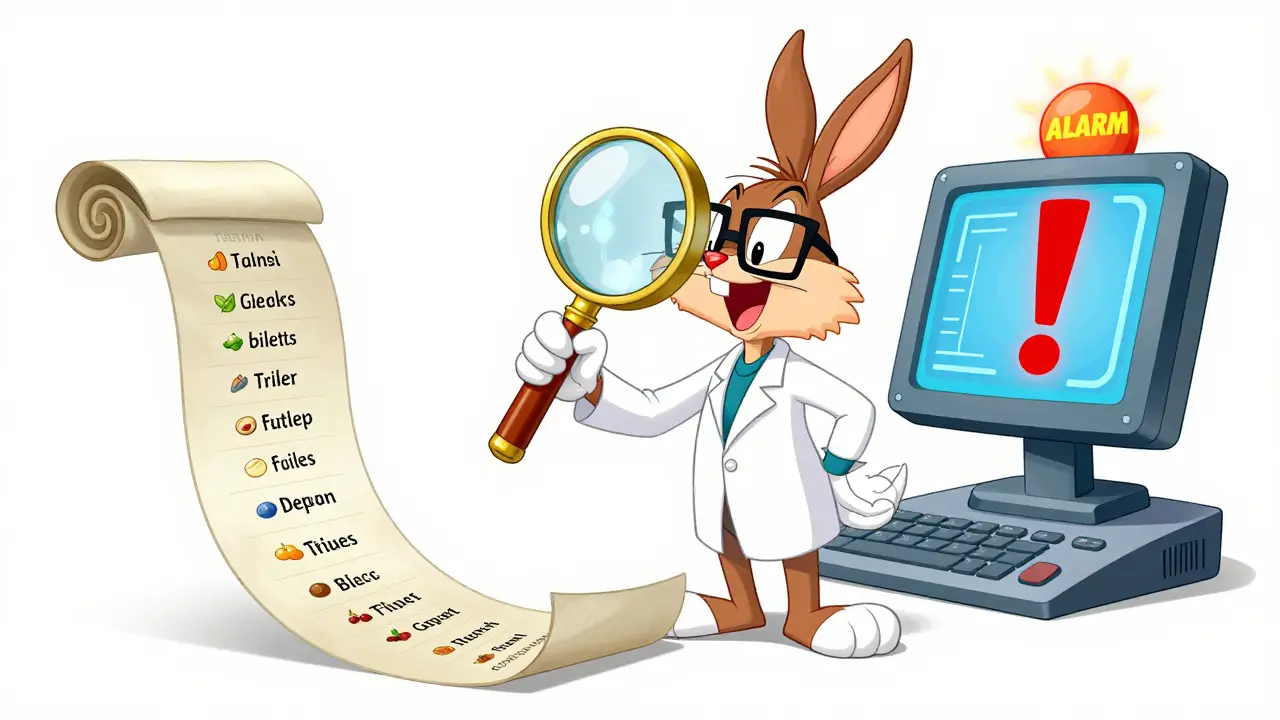
If you're managing a complex medication regimen, you can't just trust the "Active Ingredients" label. You need a strategy to audit what's actually in your pills. Pharmacists typically follow a three-step process to mitigate these risks:
- NDC Lookup: Use the National Drug Code (NDC) to find the exact manufacturer of your generic. This is crucial because "Generic Lisinopril" from Company X is chemically different from "Generic Lisinopril" from Company Y.
- Cumulative Calculation: List every inactive ingredient across all daily medications. If you see lactose in four different pills, add up the milligrams.
- Threshold Comparison: Compare that total against known sensitivity levels. For example, while some lactose-intolerant people can handle 12g of lactose a day, highly sensitive individuals may react to as little as 1-2g.
To do this, professionals rely on tools like DailyMed, a database provided by the National Library of Medicine, or the FDA's Inactive Ingredient Database. However, this isn't always easy. Only about 63% of medication package inserts fully disclose all inactive ingredients, meaning sometimes you have to call the manufacturer directly-a process that can take several business days.
The Future of Ingredient Transparency
The industry is slowly moving toward better disclosure. The FDA's "Inactive Ingredient Transparency Initiative" aims to require all manufacturers to list every inactive ingredient in digital labeling by the end of 2025. We're also seeing the rise of AI-powered tools like MedCheck AI, which can scan multiple prescriptions and flag potential excipient clashes with nearly 90% accuracy.
In Europe, the European Medicines Agency (EMA) has already pushed for stricter justifications when manufacturers use excipients known to cause hypersensitivity in more than 0.1% of the population. This proactive approach suggests that the era of "invisible" ingredients may be coming to an end, replaced by a more transparent system that prioritizes patient safety over manufacturing convenience.
Are generic drugs less safe because of inactive ingredients?
No, generic drugs are not inherently "less safe." The active ingredients are chemically identical to brand-name drugs. However, because the inactive ingredients (fillers, dyes, binders) vary by manufacturer, people with specific allergies or sensitivities may react to one generic brand but not another, or react when taking several different generics together.
Can inactive ingredients actually change how a drug works?
In most cases, no. But for medications with a "narrow therapeutic index" (where small dose changes have big effects), excipients can slightly alter the absorption rate. This has been documented in some antiepileptic drugs, where peak blood levels varied by 15-20% between different formulations.
How do I know if my generic medication has a problematic filler?
Check the "Inactive Ingredients" section of the drug facts label or the package insert. If you have a known allergy (like to lactose, gluten, or specific dyes), you can use the DailyMed database or ask your pharmacist to check the NDC-specific formulation for you.
What is a "cumulative effect" in medication?
A cumulative effect happens when you take multiple medications that each contain a small amount of the same inactive ingredient. While one pill's amount of a filler might be harmless, the total amount from five different pills might exceed your body's ability to tolerate that substance, triggering a reaction.
Should I ask my doctor to stick to one specific generic brand?
If you are sensitive to certain fillers or are taking medications where precise blood levels are critical, yes. Requesting a "dispense as written" or specifying a preferred manufacturer can prevent the fluctuating absorption rates and allergic reactions that sometimes happen when pharmacies switch generic suppliers.
Next Steps for Patients and Caregivers
If you suspect your medications are causing a reaction, don't stop taking them abruptly, but do take these steps:
- Audit Your Cabinet: Gather all your current prescriptions and look for recurring inactive ingredients like lactose, cornstarch, or specific dyes.
- Talk to Your Pharmacist: Ask them to check for "cumulative excipient exposure," especially if you are on more than five medications.
- Track the Changes: If your pharmacy changes the look of your pill (different color or shape), it's a sign the manufacturer has changed. Note any new symptoms that appear after a switch.
Lawrence Rimmer
April 5, 2026 AT 01:52The absolute audacity of assuming a label is enough... It's just a reflection of the systemic laziness we accept in modern medicine. Why do we pretend that a 'generic' is a clone when it's clearly just a cheap imitation of a concept?
Hudson Nascimento Santos
April 5, 2026 AT 21:24It is fascinating how we treat the body as a machine where only the active gear matters, ignoring the oil and the rust. The excipient is the unseen shadow of the drug, and we are only now acknowledging that the shadow has a weight of its own.
simran kaur
April 7, 2026 AT 13:42Of course they only disclose 63% of the ingredients. They're hiding the real stuff from us to keep the population docile and dependent on the 'pharmaceutical cycle' while we just blindly trust these so-called databases. It's all a game to see how much junk we can tolerate before we break.
Brian Shiroma
April 8, 2026 AT 19:25Oh great, so now I have to spend my weekends doing an NDC lookup just to make sure my blood pressure meds don't give me hives. Truly a peak moment for healthcare efficiency.
Mark Zhang
April 9, 2026 AT 10:21I totally get how overwhelming this feels for anyone managing a lot of meds. Maybe we can start a thread where people share which pharmacists are actually helpful with the NDC lookup process so others don't have to struggle alone.
sophia alex
April 10, 2026 AT 19:33Imagine living in a country where you actually have to do your own research because the system is this broken! 🙄 This is absolutely pathetic and frankly an insult to the intelligence of the American consumer! 💅✨
Divine Manna
April 11, 2026 AT 11:13One must understand that the pursuit of bioequivalence is a reductionist approach to pharmacology. It prioritizes the destination-the plasma concentration-while utterly disregarding the journey the substance takes through the gastrointestinal tract. To ignore the additive effect of excipients is not merely an oversight; it is a failure of intellectual rigor in the regulatory framework.
The Charlotte Moms Blog
April 12, 2026 AT 05:13Absolute madness!!!! Who is letting this happen...??? My kids can't just be chemistry experiments!!!! This is literally criminal behavior by these companies!!!!
Jenna Carpenter
April 13, 2026 AT 19:09you guys just need to clean up your diet first. most of these reactions happen cuz your gut is already a mess from processed foods. stop blaming the pills and start blaming the sugar.
Hope Azzaratta-Rubyhawk
April 14, 2026 AT 15:16We must demand total transparency from these manufacturers immediately! It is completely unacceptable that patients are left to perform their own forensic audits of medication labels!
Rachelle Z
April 15, 2026 AT 14:43Wow, I love how we just 'hope' the AI handles it with 90% accuracy... 🙃 because who doesn't love a 10% chance of a medical disaster??? Just wonderful!!!! 🌸🌈
Dipankar Das
April 16, 2026 AT 02:43You must realize that this information is a powerful tool for patient empowerment! We shall overcome these systemic hurdles by educating ourselves and holding the providers to a higher standard of care through rigorous demand for quality!
Ace Kalagui
April 17, 2026 AT 22:39I remember when I first started helping my community navigate the local clinic, we noticed that people from different backgrounds often had very different reactions to the same generic batches, which really highlights why this kind of detailed audit is so important for everyone involved regardless of where they are from or what they believe in, and I truly think if we just work together and talk to our pharmacists with patience, we can make the whole process much smoother for the elderly who can't use the digital databases themselves.