
There is no such thing as a single "international patent" that lasts forever across the globe. If you think filing one application protects your invention everywhere for a set time, you are setting yourself up for expensive mistakes. The reality is far more fragmented. While most countries follow a standard 20-year rule, the clock starts ticking at different moments, pauses for different reasons, and stops abruptly if you miss a bill. Understanding these timelines is not just legal homework; it is the difference between keeping a monopoly on your drug or losing it to generics while you are still paying off R&D costs.
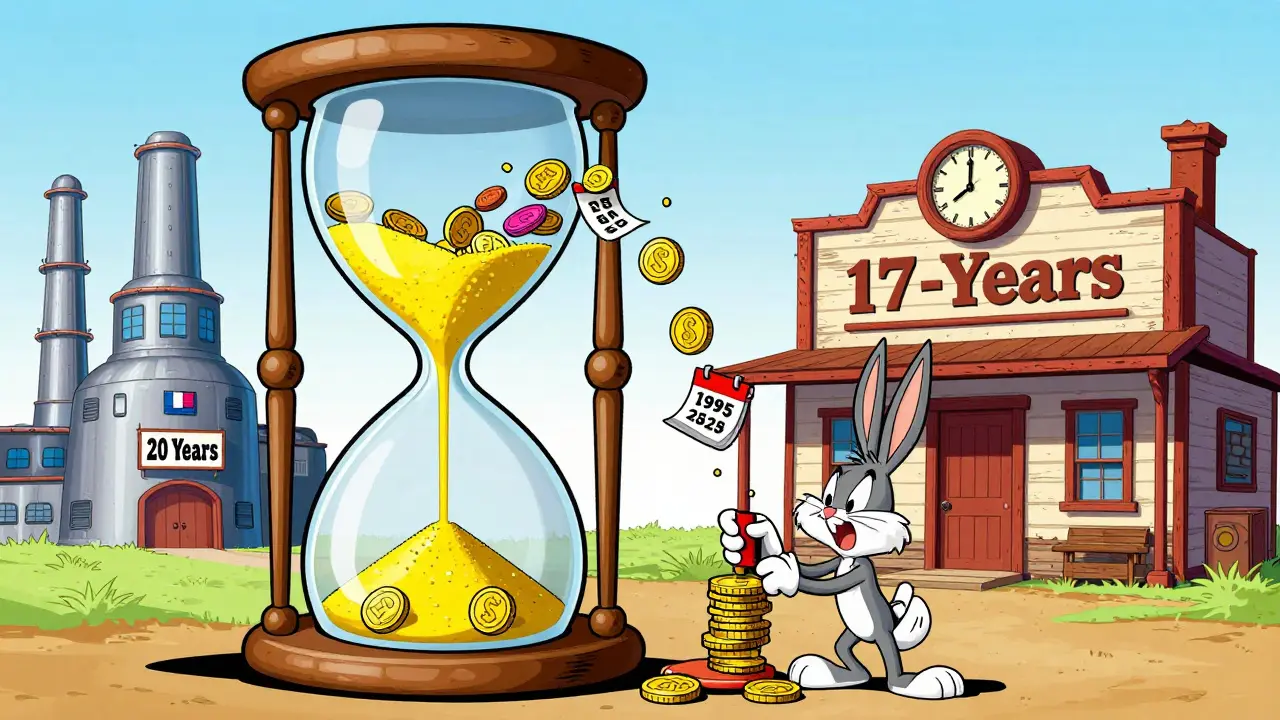
The global landscape changed drastically on January 1, 1995. Before this date, patent terms were a wild west of varying lengths. The United States, for example, granted patents for 17 years from the date they were issued. This meant a slow examination process actually extended your protection period. Today, under the Trade-Related Aspects of Intellectual Property Rights (TRIPS) Agreement administered by the World Trade Organization (WTO), virtually all major economies adhere to a 20-year term counted from the filing date. This shift moved the risk from the patent office’s speed to the applicant’s strategy. You now have less time to recoup investments because the clock starts when you hit submit, not when you get approval.
The Core Rule: 20 Years From Filing
The baseline for modern patent law is simple in theory but tricky in practice. In the US, Europe, Japan, China, and Canada, a utility patent expires 20 years from the earliest non-provisional filing date. However, "filing date" is a specific legal concept. It usually refers to the priority date established under the Paris Convention. This convention allows you to file in one country and then claim that same date for filings in other member nations within 12 months. This priority date becomes the anchor for your 20-year lifespan worldwide.
If you file a provisional application in the US first, that date counts toward the 20 years only if you later convert it to a non-provisional application. But here is the catch: provisional applications themselves do not expire after 20 years because they are not patents. They are placeholders. The actual patent term begins counting from the earliest related non-provisional filing. For patents filed before June 8, 1995, in the US, the old 17-years-from-issue rule still applies if it results in a longer term. This creates a strange hybrid system where older patents might outlive newer ones simply due to when they were filed.
Extensions and Adjustments: Getting More Time
A raw 20-year term often feels insufficient for industries with long regulatory hurdles, particularly pharmaceuticals. A drug might spend 10 years in development and another 5 years waiting for FDA or EMA approval. By the time it hits the market, only 5 years of patent life remains. To address this, many jurisdictions offer extensions.
| Region | Mechanism | Max Extension | Key Condition |
|---|---|---|---|
| United States | PTE / PTA | Up to 5 years (PTE) | Regulatory delay (Hatch-Waxman) |
| Europe (EEA) | SPC | 5 years + 6 months | Marketing Authorization delay |
| Japan | Extension | Up to 5 years | Regulatory approval > 1 year |
| China | Compensation | Up to 5 years | New drugs/exam delays |
| India | None | 0 years | No extension available |
In the United States, two distinct mechanisms exist. Patent Term Adjustments (PTAs) compensate for USPTO delays during examination. If the office takes too long to grant the patent, they add days back to the term. On average, the USPTO granted about 558 days of PTA per patent in 2022. Patent Term Extensions (PTEs) under the Hatch-Waxman Act compensate for FDA review time. These can add up to five years, but the total patent life cannot exceed 14 years after marketing approval. This cap prevents perpetual monopolies.
Europe uses Supplementary Protection Certificates (SPCs). These are not patents but certificates attached to the patent. They extend protection for up to five years, plus an additional six months if pediatric studies were conducted. This system is harmonized across European Economic Area countries, making it easier to manage than national-by-national extensions. Japan and China have recently introduced similar compensation schemes to attract innovation, acknowledging that strict 20-year limits hurt pharma investment.
The PCT Trap: No Global Patent
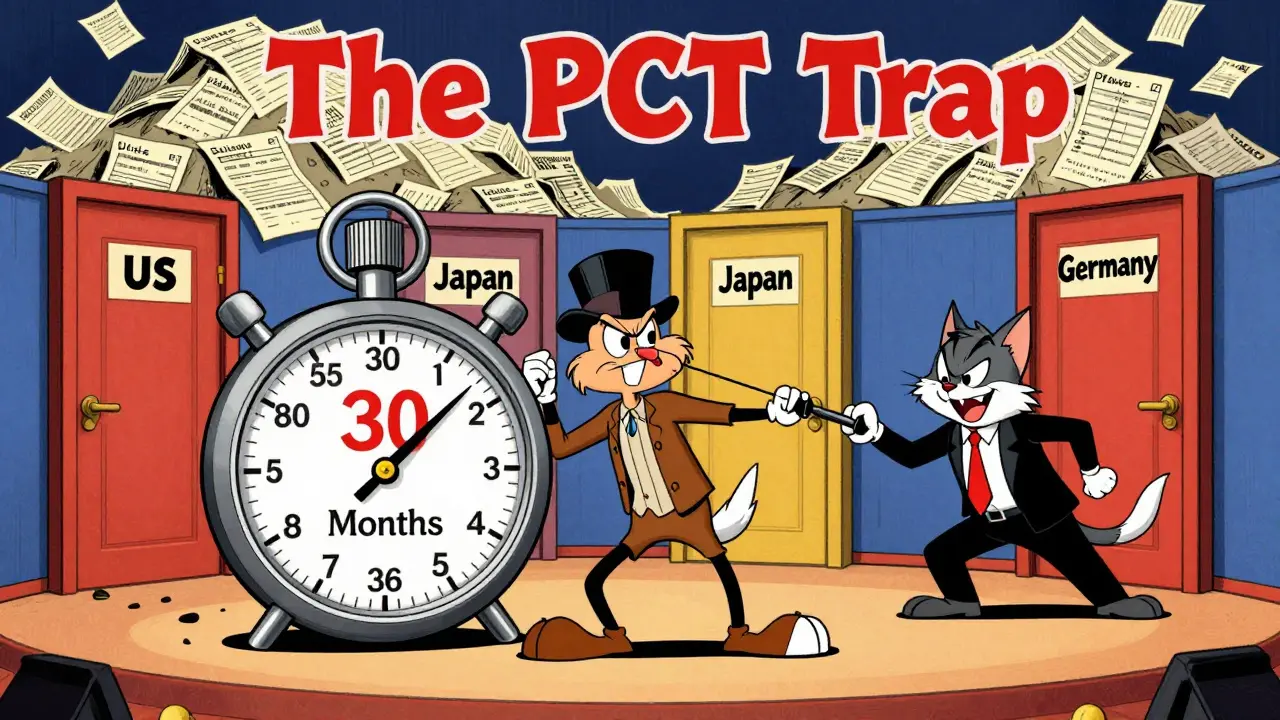
Many inventors misunderstand the Patent Cooperation Treaty (PCT). Administered by WIPO, the PCT is not a route to a single global patent. It is a procedural shortcut. When you file a PCT application, you secure a priority date and defer the massive costs of entering individual national phases. You get an international search report and publication 18 months after filing. Then, you have a window-usually 30 or 31 months from the priority date-to enter the "national phase" in specific countries like the US, Japan, or Germany.
This 30-month window is critical. If you miss the deadline to enter the national phase in a specific country, you lose rights there entirely. There is no automatic global coverage. The US allows entry at 30 months, while Canada, China, and most European countries allow 31 months. Some jurisdictions, like Japan, may grant a short extension with justification, but relying on this is risky. The PCT buys you time to decide where to invest, but it does not stop the clock on your eventual national filings.
Maintenance Fees: The Silent Killer
Your patent will expire early if you forget to pay maintenance fees. This is the most common reason patents lapse before their 20-year anniversary. Every jurisdiction requires periodic payments to keep a patent alive. These fees ensure that companies only maintain patents that are commercially valuable.
In the United States, fees are due at 3.5, 7.5, and 11.5 years after issuance. You have a six-month grace period to pay with a surcharge. Miss that, and the patent dies. Other countries have different schedules. Switzerland requires only one payment at grant. Mexico demands four payments at 5, 10, 15, and 20 years. Brazil has historically struggled with backlog, leading to effective terms shorter than 20 years despite the legal standard. Tracking these deadlines across dozens of countries requires sophisticated IP management software. One missed fee in a key market can mean billions in lost revenue for big pharma firms like Pfizer or Johnson & Johnson.
Utility Models: The Short-Term Alternative
Not all intellectual property needs 20 years of protection. Utility models, also known as "petty patents," are available in about 50 countries, including Germany, China, and Japan. They offer faster, cheaper registration with less stringent novelty requirements. In exchange, the term is much shorter-typically 6 to 10 years from filing. This makes them ideal for incremental improvements or products with short lifecycle curves, like consumer electronics. If you are looking for quick market exclusivity without the burden of high maintenance fees and long examination times, utility models are a strategic alternative to full patents.
Strategic Implications for 2026 and Beyond
As we move through 2026, the divergence in patent laws continues to impact global business strategies. Emerging economies like Indonesia and Vietnam have aligned with the 20-year standard to attract foreign investment. Meanwhile, developed nations refine their extension rules. The EU’s Unitary Patent, implemented in 2023, simplifies enforcement across 17 member states but keeps the same 20-year expiration timeline. This reduces administrative costs but does not change the fundamental race against time.
For researchers and developers, the message is clear. File early to secure your priority date. Use the PCT to defer costs but plan your national phase entries meticulously. Track maintenance fees religiously. And if you are in pharma or medtech, budget for extension applications immediately upon filing. The gap between filing and market launch is shrinking, and every month of lost patent term translates directly into reduced profitability. Do not let a technicality in one jurisdiction erase your global advantage.
How long does a patent last in the US?
For utility patents filed on or after June 8, 1995, the term is 20 years from the earliest filing date. Patents filed before this date last for the longer of 20 years from filing or 17 years from issue. Maintenance fees must be paid at 3.5, 7.5, and 11.5 years to keep the patent active.
Is there such thing as an international patent?
No. There is no single global patent. The Patent Cooperation Treaty (PCT) allows you to file one application to seek protection in over 150 countries, but you must eventually enter the "national phase" in each specific country where you want protection, adhering to their individual laws and fees.
Can patent terms be extended?
Yes, primarily for pharmaceuticals and medical devices. The US offers Patent Term Extensions (PTE) for regulatory delays. Europe offers Supplementary Protection Certificates (SPC) for up to 5 years plus 6 months. Japan and China also offer extensions for regulatory approval delays. India generally does not offer extensions.
What happens if I miss a maintenance fee?
The patent expires immediately. Most countries offer a short grace period (e.g., 6 months in the US) with a late fee, but if you miss that window, the patent lapses and the invention enters the public domain. This is irreversible in most cases.
When does the 20-year clock start?
The clock starts on the "priority date," which is typically the filing date of the earliest non-provisional application. If you file a provisional application first, the 20 years count from the subsequent non-provisional filing that claims priority to that provisional.