
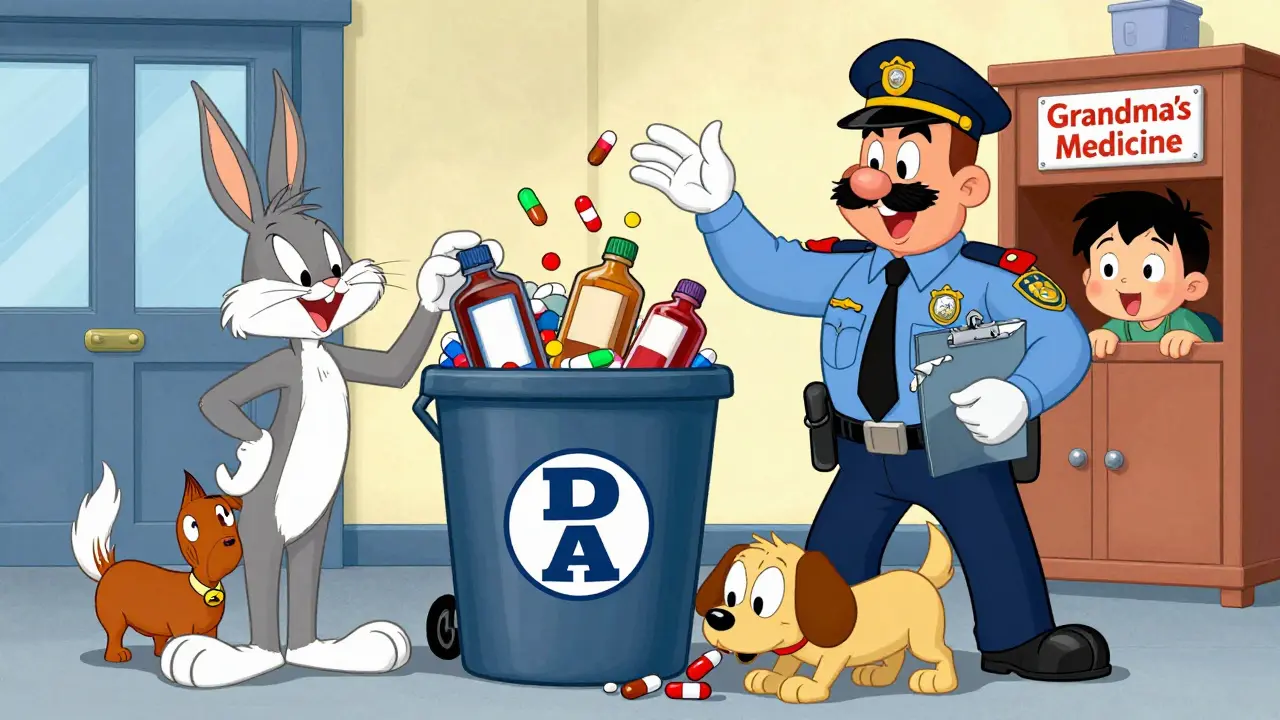
Every year, millions of unused prescription drugs sit in bathroom cabinets, kitchen drawers, and medicine chests across the U.S. Some are old painkillers, others are leftover antibiotics or sleeping pills. They’re not being used, but they’re still dangerous-especially if kids, teens, or pets get into them. That’s why the National Prescription Drug Take-Back Day exists. It’s not a marketing campaign. It’s not a suggestion. It’s a nationwide, law-enforcement-run event designed to get dangerous medications out of homes and into secure disposal systems-no questions asked.
When and Where Does It Happen?
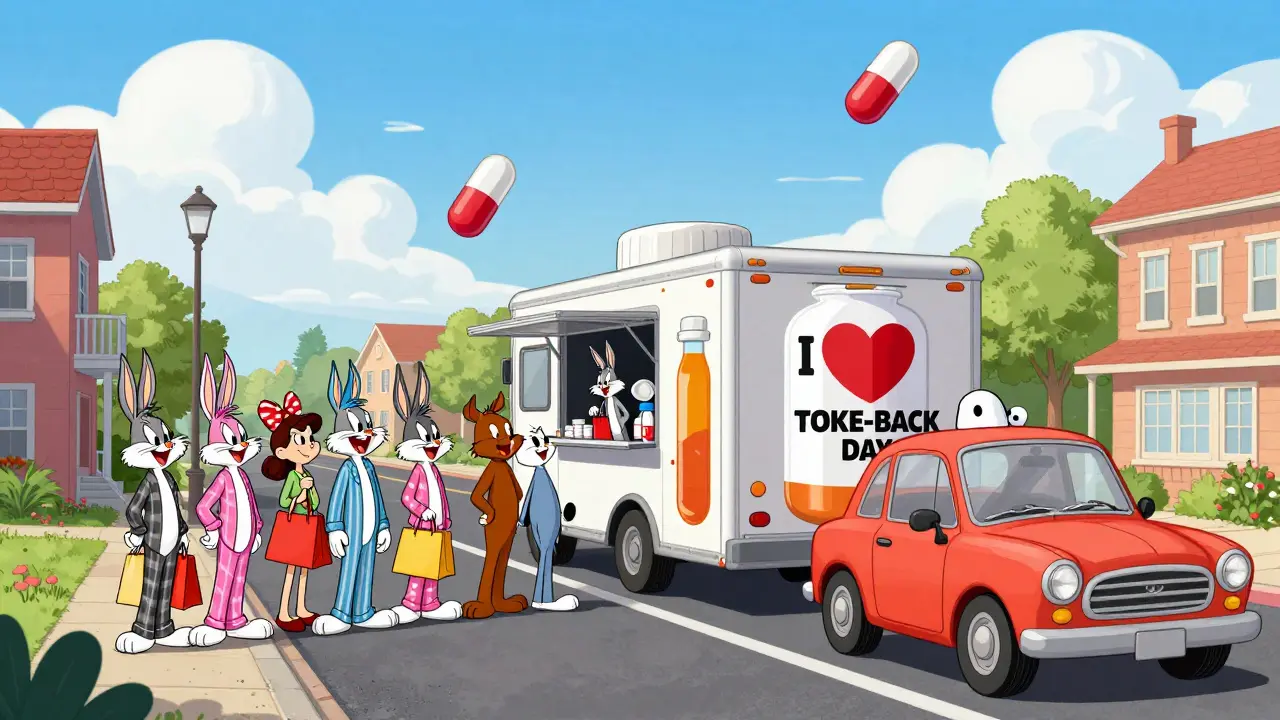
The event happens twice a year: the last Saturday in April and the last Saturday in October. In 2025, the next one is on October 25, from 10 a.m. to 2 p.m. local time. That’s it. Four hours. One day. No extensions. No rain dates. If you miss it, you wait until April next year-or find a permanent drop-off site.There are about 4,500 collection sites across the country. You’ll find them at police stations, sheriff’s offices, hospitals, clinics, and some retail pharmacies. The DEA doesn’t run these sites directly-they partner with local law enforcement. So if you’re in a small town, your nearest site might be the county sheriff’s office. In bigger cities, you might have multiple options: a fire station, a community health center, or even a pharmacy with a locked drop box.
You can find your nearest location by visiting takebackday.dea.gov or using the Dispose My Meds app. Both are updated in real time. Don’t show up somewhere you found on a flyer from last year-sites change. In 2024, over 14,000 permanent drop-off locations were registered with the DEA, but the take-back day is the only time you get a centralized, high-visibility event with law enforcement on-site.
What Can You Bring?
You can drop off almost any prescription medication in solid form:- Pills and capsules
- Transdermal patches (like fentanyl or nicotine patches)
- Oral liquids in sealed original containers (cough syrup, liquid pain relievers)
- Suppositories and inhalers
But here’s what you cannot bring:
- Syringes, needles, or sharps (these require special medical waste disposal)
- Illicit drugs like marijuana, cocaine, or heroin
- Over-the-counter meds (ibuprofen, cold pills, etc.)
- Chemotherapy drugs or radioactive medications
- Empty bottles or packaging
For liquids, keep them in their original containers. Don’t pour them into plastic bags. If the bottle is cracked or leaking, seal it in a zip-top bag first. The DEA doesn’t want spills. Law enforcement officers aren’t trained to handle hazardous leaks-they’re there to collect, not clean up.
What Happens When You Drop Off Your Medications?
You pull up. You get out of your car. You walk up to a table with a DEA badge and a collection bin. You hand over your bag of pills. You don’t need to show ID. You don’t need to explain why you’re getting rid of them. You don’t even need to say anything.That’s the whole point. It’s anonymous. No judgment. No paperwork. No follow-up. The officer takes your bag, puts it in a secure bin, and that’s it. You leave. In under two minutes.
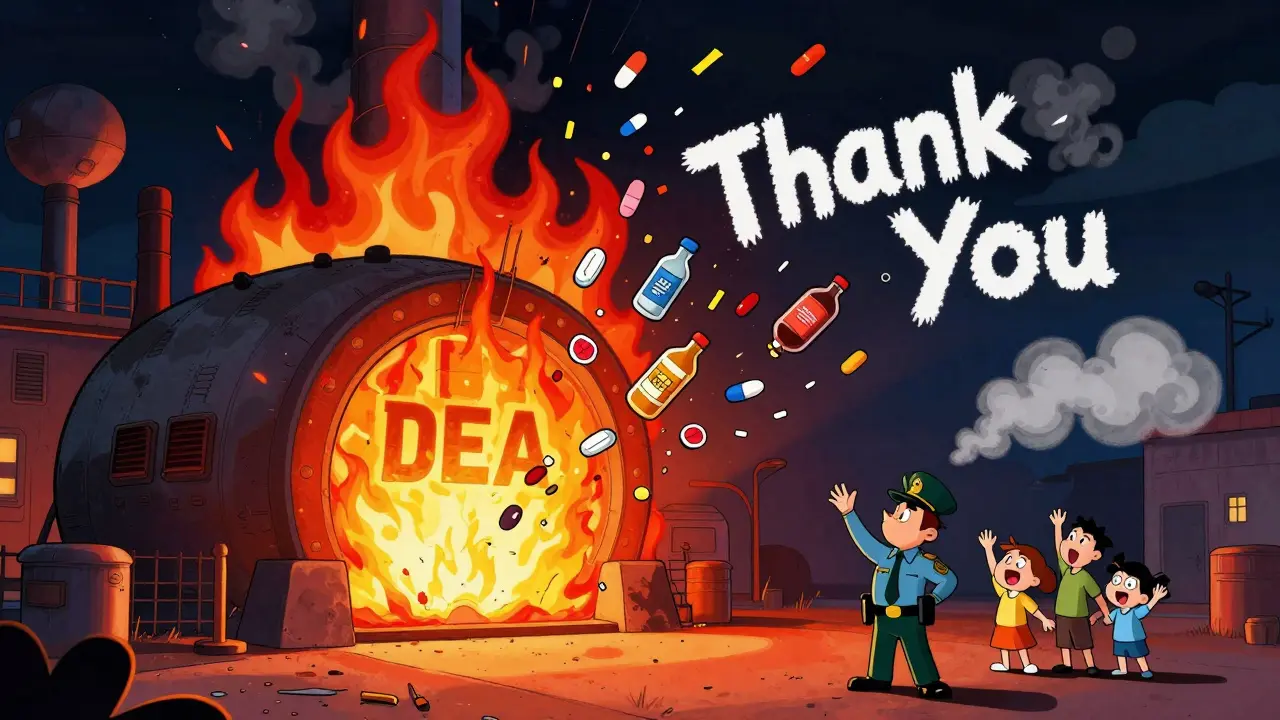
Later, those medications are transported to a federally licensed incineration facility. They’re burned at temperatures over 1,800°F. No landfill. No flushing. No recycling. Nothing gets reused. Everything is destroyed. The DEA tracks every pound collected. In April 2025 alone, they collected 620,321 pounds-over 310 tons-of prescription drugs. Since 2010, that number is nearly 10 million pounds.
Why Does This Matter?
It’s not just about cleaning out your cabinet. It’s about preventing overdose.According to the National Institute on Drug Abuse, 8 million Americans aged 12 and older misused prescription pain relievers in 2024. Most of them didn’t get them from a doctor. They got them from a relative’s medicine cabinet. A teenager finds grandma’s leftover oxycodone. A college student grabs dad’s Adderall to study. A parent accidentally gives their child the wrong dosage because the bottle wasn’t labeled.
That’s why this event works. It removes the temptation. It removes the access. It removes the risk.
And it’s not just about people. Improper disposal-flushing pills down the toilet or tossing them in the trash-contaminates water supplies and harms wildlife. The EPA has documented pharmaceuticals in rivers, lakes, and even drinking water. While the amounts are tiny, they add up. Take-back days stop that at the source.
What If You Can’t Make the Date?
You’re not out of luck. There are over 14,250 permanent DEA-authorized collection sites across the country. These are usually located in pharmacies like CVS, Walgreens, and some hospital pharmacies. They have locked kiosks where you can drop off pills anytime during business hours.As of August 2025, Walgreens and CVS have rolled out permanent kiosks in 1,200 locations. That’s a 300% increase since 2023. If you live near one of these, you don’t need to wait for October. Just check their website for a drop box near you.
But here’s the catch: permanent sites don’t always accept liquids, patches, or inhalers. They mostly take pills and capsules. That’s why the take-back day still matters-it’s the only time you can safely dispose of everything in one place.
What People Say About It
On Reddit’s r/addiction community, users regularly post about their experiences. One user wrote: “Dropped off my mom’s unused opioids at the police station-no questions asked, took 2 minutes, and I know they won’t end up in a teen’s hands.” That sentiment shows up again and again. 92% of people who’ve used the service say they appreciated the anonymity. 78% said the locations were convenient.But complaints are real, too. Nearly half of negative reviews mention the short hours. “I work until 5 p.m. How am I supposed to get there by 2?” Others say rural areas have no sites at all. The DEA is trying to fix that. In 2025, they launched 120 mobile collection units-trailers that travel to towns more than 25 miles from a fixed site. Early data shows rural participation jumped 18% in pilot areas.
What You Should Do Next
If you have unused medications at home, don’t flush them. Don’t throw them in the trash. Don’t leave them where someone else might find them.Here’s what to do:
- Check the DEA’s website or app for the next Take-Back Day date and nearest location.
- Gather all expired, unused, or unwanted prescriptions-pills, patches, liquids in original bottles.
- Remove personal info from bottles if you want, but don’t destroy the labels-staff need to know what they’re collecting.
- Bring them to the site on the day, between 10 a.m. and 2 p.m.
- Walk away knowing you’ve done something real to protect your family and your community.
And if you can’t make the date? Find a permanent drop-off site. Ask your pharmacist. Check your local health department’s website. Do it now. Don’t wait.
Why This Isn’t Just a One-Day Thing
The take-back day is a powerful tool-but it’s not a complete solution. Only 19% of unused medications are properly disposed of, according to the American Society of Addiction Medicine. That means 81% are still sitting in homes, in bathrooms, or worse-flushed down toilets.That’s why the DEA is testing new systems. Starting in 2026, some electronic health records will include automatic prompts when a prescription is filled: “Did you know you can safely dispose of unused meds? Visit takebackday.dea.gov.” It’s a small change, but it could reach millions.
For now, the take-back day remains the most effective, most trusted, and most visible way to get dangerous drugs out of homes. It’s not glamorous. It doesn’t make headlines. But it saves lives. And it’s free. And it’s here. Twice a year. All you have to do is show up.
Joanna Ebizie
December 16, 2025 AT 08:06Y’all still flushing pills? 😒 I had to clean out my grandma’s cabinet last year-half the bottles were expired since 2017. Took ‘em to the sheriff’s office on Take-Back Day. No drama, no questions, just dropped ‘em in the bin and walked away. Best 90 seconds I spent all year.
Elizabeth Bauman
December 17, 2025 AT 06:01Let me guess-this is just the government’s way to track who’s hoarding meds, right? 🤔 They say ‘no ID needed,’ but I’ve seen those bins get scanned. Next thing you know, they’ll be linking your prescription history to your Social Security number. And don’t even get me started on how they’re using this to justify more surveillance in rural towns. It’s not about safety-it’s about control.
Tiffany Machelski
December 18, 2025 AT 14:27i just dropped off my dad’s old oxy pills yesterday!! he passed last year and i just… couldn’t bring myself to throw them away. the lady at the fire station was so nice, she even asked if i needed resources. i cried a little. thanks for doing this.
SHAMSHEER SHAIKH
December 20, 2025 AT 06:26It is with profound respect and deep admiration for the dedication of the Drug Enforcement Administration that I extend my heartfelt appreciation for this invaluable public service. The systematic, lawful, and compassionate disposal of hazardous pharmaceuticals represents a monumental stride toward national public health security. May this initiative continue to expand, reach every corner of the nation, and inspire similar programs globally. The lives saved are incalculable.
Souhardya Paul
December 21, 2025 AT 20:52I’ve been using the Walgreens drop box near me since last year-super easy. But I didn’t know they took patches and liquids until now. Gonna grab my mom’s fentanyl patches this weekend. Also, did you know some places now accept vape pens with nicotine? Just check the site first.
anthony epps
December 22, 2025 AT 16:43so you just hand over your meds and leave? no one asks why? that’s kinda wild. i’d be nervous.
Dan Padgett
December 23, 2025 AT 18:48You know, in my village back home, we used to bury old medicine under the mango tree. Said it’d return to the earth. But here? You burn it. I think both ways are prayers-just different kinds. One asks the soil to forgive. The other asks the fire to erase. Either way, you’re trying to keep someone’s child safe. That’s holy work.
Hadi Santoso
December 24, 2025 AT 03:47my cousin in florida tried to drop off his insulin pens at a take-back site and they said nope, not allowed. he was so confused. turns out needles are a whole other thing. maybe they should make a sign that says ‘no sharps’ in bigger letters? or like, a picture of a syringe with a red X?
Arun ana
December 24, 2025 AT 17:04✅ Took my mom’s leftover Ambien to the police station last Saturday. 👍 No ID. No questions. Just dropped it in. 🙌 So glad this exists. 🇺🇸
Kayleigh Campbell
December 25, 2025 AT 06:34They collect 310 tons of pills and call it a win… but we still have opioid prescriptions being mailed to people like candy. 🤦♀️ It’s like cleaning up spilled milk while the cow’s still standing in the kitchen. Cool initiative. Doesn’t fix the system. But hey, at least your cabinet’s clean.
Dave Alponvyr
December 26, 2025 AT 03:132 hours to drop off meds? Bro, I work till 6. That’s not convenient. That’s a joke.
Kitty Price
December 27, 2025 AT 10:55my cat almost ate one of my dad’s pills last year. i still get chills thinking about it. 🐱💔 so glad i finally dropped them off. peace of mind, you know?
Aditya Kumar
December 29, 2025 AT 10:04eh. i’ll wait till april.
Dave Alponvyr
December 30, 2025 AT 13:08They just opened a mobile unit 15 miles from me. Took my wife’s antidepressants. No one even looked at me. Best part? I didn’t have to explain why we stopped using them.