
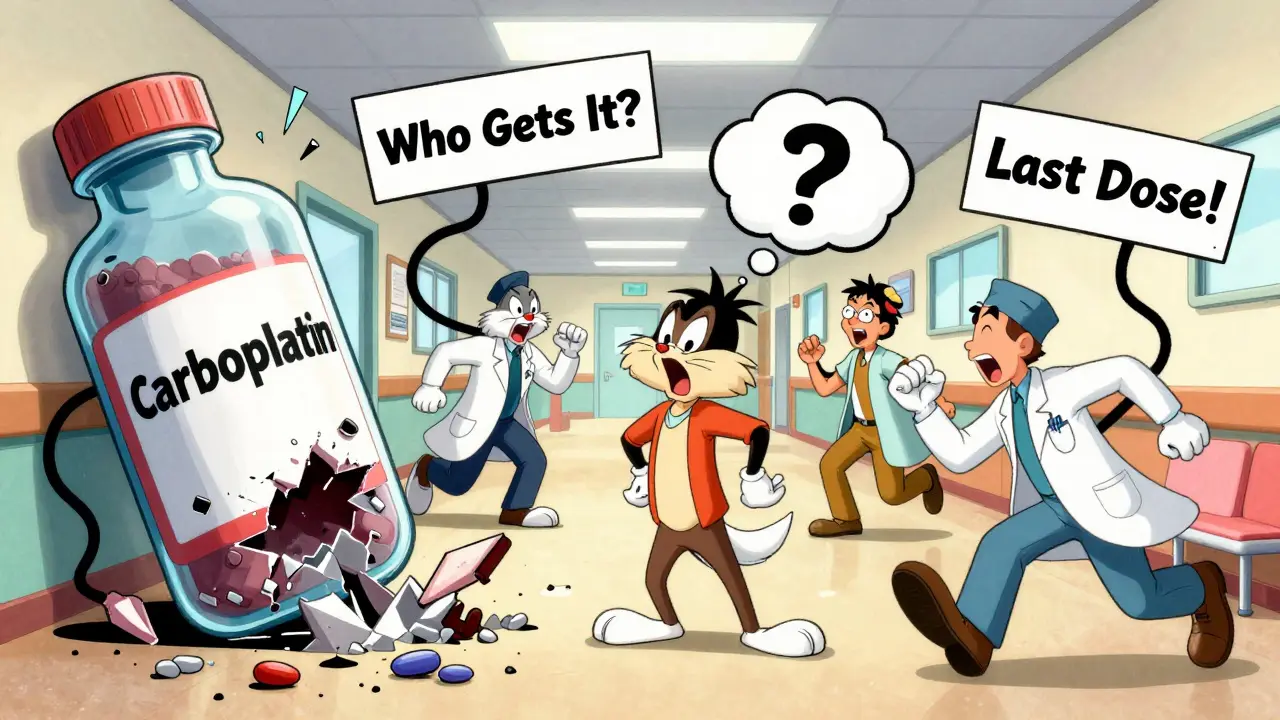
When a life-saving drug runs out, who gets it?
It’s not a hypothetical question anymore. In 2023, over 300 drugs were in short supply across the U.S., including critical cancer treatments like carboplatin and cisplatin. Hospitals had to make choices: which patient gets the next dose? Which one waits? And who decides? This isn’t about greed or bad planning-it’s about a system pushed to its limit. When supply falls short of need, healthcare workers face impossible decisions every day. The question isn’t whether rationing happens-it’s whether it happens fairly.
Why are drugs running out?
Drug shortages aren’t random. They’re built into the system. A handful of manufacturers produce most generic injectable drugs-just three companies control 80% of the market. If one factory shuts down for quality issues, or if raw materials get delayed, the whole supply chain breaks. The FDA requires manufacturers to report shortages six months in advance, but only 68% actually do. That leaves hospitals scrambling. Oncology drugs are especially vulnerable. Sterile injectables make up 43% of all shortages. Why? Because they’re hard to make, need sterile environments, and have low profit margins. No company wants to invest in a drug that sells for $20 a vial but costs $200,000 to produce safely.
What happens when a hospital runs out?
Some hospitals try to stretch what’s left. They reduce doses, extend intervals between treatments, or switch to alternatives-even if those aren’t as effective. But when those options fail, someone has to decide who gets the last dose. Left to individual doctors, this leads to chaos. A 2022 study found that over half of rationing decisions were made at the bedside, with no oversight. That means one oncologist might give a dose to a younger patient. Another might prioritize someone with better insurance. Or worse-no one gets told why.
The ethical framework that should guide decisions
There’s a better way. Experts agree on four key principles for fair rationing: transparency, consistency, appeal, and accountability. This is called the Daniels and Sabin framework. It means decisions aren’t made behind closed doors. They’re written down, explained to patients, and reviewed by a team. A proper rationing committee includes pharmacists, nurses, doctors, social workers, patient advocates, and ethicists. Not just one person. Not just the head of oncology. A group. And they don’t just guess-they use clear rules. For example, should priority go to the patient with the highest chance of survival? The one who will live the longest? Or the one who needs it most urgently? Each criterion has trade-offs. The American Society of Clinical Oncology recommends using cancer-specific data: recurrence risk, survival benefit in months, and whether there’s a viable alternative. No guessing. No favoritism.

Why most hospitals still get it wrong
Only 36% of U.S. hospitals have a standing committee for drug shortages. And of those, only 13% include physicians. A shocking 2.8% include an ethicist. Rural hospitals are even worse-68% have no formal plan at all. That means in many places, decisions are made on the fly, often by exhausted nurses or overworked pharmacists. Clinicians report high levels of moral distress. One oncologist in Texas said she had to choose between two stage IV ovarian cancer patients for limited carboplatin doses three times last year-with no guidance. The emotional toll is real. Hospitals with formal committees saw 41% lower burnout rates among staff. But setting up these teams takes time. Training, policy writing, meetings. Most hospitals don’t start until the shortage is already here. By then, it’s too late.
Who gets left out?
Here’s the uncomfortable truth: current systems often ignore equity. A 2021 report found that 78% of rationing protocols don’t include any metrics to protect marginalized groups. That means patients without insurance, those in low-income neighborhoods, or non-English speakers are more likely to be left behind. A patient with Medicaid might get a less effective substitute. Someone without a primary care doctor might not even know a shortage is happening. And when patients aren’t told about rationing-only 36% are informed-they can’t ask questions or push back. That’s not just unethical. It’s dangerous. Trust in healthcare erodes fast when people feel hidden decisions are being made about their lives.
What’s being done to fix it?
Change is coming, slowly. In April 2023, Minnesota released a detailed guide for allocating carboplatin and cisplatin, prioritizing patients with curative intent and no alternatives. The Food and Drug Administration launched a task force in October 2023 to build an AI-powered early warning system to predict shortages before they happen. ASCO released new ethical guidance in August 2023, stressing that patients must be told when their treatment is being rationed. The National Academy of Medicine is developing standardized metrics for allocation, with draft rules expected in mid-2024. And in January 2024, pilot certification programs for hospital ethics committees launched in 15 states. These aren’t perfect fixes-but they’re steps toward consistency.
What hospitals need to do now
If your hospital doesn’t have a rationing plan, here’s what to do:
- Form a committee with at least one ethicist, one pharmacist, one nurse, one doctor, a patient advocate, and a social worker.
- Adopt the Daniels and Sabin framework: make decisions public, evidence-based, appealable, and enforced.
- Create clear, disease-specific criteria-for example, prioritize patients with higher survival benefit or no viable alternative.
- Train staff on ethics and crisis communication. Eight hours of training isn’t optional-it’s essential.
- Track every rationing decision in the electronic health record with notes on justification and patient communication.
- Start planning before a crisis hits. You need 90 days to build this right.
What patients should know
If you’re on a drug that’s in short supply, ask: Is there a plan for how this drug is allocated? Who decides who gets it? Was my doctor told why I’m getting less-or a different drug? You have a right to know. If your hospital can’t answer, ask for the ethics department. Demand transparency. Your life isn’t a guess. It shouldn’t be a lottery.
What’s next?
The problem isn’t going away. The FDA predicts 25-30% annual drug shortages through 2027. Manufacturing is too concentrated. Supply chains are too fragile. But we can stop making the same mistakes. Ethical rationing isn’t about choosing who lives or dies. It’s about making sure no one is left to decide alone. It’s about turning panic into policy. And that starts with asking the hard questions-before the last vial runs out.
Is medication rationing legal?
Yes, but only when done through structured, transparent, and fair processes. Unregulated, ad-hoc decisions by individual clinicians are not legally protected and can lead to liability. Ethical frameworks like those from ASCO and ASHP provide legal and moral grounding for allocation decisions, especially when they follow principles of transparency, consistency, and appeal.
Can patients be denied treatment because of a shortage?
In some cases, yes. If a life-saving drug is unavailable and no alternative exists, treatment may be delayed or modified. But patients must be informed. Ethical guidelines require that rationing decisions be communicated clearly-not hidden. Denying care without explanation violates basic standards of informed consent and patient autonomy.
Why aren’t more hospitals using ethics committees for rationing?
Cost, time, and resistance. Setting up a committee takes training, staffing, and policy development. Many hospitals wait until a crisis hits, then scramble. Others lack leadership support. Physicians often feel they should have the final say, even though research shows bedside decisions lead to more bias and distress. It’s easier to act alone than to build systems-but it’s also far less fair.
Do drug shortages affect rural hospitals more?
Yes, dramatically. Rural hospitals have fewer pharmacists, no ethicists on staff, and limited access to specialists. 68% of them lack formal rationing protocols compared to 32% of academic centers. They also rely more heavily on a few suppliers, so when one drug runs out, they have no backup. This creates dangerous disparities in care.
Are there alternatives to rationing?
The best alternative is preventing shortages in the first place. That means diversifying manufacturers, improving supply chain resilience, and incentivizing production of critical drugs. Some countries use national stockpiles or centralized purchasing to avoid shortages. In the U.S., the FDA is testing AI tools to predict shortages 6-12 months ahead. But until those systems scale, rationing remains unavoidable.
How can patients advocate for fair access?
Ask your care team: Do you have a written plan for drug shortages? Who makes the decisions? Can I see it? Contact your hospital’s ethics committee or patient advocate office. Demand transparency. Share your experience with patient advocacy groups. Pressure lawmakers to support legislation that requires hospitals to disclose their rationing policies. Your voice matters when systems fail.


christian jon
February 13, 2026 AT 22:13And don't even get me started on the FDA's "six-month advance notice"-that’s like warning people a hurricane’s coming… after it’s already flooded your basement.
Meanwhile, the same companies that make $200,000-per-vial drugs are the ones crying about profit margins on $20 vials. Where’s the moral compass? It’s buried under a pile of quarterly earnings reports.
Pat Mun
February 15, 2026 AT 18:29I remember one night, I had to tell two patients they’d have to wait a week for their next chemo dose. One was a single mom. The other was a retired teacher who’d already lost his wife to cancer. I didn’t have a protocol. I had a clipboard and a trembling voice.
We need systems. Not heroics. Not saints. Just structure. Because no one should have to make this choice alone. And if we don’t fix this, we’re not just failing healthcare-we’re failing humanity.
andres az
February 15, 2026 AT 23:42Three companies control 80%? That’s not a market failure-that’s collusion. And don’t tell me the FDA’s AI system will fix it. They’re still using fax machines to track inventory.
Meanwhile, the real solution? Ban generic injectables. Let the market decide. If you can’t afford chemo, maybe you shouldn’t be getting it. Harsh? Yes. Honest? Absolutely.
Steve DESTIVELLE
February 17, 2026 AT 08:37When a society begins to ration existence itself-when hope becomes a commodity measured in milliliters-we have already abandoned ethics.
What is a life worth? A dollar figure? A statistical curve? A bureaucratic checklist?
We are not solving shortages. We are ritualizing despair. And the committee members? They are not saviors. They are priests of a dying temple. They bless the vials. They do not question the altar.
Stephon Devereux
February 17, 2026 AT 12:34Setting up a rationing committee sounds great on paper. But when your hospital has 12 nurses and 2 pharmacists, and one of them just quit because they couldn’t afford rent, who’s going to run the ethics meetings?
And yes, rural hospitals are getting crushed. But the fix isn’t just adding an ethicist. It’s funding. It’s infrastructure. It’s making it profitable to make cheap drugs.
Until we stop treating healthcare like a startup and start treating it like a public good, we’re just rearranging deck chairs on the Titanic.
steve sunio
February 18, 2026 AT 02:31Big pharma owns the FDA. The FDA owns the supply chain. The supply chain owns the hospitals. And the hospitals? They own your silence.
Meanwhile, you’re over here talking about "transparency" like it’s a magic spell. Newsflash: they don’t want you to know. They want you to be grateful for whatever scraps they toss you.
Stop asking for committees. Start asking for revolution.
Neha Motiwala
February 18, 2026 AT 18:26But here’s the thing: in the U.S., you have all the money, all the tech, all the experts-and you’re still letting people die because someone didn’t fill out a form?
It’s not a shortage. It’s a failure of moral courage.
And don’t even get me started on how patients are kept in the dark. If I found out my life was being decided by a spreadsheet, I’d burn the hospital down. Literally.
athmaja biju
February 19, 2026 AT 00:56Why is it that in India, we don’t have "ethical frameworks" for cancer drugs? Because we don’t pretend we have a system. We have chaos. And in chaos, people help each other.
Here? You have committees. You have guidelines. You have PowerPoint presentations. And still, someone dies because the paperwork was filed on Tuesday instead of Monday.
Stop glorifying bureaucracy. It’s not ethics. It’s delay with a title.
Gloria Ricky
February 19, 2026 AT 07:45My mom went through chemo during a shortage. We never knew why she got the dose one week and not the next. The nurse just said, "We’re doing our best."
That’s not enough. We need systems. We need transparency. We need to stop pretending this is normal.
Annie Joyce
February 20, 2026 AT 00:18Let me tell you-the real villain isn’t the manufacturer. It’s the reimbursement system. Medicare pays $18 for a vial that costs $19 to prepare. So hospitals lose money every time they give it. That’s why they hoard. That’s why they ration.
And yes, we have protocols. But they’re useless if the hospital’s budget is in the red.
Fix the payment model. Not the ethics committee. That’s the root. Everything else is just band-aids.
Rob Turner
February 20, 2026 AT 00:30What struck me most in this article is how American we’ve made this. It’s not about access. It’s about worth. Who deserves to live? Who’s "worth" the vial?
We need to stop framing this as a medical issue. It’s a moral one. And until we treat it like one, no committee, no algorithm, no guideline will help.
Luke Trouten
February 20, 2026 AT 06:34What’s missing is political will. Not money. Not technology. Will.
It’s easier to let a nurse cry in a supply closet than to pass a law. It’s easier to say "it’s too complicated" than to hold a corporation accountable.
But if we can send a man to Mars, we can make sure a cancer patient gets their next dose. The question isn’t whether we can. It’s whether we care enough to try.
Gabriella Adams
February 21, 2026 AT 17:44