
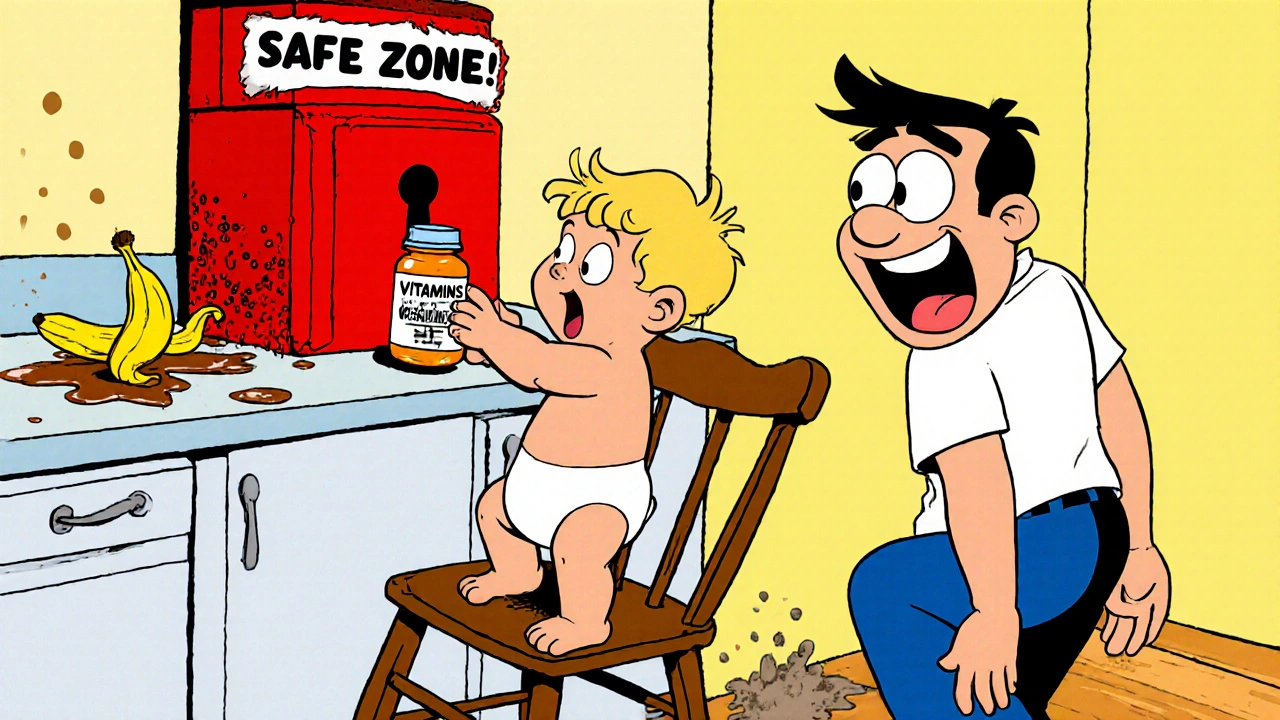
Every year, 60,000 children under five end up in emergency rooms because they got into medicine they weren’t supposed to. That’s not a rare accident-it’s a preventable crisis. And it’s happening in homes where parents think they’re doing everything right. Maybe you keep pills in the bathroom cabinet because it’s convenient. Maybe you leave a pill organizer on the counter after giving your toddler their medicine. Maybe you think, "My kid doesn’t even know what medicine is." But here’s the truth: kids as young as 18 months can open child-resistant caps. They can climb on chairs to reach shelves. They can find hidden stashes in purses, drawers, or overnight bags. And they don’t care if it’s a vitamin, a painkiller, or an opioid. If it looks like candy, they’ll eat it.
Why "Out of Sight" Isn’t Enough
You’ve heard it before: "Keep medicine out of reach." But that’s not enough. A 2022 study tracking 1,200 households found that high shelves alone stopped only 72% of kids from getting into medicine. That means nearly one in four children still got to the pills. Why? Because kids are smart, curious, and strong for their size. By age two, most can open standard cabinet latches in under 30 seconds. And if you think your child is too young to figure it out, think again. The American Academy of Pediatrics says 62% of toddlers can open a cabinet latch within half a minute. That’s faster than you can turn around to grab a glass of water. The real problem? We confuse "child-resistant" with "child-proof." All prescription bottles have safety caps that require twisting and pressing. But Express Scripts’ 2023 analysis found that half of all children under five can open those caps in less than a minute when unsupervised. And if the bottle’s sitting on a counter? Forget it. Kids don’t need to open the cap-they just need to grab the whole bottle.The Only Real Solution: Lock It Up
The most effective way to stop accidental poisonings isn’t to hope your child doesn’t climb. It’s to lock the medicine away. Locked cabinets reduce access by 98%, according to the same 2022 study. That’s not a small improvement-it’s a game-changer. And you don’t need a fancy safe. A simple lockbox, a high cabinet with a childproof latch, or even a small steel box bolted to the wall works. Here’s what works best:- Lockable storage: Use a lockbox made of steel or hardened plastic. Size matters-aim for at least 6 x 4 x 2 inches to fit standard prescription bottles.
- Location: Store it up high, above counter height (at least 36 inches), and never in the bathroom. Humidity ruins medicine, and bathrooms are easy for kids to reach.
- Consistency: Put every pill, patch, liquid, and inhaler inside. Even vitamins, cough syrup, and topical creams. If it’s not locked, it’s a risk.
What About Refrigerated Medications?
Insulin, some antibiotics, and biologics need to stay cold. But the fridge isn’t safe either. Kids open fridge doors. They pull out containers. They sip what they think is juice. Seattle Children’s Hospital recommends storing refrigerated meds in a locked container inside the fridge-not just on a shelf. A small, lockable plastic box inside the fridge keeps insulin safe and prevents accidental ingestion. And if you’re using a syringe or pen? Lock those too. Needle sticks are another common injury.The Two-Minute Rule: Never Leave Medicine Unattended
Even if you lock everything, mistakes happen. The biggest risk isn’t from a hidden stash-it’s from what’s in your hand right now. The CDC’s "Two-Minute Rule" says: never leave medicine unattended for more than 120 seconds. That means:- Don’t set a pill bottle on the counter while you answer the door.
- Don’t leave a syringe on the table while you get water.
- Don’t place a liquid medicine cup on the edge of the sink while you wash your hands.
Grandparents, Visitors, and Travel
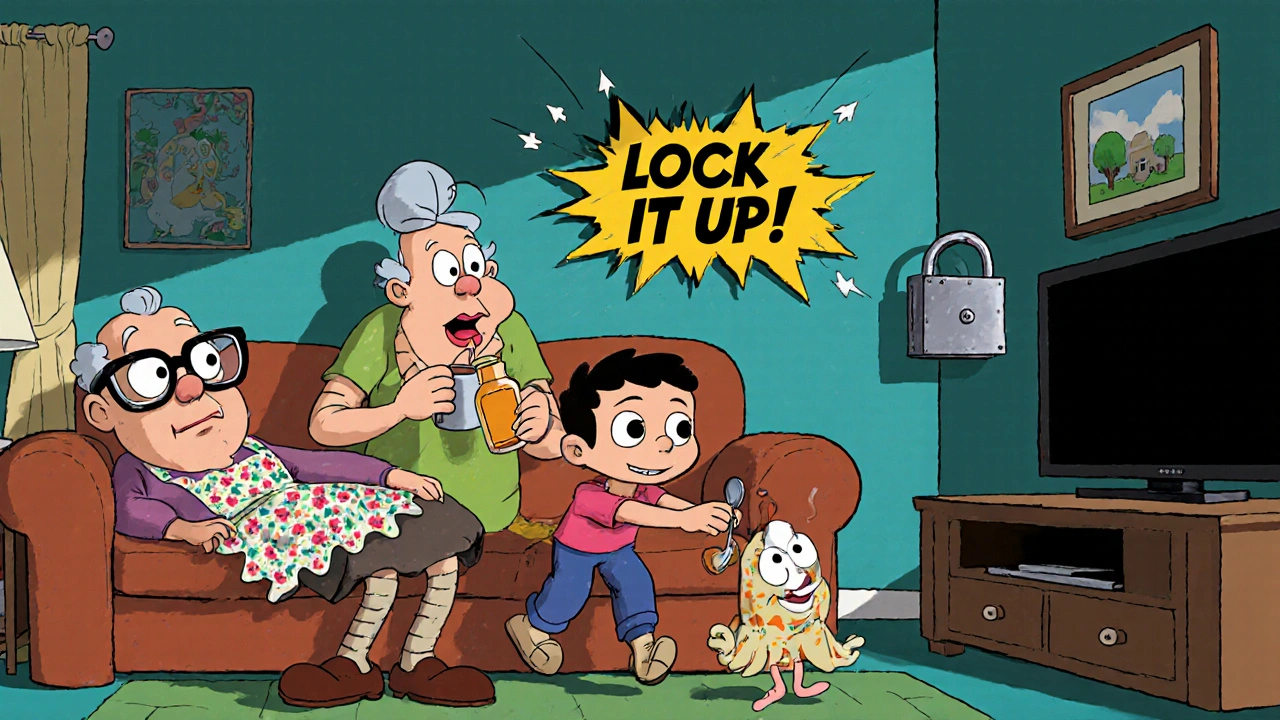
Most accidental ingestions happen at grandparent’s houses or during travel. A 2023 Safe Kids Worldwide survey found that 76% of grandparents don’t lock up medicine when grandchildren visit. Why? They think, "My grandchild knows not to touch medicine." But kids don’t understand the difference between medicine and candy. A chewable Tums looks like a SweeTart. Aspirin looks like Skittles. And if your child’s been to grandma’s before and found pills there? They’ll go back. Travel is another major risk. The CDC reports a 31% spike in poisonings during holidays. That’s because people pack meds in suitcases, purses, or hotel drawers. Solution? Use a portable lockbox. The CDC’s 2024 "Travel Safety Kit" includes a small, TSA-approved lockbox that fits in a hotel safe. Keep it with you-not in checked luggage. And if you’re staying at a hotel, never leave medicine on the nightstand or in the mini-fridge.What About Teenagers?
This isn’t just about toddlers. Teens are the second-largest group for accidental and intentional overdose. The National Association of Pediatric Nurse Practitioners recommends a "monitored medication system" for households with teens. That means:- Locking all prescriptions in a separate, high-access lockbox.
- Having the teen log each dose with a parent’s signature.
- Only releasing pills when the teen has a legitimate need.
What to Do With Old or Expired Medicine
Don’t flush it. Don’t throw it in the trash. Don’t leave it in a drawer "just in case." The FDA recommends mixing pills with something unappetizing-like coffee grounds or cat litter-then sealing them in a plastic bag before tossing them. Better yet: use a drug disposal kiosk. As of 2023, 78% of U.S. pharmacies have permanent drop-off bins. Just ask at your local pharmacy. Some even offer mail-back envelopes for free.
Emergency Medications: How to Balance Safety and Speed
What if your child has an asthma inhaler or an EpiPen? You can’t lock those away and expect to save a life in time. Seattle Children’s Hospital recommends a "medication triage system":- Emergency meds: Keep in a clearly labeled, easily accessible location-like a hook by the door or a high shelf with a quick-release latch.
- Daily meds: Locked in a high cabinet or box.
- Occasional meds: Locked away, even if you use them once a month.
Why This Matters More Than You Think
Every emergency room visit for a child who swallowed medicine costs an average of $3,217. The total annual cost in the U.S.? Over $67 billion. That’s not just money-it’s time lost from work, stress on families, and trauma for the child. And it’s all preventable. The Up and Away campaign, backed by the CDC and 12 national health organizations, says one thing clearly: "Out of sight is necessary but insufficient without physical barriers." You can’t rely on child-resistant caps. You can’t rely on teaching kids "no." You can’t rely on luck. You need a lock. You need a routine. You need to treat medicine like a loaded gun.What to Do Today
Here’s your simple checklist:- Find every medicine in your home-bathroom, kitchen, bedroom, purse, car, drawer, nightstand.
- Put all of them into a lockbox (even vitamins and supplements).
- Install the lockbox in a high, dry location-never the bathroom.
- Teach everyone who visits: "This is locked. No one gets in without a key."
- Practice the Two-Minute Rule: never leave medicine unattended.
- Dispose of old pills properly using a pharmacy drop-off.
Can child-resistant caps really be opened by kids?
Yes. While child-resistant caps are designed to slow down access, they’re not foolproof. Express Scripts’ 2023 analysis found that 50% of children under five can open standard safety caps in under one minute when unsupervised. By age two, many kids can twist and press the cap with enough force to open it. These caps are meant to delay access-not prevent it entirely. That’s why locking medicine away is the only reliable solution.
Is it safe to store medicine in the bathroom?
No. Bathrooms are humid, which can degrade medicine and make it less effective. More importantly, they’re easy for children to access. Bathroom cabinets are usually low, and kids can stand on the toilet or sink to reach them. Even if the cabinet has a latch, most toddlers can open it in under 30 seconds. Store medicine in a dry, high location like a bedroom closet or kitchen cabinet that’s locked.
What should I do if my child swallows medicine by accident?
Call Poison Control immediately at 1-800-222-1222 (U.S.) or your local emergency number. Don’t wait for symptoms. Don’t try to make your child vomit. Have the medicine container ready so you can tell them the name, dose, and time it was taken. Keep the container with you when you go to the hospital. Even if your child seems fine, some medications cause delayed reactions. Always get professional help.
Are smart lockboxes worth the extra cost?
They can be, but they’re not required. Smart lockboxes with Bluetooth alerts cost $60-$120 and notify you if someone opens them. But Consumer Technology Association testing in May 2024 found only 43% reliability in these alerts. A basic $45 steel lockbox with a key is more dependable. If you’re tech-savvy and want extra peace of mind, go for a smart box. But don’t skip locking medicine just because you don’t want to spend more.
How do I store medicine safely during travel?
Always carry your medicine with you-not in checked luggage. Use a small, portable lockbox that fits in your carry-on. If you’re staying in a hotel, store the lockbox inside the room safe-not on the nightstand or in the mini-fridge. Never leave medicine in the car. Heat and cold can ruin it, and kids can break into vehicles. The CDC’s 2024 Travel Safety Kit includes a compact lockbox designed for this exact situation.
Do I need to lock up over-the-counter medicine too?
Yes. Many accidental poisonings come from OTC meds like children’s Tylenol, cough syrup, or antihistamines. Even something as simple as a bottle of Tums can cause serious harm if a toddler swallows several. Treat every pill, liquid, or patch the same way-lock it up. The American Academy of Pediatrics recommends locking all medications, regardless of whether they’re prescription or not.
How often should I check my medicine storage?
Check your lockbox every month. Look for expired meds, damaged packaging, or signs of tampering. Also, make sure the lock still works. If you’ve had guests, visitors, or changes in your household (like a new caregiver), do a quick safety audit. The American Academy of Family Physicians recommends annual safety drills with all caregivers to review where everything is stored and how to respond in an emergency.



Sullivan Lauer
November 29, 2025 AT 13:36Let me tell you something-I used to think I was doing fine keeping meds in the bathroom cabinet. My kid was just a baby, I thought, "He’s not even crawling yet!" Then one day, I turned around to grab a towel, and he had the Advil bottle in his mouth. Not swallowed. Not even opened. But he was *biting* it like it was a teether. That’s when I realized: kids don’t need to understand what it is-they just need to know it’s something they can grab. I bought a $35 lockbox from Amazon, bolted it to the wall in the closet, and now I sleep like a human again. Not a single pill left out. Not even vitamins. Not even my damn melatonin. If it’s not locked, it’s a liability. And yeah, it’s a pain to open every time I need a Tylenol-but I’d rather be inconvenienced than bury my child. Period.
PS: I told my mom. She laughed. Then she went home and locked her meds. She didn’t want to be the reason her grandkid ended up in the ER. Good call, Mom.
PPS: If you’re still using "child-resistant" as your safety plan, you’re playing Russian roulette with a loaded gun. And your kid is the one pulling the trigger.
PPPS: I’m not a doctor. I’m just a dad who learned the hard way.
Sohini Majumder
November 29, 2025 AT 20:06OMG i literally just threw my meds on the counter after giving my 2yo his syrup… like 2 mins ago… oh god oh god oh god… i’m so stupid… i thought he was asleep… he’s not even 2 yet and he climbed on the chair last week to get the gummy vitamins… i’m literally gonna go lock everything right now… why did no one tell me this??
tushar makwana
November 30, 2025 AT 06:14My cousin in India, she keeps medicine in kitchen shelf, near sugar jar. Her 18-month-old took 3 paracetamol tablets once. She didn’t know until he started vomiting. Took him to hospital. He was fine. But she cried for days. Now she uses small lock box, like the one in this post. Even her old mother, who says "children know what is medicine," now keeps it locked. Because safety is not about belief. It is about action. Simple. No drama. Just lock it. Every time. Even if you are in hurry. Even if you think "just this once." One time is enough.
God bless all parents. Be careful.
Richard Thomas
December 1, 2025 AT 01:21The statistical rigor presented in this article is commendable, particularly the citation of the 2022 household study and the Express Scripts analysis. However, one must critically interrogate the underlying assumption that behavioral interventions (e.g., the Two-Minute Rule) are sufficient without structural redesign. The mere existence of child-resistant packaging, which was mandated under the Poison Prevention Packaging Act of 1970, has demonstrably reduced pediatric poisonings by over 80% since its inception. Yet, the current paradigm shifts responsibility entirely onto the caregiver, ignoring systemic failures in product design and public health infrastructure. A more holistic approach would include mandatory integration of tamper-evident, biometrically secured dispensers in all pharmaceutical packaging-a solution already in development by several EU manufacturers. Until then, we are merely bandaging a wound that requires amputation.
That said, the lockbox recommendation is pragmatically sound. I have installed a Med-Tek unit in my home and have not experienced a single lapse in compliance since January.
Matthew Higgins
December 1, 2025 AT 17:59Bro, I used to leave my EpiPen on the coffee table because it was "so convenient." Then my neighbor’s kid grabbed it and started shaking it like a snow globe. I didn’t even realize it was gone until I needed it for my own kid. Now? It’s in a little lockbox with a red tag that says "EMERGENCY ONLY." I keep the key on my keychain. My wife has a copy. The babysitter has a copy. My mom has a copy. I even taped a note to the fridge: "IF YOU SEE THIS BOX, DON’T OPEN IT UNLESS KID IS DYING."
And yeah, I know it sounds dramatic. But I’d rather look like a paranoid dad than a grieving one.
Also-TSA-approved lockbox? That’s genius. I just bought one for our road trip next week. No more meds in the glovebox.
Peter Axelberg
December 2, 2025 AT 16:10I work in a pharmacy. I’ve seen it all. Parents come in all the time asking for advice on how to store meds. Most of them say, "We’re careful." But when I ask where they keep it, it’s always the same: bathroom cabinet, nightstand, purse, car console. One guy kept his insulin in the fridge… but on the top shelf, right next to the milk. His 3-year-old drank it. Thought it was chocolate milk. The kid had a seizure. He’s fine now. But he’s got a scar on his tongue from the IV tube.
Here’s the thing: kids don’t care if it’s prescription or not. A bottle of Benadryl looks like juice. A patch looks like a sticker. A pill looks like candy. And they’re not being naughty-they’re just curious. That’s what kids do.
Lock it. Don’t overthink it. Spend $40. Save a life. It’s not that hard.
And if you think your kid is too young to figure it out? Wait until they turn two. Then come back and tell me you were right.
Peter Lubem Ause
December 2, 2025 AT 20:24This is not just about safety. This is about love. I am from Nigeria. In my village, many people keep medicine in open shelves. Children take them. Some die. I lost a nephew to a wrong pill. He was only 18 months. We did not know it was heart medicine. We thought it was sugar.
Now I tell everyone: lock it. Even if you are poor. Even if you have no money. Use a tin box. Nail it to the wall. Tie it with rope. But lock it. No excuses. Because when a child dies from something you could have fixed in five minutes, the guilt never leaves.
Thank you for writing this. I will share it with every parent I know.
gerardo beaudoin
December 3, 2025 AT 02:10My sister just moved in with me after her divorce. She’s a single mom with two kids under four. She didn’t lock anything. Said she didn’t want to "make it feel like a prison." So I bought her a lockbox. Told her, "It’s not a prison. It’s a shield." She rolled her eyes. Then her 3-year-old found the cough syrup in the purse and drank half. She panicked. Called Poison Control. Kid was fine. But she cried for an hour. Now she locks everything. Even the baby’s teething gel.
Just lock it. Please.
It’s not about being overprotective. It’s about being prepared.
Sara Shumaker
December 4, 2025 AT 03:14There’s something deeply human here-this fear, this guilt, this desperate need to control the uncontrollable. We want to believe our children are safe because we love them. But safety isn’t love. Safety is structure. It’s ritual. It’s the quiet, unglamorous act of locking a box every single day, even when you’re tired, even when you’re sure you’ll only be gone for a second. We don’t lock medicine because we think our kids are evil. We lock it because we know they’re innocent. And innocence doesn’t understand danger-it just reaches for what looks like candy.
Maybe the real question isn’t how to store medicine. Maybe it’s how to live in a world where we have to protect our children from the very things meant to heal them. That’s the tragedy. And that’s why this isn’t just advice-it’s a moral imperative.
I’m locking my box tonight. And I’m telling my sister to do the same. Not because I’m scared. But because I care too much to risk it.