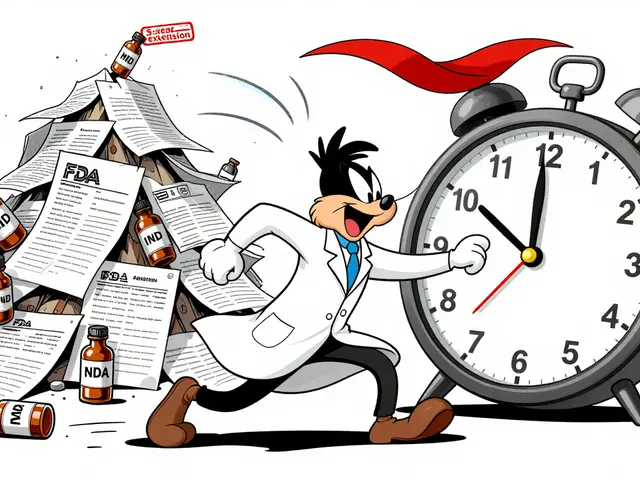
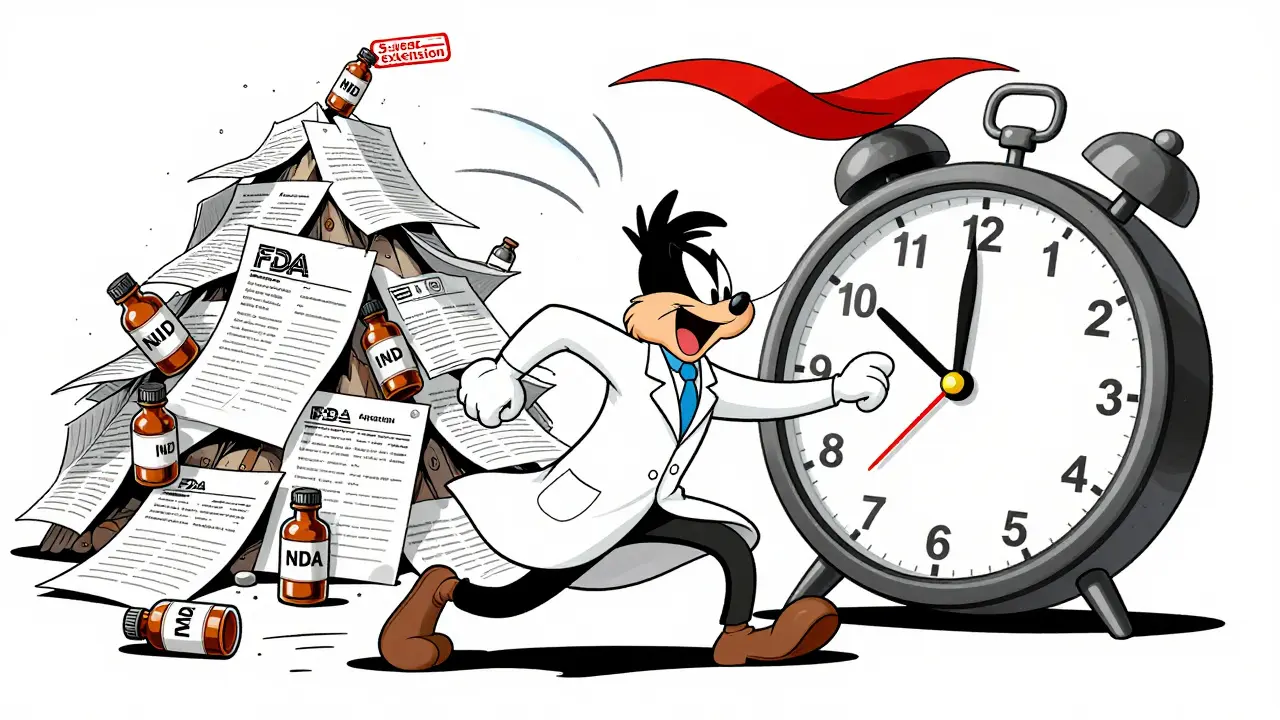
Imagine spending 12 years and $2 billion to develop a new cancer drug - only to find out you have just 8 years left on your patent after it finally hits the market. That’s the reality for many pharmaceutical companies. Patent term restoration is the legal tool that helps them recover some of that lost time. It’s not a loophole. It’s a congressionally approved fix to a broken system where regulatory delays eat up half of a drug’s patent life before it even reaches patients.
Why Patent Term Restoration Exists
The U.S. patent system gives inventors 20 years of exclusive rights from the filing date. But for drugs, that clock starts ticking long before the product can be sold. Clinical trials, FDA reviews, and safety studies can take 8 to 10 years - sometimes more. By the time a drug gets approved, only a fraction of its patent life remains. Without intervention, companies would have little incentive to invest in risky, expensive drug development. The solution came in 1984 with the Hatch-Waxman Act. Named after Senator Orrin Hatch and Representative Henry Waxman, this law created Patent Term Restoration (PTR) to balance two goals: letting generic drugs enter the market faster, while still rewarding innovators for their time and money. The result? A legal pathway to extend patent life for drugs, medical devices, and certain food additives that faced unavoidable regulatory delays.How PTR Works: The Rules
Not every patent qualifies. There are strict conditions:- The product must require FDA approval before it can be sold.
- The patent must cover the approved product, a method of using it, or the manufacturing process.
- Only one patent per product can be extended - even if the company holds multiple patents on the same drug.
- The extension cannot exceed 5 years total.
- The total market exclusivity period - including the original patent term plus extension - cannot go beyond 14 years after FDA approval.
- Testing phase: From when the investigational new drug (IND) application is submitted to when the new drug application (NDA) is filed.
- Approval phase: From NDA submission to FDA approval.
What’s Covered? What’s Not
PTR only protects the specific use approved by the FDA. If your patent covers 10 different uses for a drug, but only one got FDA approval, your extension only covers that one use. This is a common point of confusion. Courts have consistently ruled that the extended rights are narrow - not a blanket revival of the entire patent. It also doesn’t apply to all types of drugs equally. Small-molecule drugs - traditional pills and injections - get extended in 98% of cases. Biologics - complex proteins made from living cells - only see extensions in about 82% of cases. Combination products, like drug-eluting stents or inhalers with built-in medication, are the fastest-growing category for PTR applications, with a 300% spike between 2015 and 2022.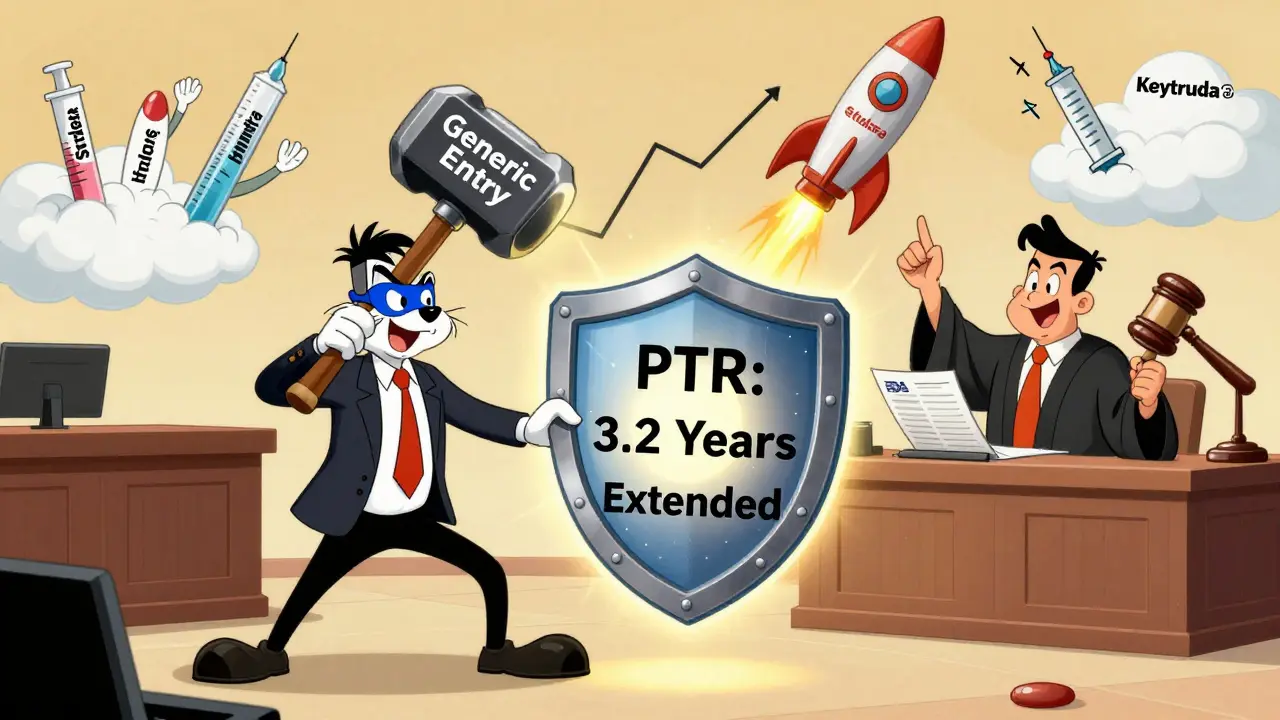
PTR vs. Other Exclusivity Tools
Many people confuse PTR with other forms of market protection. Here’s how they differ:| Tool | What It Protects | Duration | Administered By |
|---|---|---|---|
| Patent Term Restoration (PTR) | Patent rights for approved product | Up to 5 years (capped at 14 years post-approval) | USPTO (based on FDA data) |
| Data Exclusivity | Prevents generics from relying on innovator’s clinical data | 5 years for new chemical entities; 3 years for new clinical studies | FDA |
| Orphan Drug Exclusivity | Exclusivity for rare disease drugs | 7 years | FDA |
| Patent Term Adjustment (PTA) | Compensates for USPTO delays during patent prosecution | Months to a few years | USPTO |
Who Uses It - And Why It Matters
Top-selling drugs rely on PTR. In 2022, 87% of the top 100 pharmaceutical products by sales used patent term restoration. Drugs like Stelara®, Humira®, and Keytruda® all gained years of extra exclusivity this way. The average extension? About 3.2 years. That’s not just a technicality - it’s the difference between a profitable drug and a financial failure. The economic stakes are huge. A Duke University study found PTR boosts the net value of drug development by 11-15%. Without it, pharmaceutical companies say R&D returns would drop by 18%. But there’s a flip side. The Congressional Budget Office estimates PTR extensions cost Medicare $5.2 billion a year by delaying cheaper generics. Critics argue it fuels "evergreening" - minor tweaks to old drugs just to reset the clock. The FTC found 12% of PTR applications between 2015 and 2019 involved "product hopping," where companies slightly changed a drug’s formulation to trigger a new regulatory review period.
Common Mistakes and How to Avoid Them
Even big pharma companies mess this up. Surveys show:- 37% of denied PTR applications were filed after the 60-day deadline.
- 28% failed because the wrong patent was selected for extension.
- Many companies underestimate the "due diligence" requirement - if the FDA thinks you dragged your feet on trials, your extension gets slashed.
The Future of Patent Term Restoration
PTR isn’t going away. In fact, it’s growing. As drug development gets longer - especially for cancer and rare diseases - more companies will rely on it. The FDA approved over 150 PTR applications annually in 2023, and that number is expected to rise 15% over the next five years. But political pressure is building. Proposals like the "Lower Drug Costs Now Act" tried to cap extensions at 3 years. While that bill stalled, lawmakers are watching. The Supreme Court’s 2021 Amgen v. Sanofi decision raised questions about how broadly patents can cover biological drugs - which could indirectly affect how PTR is applied. For now, PTR remains a critical, if controversial, part of the drug innovation engine. It’s not perfect. It’s not simple. But for companies betting billions on new treatments, it’s the legal lifeline that keeps the pipeline flowing.Can any patent be extended under Patent Term Restoration?
No. Only patents that claim a product, method of use, or manufacturing process for a product requiring FDA approval qualify. The patent must be in force when the product is approved, and only one patent per product can be extended. Patents on non-regulated products, like software or consumer goods, don’t qualify.
How long does it take to get a patent term extension approved?
The FDA reviews the application and calculates the regulatory review period within 60 days. Then the USPTO issues the actual extension. Since January 2023, electronic filing has cut the total process from 90 days to about 60 days on average. But if a third party challenges the extension - like claiming the applicant wasn’t diligent - the process can stretch for months.
What happens if I miss the 60-day filing window after FDA approval?
You lose the right to request an extension forever. There are no exceptions. This is the most common reason applications get denied. Companies must track FDA approval dates precisely and have legal teams ready to file immediately.
Can a patent be extended more than once?
No. Only one patent term extension is allowed per product, even if multiple patents cover it. Companies must choose the strongest patent - the one with the broadest claims or the longest remaining life - to extend. Choosing wrong can cost years of market exclusivity.
Does Patent Term Restoration apply to generic drugs?
No. PTR is only for innovator companies that hold the original patent. Generic manufacturers don’t apply for PTR. Instead, they rely on the expiration of the innovator’s patent (or its extension) to enter the market. Some generics even challenge PTR extensions in court to try to enter earlier.