
Topical steroids are one of the most common treatments for eczema, psoriasis, and other inflamed skin conditions. They work fast. Many people see results in just a few days. But if used the wrong way, they can cause serious problems-especially skin thinning. This isn’t rare. It’s preventable. And it starts with understanding how much to use, where to use it, and for how long.
How Topical Steroids Work
Topical corticosteroids are anti-inflammatory drugs applied directly to the skin. They reduce redness, swelling, and itching by calming overactive immune responses in the top layers of skin. Unlike oral steroids, which flood your whole body, topical versions mostly stay where you put them. Skin cells break down most of the medicine before it can enter your bloodstream. That’s why they’re safer than pills for long-term use-but only if you use them correctly.
They come in different strengths, from mild over-the-counter hydrocortisone to super-potent prescriptions like clobetasol. The strength you need depends on your condition, where it’s located, and how bad the flare is. A rash on your eyelid? That needs a mild formula. Thick, scaly patches on your elbows? A stronger one might be necessary.
What Causes Skin Thinning?
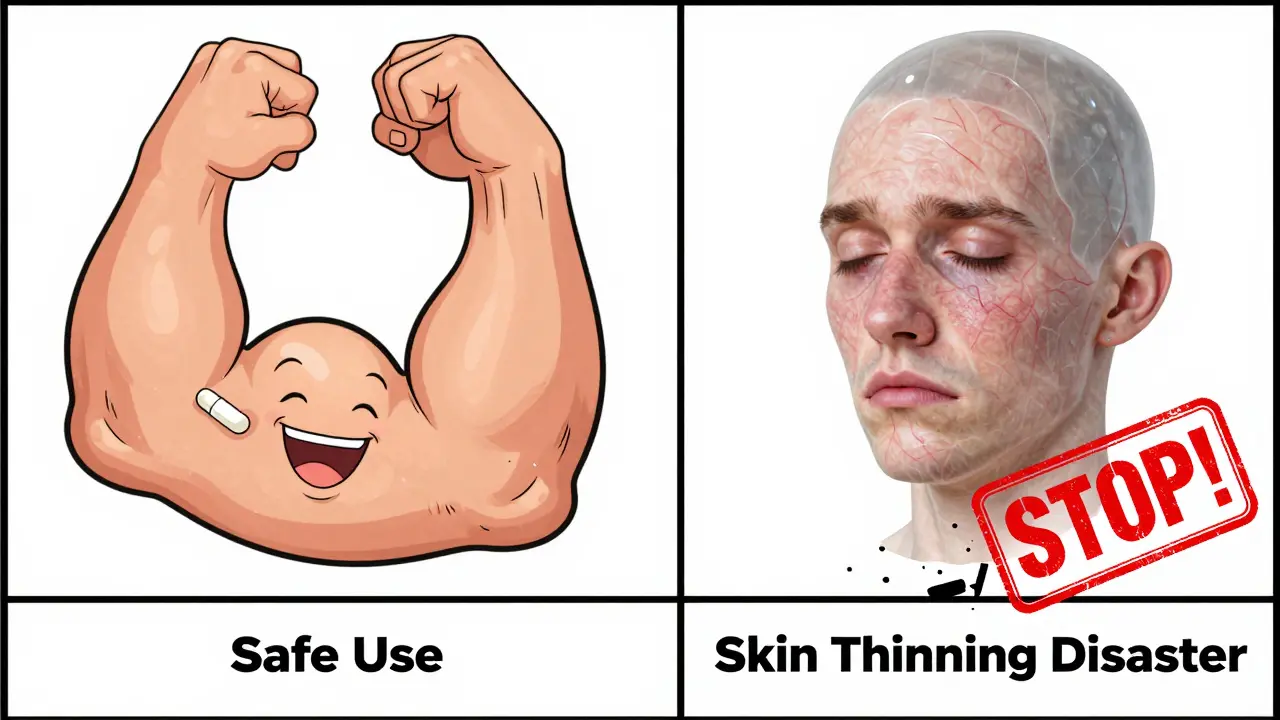
Skin thinning, or atrophy, happens when the steroid breaks down collagen and elastin-the proteins that give skin its structure and bounce. It doesn’t happen overnight. It builds up over time, especially with:
- Using high-potency steroids on thin skin (face, armpits, groin, inner thighs)
- Applying more than once a day
- Using them for more than 2-4 weeks without a break
- Covering the area with bandages or tight clothing
The skin becomes fragile. You might notice visible veins, easy bruising, or stretch marks. In extreme cases, the skin can tear or fail to heal after minor injuries. Around the eyes, long-term use can raise the risk of glaucoma or cataracts. Around the mouth, it can trigger perioral dermatitis-a red, bumpy rash that looks like acne but won’t respond to acne treatments.
How Much Should You Use?
Most people use too much-or too little. Both are problems.
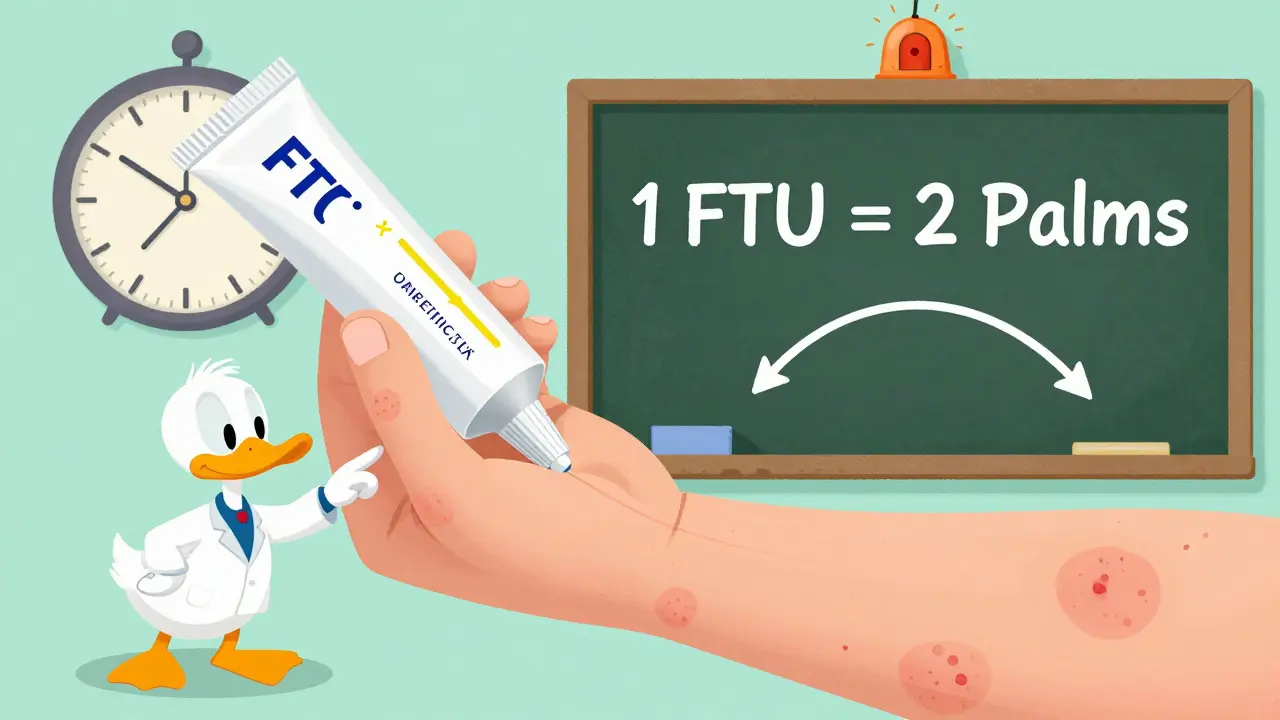
The standard measurement is the fingertip unit (FTU). One FTU is the amount of cream or ointment squeezed from a tube along the length of an adult’s index finger, from the tip to the first crease. That’s about 0.25 to 0.5 grams, depending on the source. It sounds small, but it’s enough to cover an area the size of two adult palms.
Here’s what one FTU covers:
- One hand (front and back): 1 FTU
- One arm (front and back): 3 FTUs
- One leg (front and back): 6 FTUs
- One foot: 2 FTUs
- Entire face and neck: 2-3 FTUs
Apply a thin layer. Rub it in gently. You shouldn’t see a visible residue. If it looks like you just painted the area, you’ve used too much. And never apply it to unaffected skin-only where it’s red, flaky, or itchy.
When and How Often to Apply
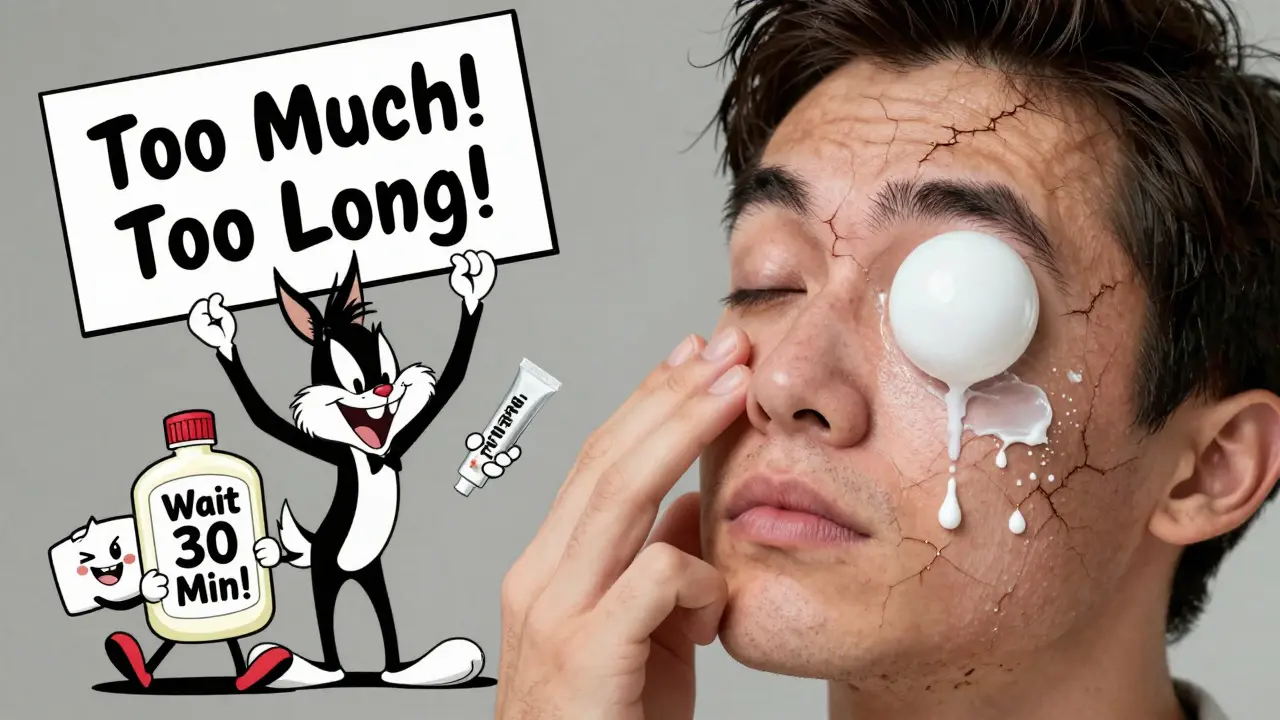
Most topical steroids work best when used once a day. Even if your skin still feels itchy after a few hours, don’t reapply. Studies show no extra benefit from applying twice daily for most conditions. In fact, doing so increases side effect risks without improving results.
Super-potent and potent steroids (Classes I-IV) should never be used for more than two weeks. Even moderate ones (Classes V-VI) shouldn’t go beyond four weeks without a doctor’s review. If symptoms return after stopping, don’t just restart the same cream. Talk to your provider. You might need a step-down plan-start strong, then switch to a weaker version or a non-steroid alternative like tacrolimus or crisaborole.
Where Not to Use Them
Some areas are too delicate for strong steroids:
- Face (especially around the eyes and mouth)
- Armpits
- Genitals and groin
- Under the breasts
For these areas, only mild steroids (like 1% hydrocortisone) should be used-and only for short periods. Even then, limit use to 5-7 days unless your doctor says otherwise. The skin here is thin and absorbs more medicine. Long-term use here is the most common cause of visible atrophy.
Stronger steroids are fine on thick skin: palms, soles, elbows, knees. These areas have more layers and absorb less. That’s why a cream that would be dangerous on your face works safely on your heel.
Combining with Moisturizers
Moisturizers are essential for conditions like eczema. But applying them right after your steroid wipes out the medicine. The steroid needs to be absorbed into the skin’s top layers to work. If you slather on lotion immediately after, you’re diluting it.
Wait 20-30 minutes after applying the steroid before putting on moisturizer. This gives the medicine time to sink in. Always apply the steroid first, then the emollient. And don’t mix them in the same container-keep them separate.
What Happens When You Stop Too Soon-or Too Late?
Some people stop using steroids too early because they’re scared of side effects. That can backfire. If you stop before the inflammation is fully under control, the rash comes back harder and faster. This leads to longer treatment cycles and more total steroid exposure.
On the flip side, using steroids for months without a break-especially on sensitive skin-can lead to withdrawal reactions. This isn’t addiction. It’s a rebound effect. Symptoms like burning, redness, and swelling can flare worse than before. This is more common in people who self-treat chronic eczema with strong steroids for years. Reddit forums and dermatology clinics report cases where patients had to go months without treatment just to let their skin recover.
Alternatives and the Future
Non-steroid options like crisaborole (Eucrisa), tacrolimus (Protopic), and pimecrolimus (Elidel) are growing in use. They don’t cause skin thinning. But they’re more expensive, and not always covered by insurance. They’re especially useful for the face and folds where steroids are risky.
Researchers are working on new delivery systems-patches, gels, and sprays-that target inflammation without affecting skin structure. But for now, topical steroids remain the most effective, fastest-acting option for most flare-ups.
Experts agree: the goal isn’t to stop using them. It’s to use them smarter. Follow your doctor’s instructions. Stick to the right strength. Use the right amount. Limit the time. And always step down when the flare clears.
What to Do If You’re Worried
If you’ve been using a strong steroid for more than a few weeks, especially on your face or groin, talk to your doctor. Don’t stop cold turkey. Ask about a tapering plan. Watch for signs of thinning: shiny skin, visible blood vessels, easy bruising, or stretch marks.
If you’ve been self-treating with over-the-counter hydrocortisone for months, that’s also a red flag. Chronic use-even mild-can still cause problems. Your skin might look better now, but long-term damage could be happening under the surface.
Keep a log: note when you start, what strength you’re using, where you’re applying it, and how long you’ve been on it. Bring it to your next appointment. It helps your provider make better decisions.
Can topical steroids cause permanent skin damage?
Yes, in rare cases. Long-term use of high-potency steroids on thin skin can lead to permanent thinning, visible blood vessels, stretch marks, or loss of skin elasticity. But this almost always happens with misuse-using too strong a product, too often, for too long. When used as directed for short periods, the risk is very low.
Is it safe to use topical steroids on children?
Yes, but with extra care. Children’s skin is thinner and absorbs more medicine. Only mild to mid-potency steroids should be used, and only for the shortest time needed. Never use super-potent formulas on kids unless under strict medical supervision. Always use the fingertip unit method to avoid over-application.
Why do some doctors prescribe steroids for only a few days?
Because short bursts are often enough. Many flares clear up in 5-7 days with proper treatment. The goal isn’t to cure eczema-it’s to calm the flare so your skin can heal. Once the redness and itch are gone, switching to moisturizers alone prevents recurrence without risking side effects.
Can I use topical steroids with other creams or ointments?
Yes, but not at the same time. Always apply the steroid first, then wait 20-30 minutes before applying moisturizers, antibiotics, or other topical treatments. Mixing them reduces effectiveness. Also, never combine different steroid creams unless your doctor tells you to.
Are over-the-counter hydrocortisone creams safe for long-term use?
No. Even 1% hydrocortisone can cause skin thinning if used daily for more than 2 weeks. OTC products are meant for short-term relief of mild irritation, not chronic conditions. If your eczema or rash keeps coming back, see a dermatologist. You may need a different treatment plan.

David L. Thomas
March 11, 2026 AT 04:16Let’s be real-topical steroids are the Swiss Army knife of dermatology. Potent, precise, and perilously easy to misuse. The FTU metric? Genius. Most people eyeball it like they’re spreading butter on toast. I’ve seen patients use 4 FTUs for a quarter-sized patch. No wonder their skin looks like parchment.
And the ‘just one more day’ mentality? That’s how you end up with striae on your inner thighs. It’s not addiction-it’s pharmacokinetic creep. The skin’s barrier function gets rewired. Collagen synthesis plummets. You don’t notice until you’re 40 and your knuckles are translucent.
Also, moisturizers after 30 minutes? Spot on. Slathering on CeraVe right after clobetasol is like pouring water on a fire extinguisher. The steroid’s half-life is 15-20 minutes in the stratum corneum. After that? It’s just emollient soup.
Donnie DeMarco
March 11, 2026 AT 18:43bro i used hydrocortisone on my neck for 8 months cuz my ‘acne’ wouldn’t chill. turned into this weird shiny, veiny mess like i got a second skin made of tissue paper. dermatologist laughed and said ‘you didn’t have acne, you had steroid-induced rosacea.’ now i use niacinamide and pray to the skincare gods. never again. also i didn’t know ftu was a thing. i thought it was a typo for ‘f*** this’.
Kenneth Zieden-Weber
March 12, 2026 AT 21:15Oh sweet mercy. Another person who thinks OTC hydrocortisone is a daily face moisturizer. Let me guess-you’ve been using it since 2020 because ‘it helps with stress zits.’
Here’s the thing: skin isn’t a light switch. It doesn’t turn off. It turns *on*-and then it turns *on* harder when you stop. That’s why people come in with ‘steroid withdrawal’ looking like they’ve been set on fire by a disgruntled fairy.
And don’t even get me started on people slathering super-potent stuff on their eyelids. You think you’re treating eczema? You’re just prepping for glaucoma bingo. One FTU for the whole face? Yeah. Two if you’re a dragon with a beard.
Stop treating your skin like a vending machine. It doesn’t dispense relief. It demands respect. And a calendar.
Tom Bolt
March 14, 2026 AT 11:37There’s a quiet epidemic here. Not of eczema. Not of psoriasis. But of people who treat their skin like a project they can ‘fix’ with a tube from the pharmacy. You don’t ‘manage’ inflammation-you negotiate with it. And if you treat it like a temporary glitch, your skin will retaliate with the subtlety of a sledgehammer.
Skin thinning isn’t a side effect. It’s a *consequence*. A slow-motion betrayal by your own biology. The collagen doesn’t vanish overnight. It withers. Like a plant left in a dark room. You think you’re winning until one day, you catch your reflection-and you realize your skin looks like it’s been vacuum-sealed.
And yet, we still glorify ‘quick fixes.’ We worship the 2-day miracle cure. Meanwhile, the skin remembers. It always remembers.
Shourya Tanay
March 14, 2026 AT 19:13As someone from a region where dermatology access is limited, I’ve seen firsthand how OTC steroids become the default solution. People use them for months because they can’t afford a specialist. The cultural stigma around ‘skin issues’ means many never seek help until the damage is visible.
The FTU method is brilliant, but how many patients are actually shown it? In my clinic, we use a ruler and a spoon to demonstrate volume. It’s crude, but it works. We also teach patients to mark their calendars-start date, strength, location. Paper logs beat memory.
Non-steroid alternatives like tacrolimus are game-changers, but cost is a barrier. Insurance often denies them unless you’ve failed 3 steroid cycles. That’s not patient-centered care. That’s a system that rewards suffering before it helps.
LiV Beau
March 15, 2026 AT 19:03OMG I JUST REALIZED I’VE BEEN USING MY STEROID CREAM LIKE A NIGHT CREAM 😭
Wait-so I was supposed to wait 30 mins before my moisturizer?! I’ve been mixing them like a smoothie for 2 years 😭😭😭
Also, I used clobetasol on my elbows for 6 weeks because ‘it felt so good’ and now they’re kinda see-through?? 🤭 I’m gonna book a dermatologist tomorrow. Also, I love this post. It’s like a skincare diary with footnotes. 🫶🫶🫶
P.S. I printed the FTU chart and taped it to my bathroom mirror. My cat now judges my applications. She’s very stern.
Denise Jordan
March 16, 2026 AT 01:11So… you’re saying I shouldn’t use this stuff every day? But it makes my red patches disappear. What am I supposed to do? Just let my skin look like a potato? 😑
I’m not gonna stop. I’ve got work. I’ve got Zoom calls. I’ve got a life. This isn’t a hobby. It’s survival.
Gene Forte
March 16, 2026 AT 14:00There is a profound wisdom in restraint. The body does not need to be dominated-it needs to be guided. Topical steroids are not enemies. They are tools. Like a scalpel, they can heal or harm, depending on the hand that wields them.
True healing does not come from force, but from rhythm. A rhythm of application, of rest, of observation. The skin is not a problem to be solved. It is a mirror. It reflects our haste, our impatience, our desire for instant control.
Perhaps the real question is not ‘how long should I use it?’ but ‘what am I afraid of, when I reach for the tube?’