
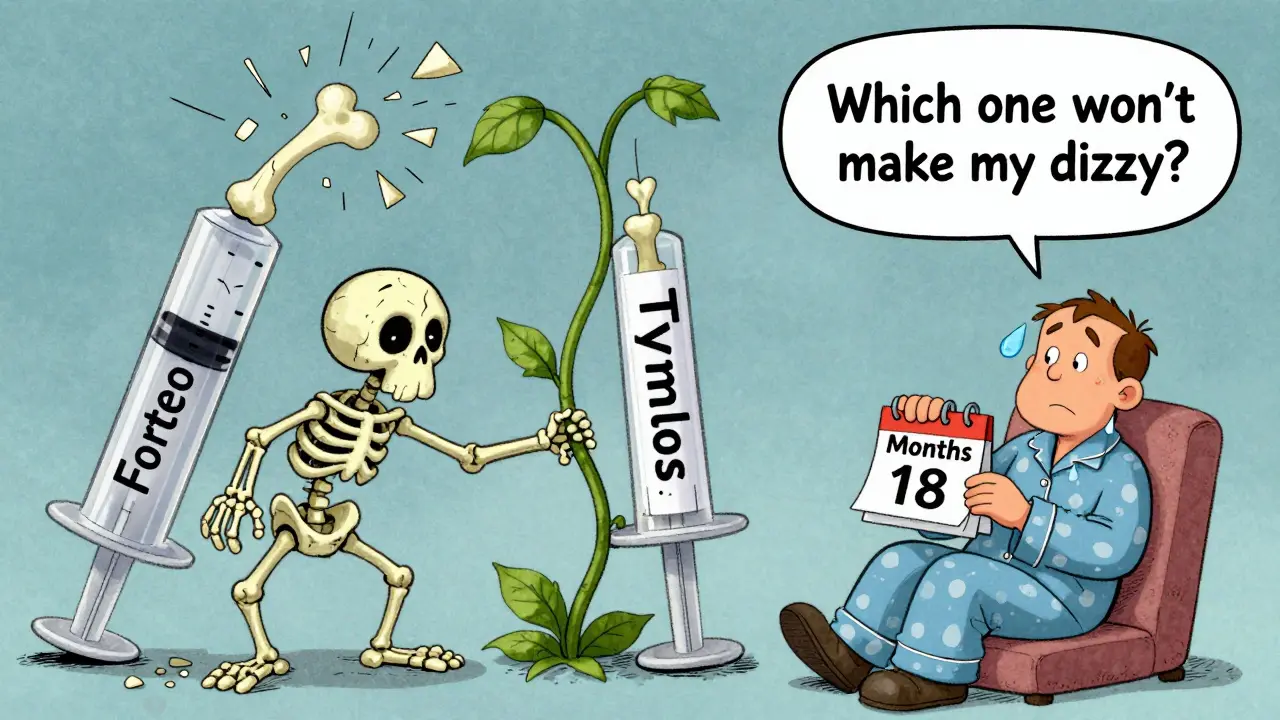
When your bones are breaking easily-maybe from a simple fall or even just standing up too fast-you need more than just a calcium pill. Osteoporosis isn’t just about getting older. It’s about losing bone strength so fast that everyday life becomes risky. For people with severe osteoporosis, especially those who’ve already had a fracture, standard drugs like bisphosphonates or denosumab often aren’t enough. That’s where anabolic agents come in. Unlike older drugs that slow bone loss, these medications actually build new bone. Two names stand out: teriparatide and abaloparatide.
What Makes These Drugs Different?
Teriparatide and abaloparatide both come as daily injections under the skin. They’re not pills. They’re not infusions. You have to stick yourself every day for up to 18 months. But that’s where the similarity ends.
Teriparatide, sold as Forteo, is a piece of your body’s own parathyroid hormone-specifically, the first 34 amino acids. It’s been around since 2002. Abaloparatide, sold as Tymlos, is a lab-made copy of a different hormone your body makes called PTHrP. It came out in 2017. On paper, they sound similar. But in practice, they work differently.
Here’s the key: teriparatide activates both sides of the bone-building process. It tells your body to make new bone, but it also briefly wakes up cells that break bone down. Abaloparatide is more selective. It leans heavily on the bone-building side and barely touches the bone-breaking side. That’s why, in studies, people on abaloparatide had fewer cases of high calcium in their blood-a common side effect of teriparatide.
Which One Builds Bone Better?
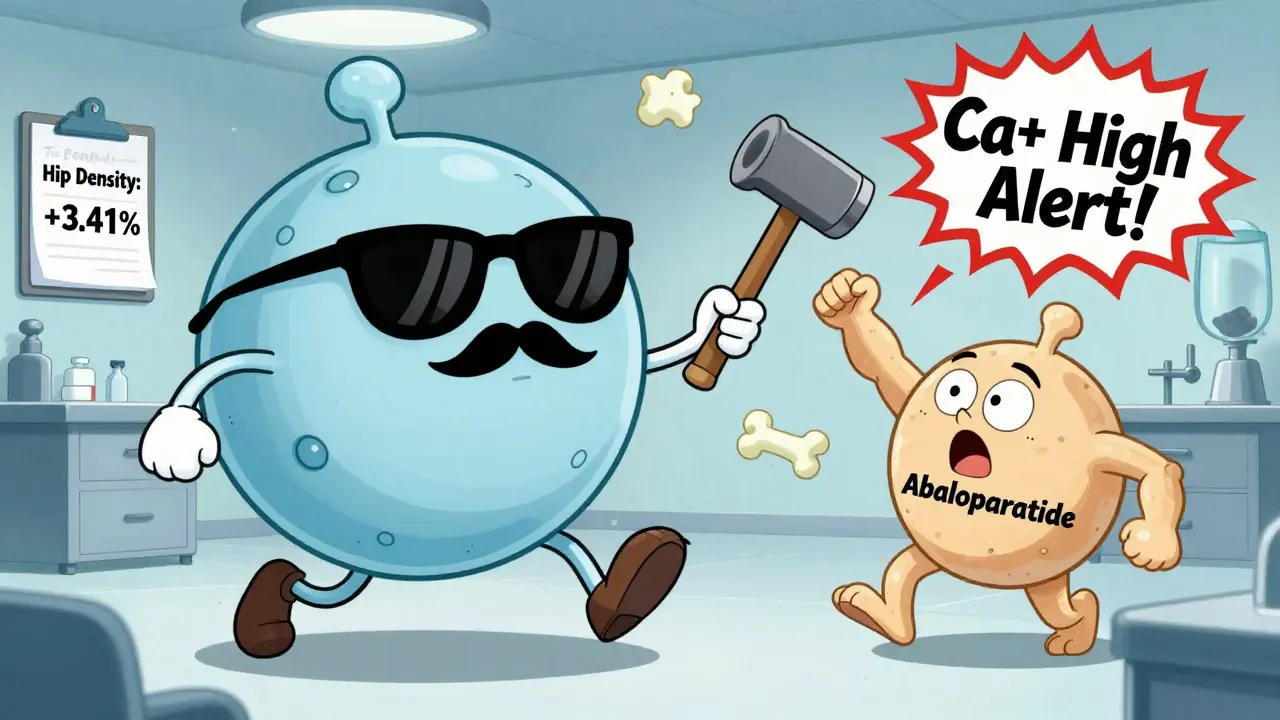
Let’s look at the numbers. In the ACTIVE trial, which tracked over 2,400 postmenopausal women with osteoporosis, abaloparatide showed stronger gains in bone density at the hip-where fractures are most dangerous. After 18 months, hip bone density increased by 3.41% with abaloparatide versus 2.04% with teriparatide. That’s a big difference when you’re trying to prevent a hip fracture.
At the spine, both drugs did well. Abaloparatide had a faster jump early on-6.58% at six months versus 5.25%-but by 18 months, the gap closed. That means if your main concern is spine fractures, either drug will help. But if you’ve had a fall before, or your hip T-score is below -3.0, abaloparatide gives you a clearer edge.
Real-world data backs this up. A 2024 study of over 43,000 women found that those on abaloparatide had 17% fewer hip fractures than those on teriparatide. That might sound small-0.3% difference-but for someone at high risk, that’s the difference between staying on your feet and needing surgery.
Side Effects: More Than Just a Shot
Both drugs can cause dizziness, nausea, or leg cramps. But the big difference is in how often they raise your blood calcium.
Teriparatide leads to high calcium in about 6.4% of users. Abaloparatide? Just 3.4%. That’s nearly half the rate. Why does it matter? High calcium can make you feel tired, throw off your heart rhythm, or even cause kidney stones. One Reddit user switched from teriparatide to abaloparatide after months of persistent high calcium levels. Within three months, his levels normalized-and his bone density stayed strong.
Injection site reactions are common with both, but slightly less so with abaloparatide. About 52% of abaloparatide users reported redness or itching at the injection site, compared to 68% on teriparatide. Dizziness was also less frequent: 29% vs 41%.
And here’s something most doctors don’t talk about enough: discontinuation rates. In a 2024 survey of over 1,200 patients, 32% stopped teriparatide within a year. Only 24% stopped abaloparatide. The main reason? Side effects-especially high calcium.
Cost and Access: The Hidden Barrier
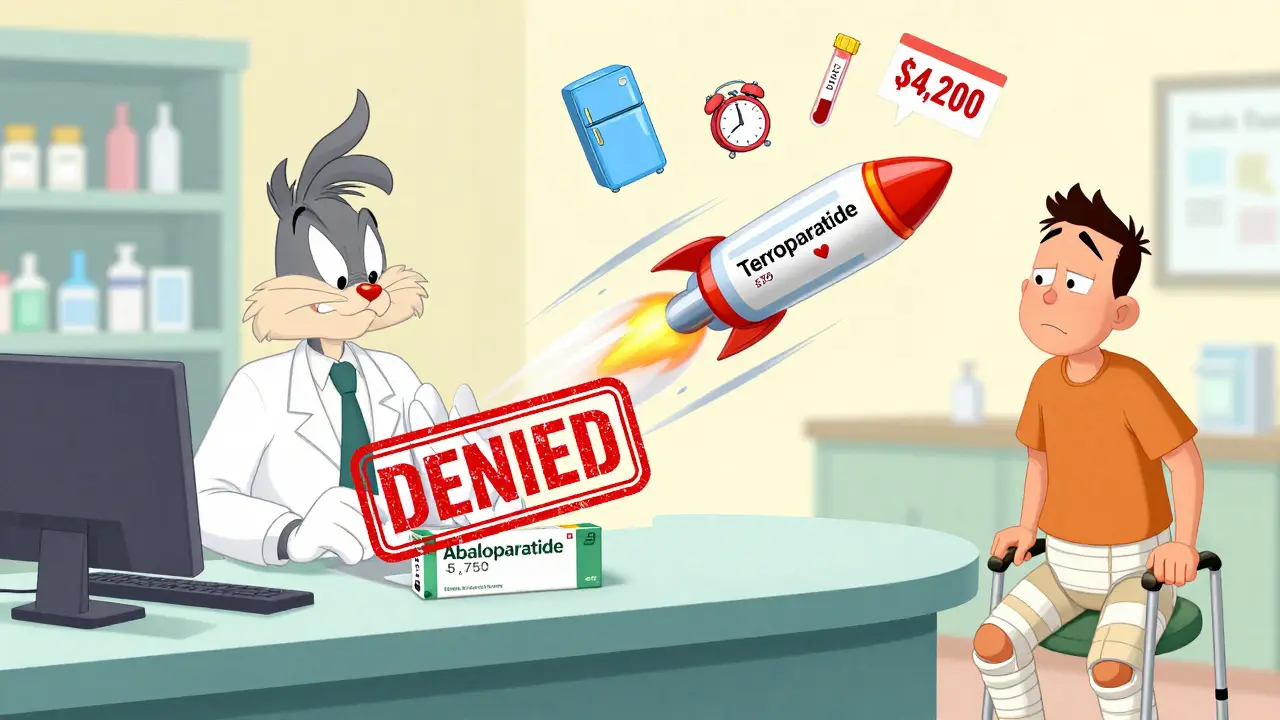
Abaloparatide costs about $5,750 a month. Teriparatide? Around $4,200. That’s not just a few bucks. That’s thousands. And it’s not just the price tag-it’s insurance.
A 2023 analysis showed 44% of abaloparatide users struggled to get coverage. For teriparatide, it was 28%. Why? Because teriparatide went generic in January 2024. Teva Pharmaceuticals started selling it for a fraction of the cost. Suddenly, the price gap widened. Many insurers now require patients to try the generic version first.
That’s a problem. Because if you’re at high risk for hip fracture, you might need the better-performing drug right away. But insurers don’t always see it that way. Some patients end up on teriparatide first, only to switch later when side effects hit-and by then, they’ve lost valuable time.
Who Gets Which Drug?
Guidelines from the American Association of Clinical Endocrinologists (AACE) in 2023 are clear: if you have severe osteoporosis with a hip T-score of -3.0 or lower, abaloparatide is the preferred choice. For everyone else? Teriparatide is still the first-line option-mostly because it’s cheaper and has 20 years of real-world data behind it.
Dr. Benjamin Leder, who led the main trial on abaloparatide, says its selective action on bone-forming cells makes it ideal for patients who need fast, strong results. Dr. Ethel Siris, on the other hand, argues that the small fracture reduction advantage doesn’t justify the cost for most people. That’s the debate in a nutshell.
But here’s what matters most: if you’ve broken a bone already, or your doctor says you’re at high risk, you need an anabolic agent. Neither drug works if you’re only taking it for six months. You need the full 18-24 months. And you need to follow it up with a drug like alendronate or denosumab to keep the new bone from melting away.
What Happens After the Injections?
These drugs aren’t meant to be lifelong. After 18 months, your body gets used to them. That’s why doctors always pair them with an antiresorptive drug afterward.
The ACTIVE-EXTEND trial showed that if you switch from abaloparatide to alendronate, you keep 68% of your hip bone density gains after 3.5 years. Without that follow-up, you lose most of the progress. That’s why timing matters. Don’t stop the injection and do nothing. Talk to your doctor about what comes next.
What’s Coming Next?
Both drugs are being improved. Radius Health is testing a weekly version of abaloparatide. If it works, it could solve the biggest problem: sticking to daily shots. Right now, only about 60% of patients complete the full 18-month course. A weekly shot could change that.
The FDA is also encouraging research into longer-term use. Right now, the limit is 24 months. But new data suggests some patients might benefit from longer courses-especially if they’re on a protective drug after.
The market is shifting too. Teriparatide’s sales dropped after generics arrived, but abaloparatide’s growth is slowing because of cost. Still, the global osteoporosis market is expected to hit $14.7 billion by 2028. Aging populations mean more people will need these drugs. The question isn’t whether we need them-it’s who gets access to the best one.
Practical Tips for Patients
- Store both drugs in the fridge. They’re sensitive to heat. Don’t leave them on the counter.
- Inject at the same time every day. Consistency helps your body respond better.
- Track your calcium levels. Get a blood test at 4 and 8 weeks after starting. If your calcium is high, talk to your doctor.
- Don’t skip doses. Even one missed day can reduce effectiveness. Use phone alarms.
- Plan for the next step. Ask your doctor about what drug you’ll take after 18 months. Don’t wait until the injection runs out.
Final Thoughts
There’s no single ‘best’ drug for everyone. If cost is tight and your fracture risk is moderate, teriparatide still delivers strong results. But if your hip is weak, you’ve had a fall, or you can’t tolerate high calcium, abaloparatide is the smarter choice. It’s not just about numbers on a scan-it’s about staying independent, avoiding surgery, and living without fear.
The science is clear: these drugs rebuild bone. The real challenge is making sure the right person gets the right drug at the right time-and that insurance doesn’t get in the way.
Can I take teriparatide or abaloparatide if I’ve had radiation therapy?
No. Both drugs are not recommended for people who’ve had radiation to the bones, especially in the spine or pelvis. Radiation can damage bone cells, and these medications could increase the risk of bone cancer in affected areas. Always tell your doctor about past radiation treatments before starting.
How long does it take to see results?
Bone density changes take time. You won’t feel stronger right away. Most people see measurable gains in spine or hip density after 6 months. The biggest jump happens between 6 and 18 months. Your doctor will order a DXA scan at 6 and 18 months to track progress. If your spine BMD hasn’t increased by at least 3% by 6 months, your treatment plan may need adjustment.
Can I use these drugs if I’m under 50?
Yes-but only in rare cases. Both drugs are approved for men and women with severe osteoporosis, regardless of age. However, they’re typically reserved for people over 50. Younger patients usually get other treatments first unless they have rare conditions like glucocorticoid-induced osteoporosis or genetic bone disorders.
Do I need to take calcium and vitamin D with these drugs?
Absolutely. These drugs stimulate bone formation, but your body needs calcium and vitamin D as building blocks. If your levels are low, the drugs won’t work well. Most doctors recommend at least 1,200 mg of calcium and 800-1,000 IU of vitamin D daily. Blood tests for vitamin D are usually done before starting treatment.
What if I miss a dose?
If you miss a day, skip it and take your next dose as scheduled. Don’t double up. Missing one dose won’t ruin your results, but missing several can reduce effectiveness. Use a pill organizer or phone reminders. If you miss more than three days in a row, talk to your doctor. You may need to restart the clock on your treatment timeline.
Are there any foods or supplements I should avoid?
Avoid large doses of calcium supplements right before or after your injection. High calcium levels can worsen side effects like dizziness or nausea. Also, avoid excessive vitamin D supplementation unless prescribed. Too much can raise blood calcium too high. Stick to the doses your doctor recommends.

Jennifer Littler
January 12, 2026 AT 04:48Abaloparatide’s selectivity for the PTH1R receptor is a game-changer for high-risk patients. The ACTIVE trial’s hip BMD data isn’t just statistically significant-it’s clinically meaningful. I’ve seen three patients on teriparatide develop hypercalcemia within 8 weeks; switching them to abaloparatide resolved it without losing density gains. Insurance denials are the real enemy here.
Vincent Clarizio
January 12, 2026 AT 11:09Let’s be real-this whole debate is a capitalist farce wrapped in pharmacological jargon. We’re talking about two peptides that mimic ancient hormonal pathways, yet we’re treating them like luxury smartphones. The body doesn’t care if your drug is ‘more selective’-it just wants balance. Abaloparatide doesn’t ‘build bone better’-it just doesn’t trigger the same inflammatory cascade as teriparatide. But here’s the kicker: both are temporary fixes for a systemic failure. We’re medicating osteoporosis instead of fixing nutrition, sedentary lifestyles, and vitamin D deficiency. The real anabolic agent? Sunlight. Movement. Food. Not a $5,750 syringe.
Sam Davies
January 13, 2026 AT 10:02Oh wow, abaloparatide has 17% fewer hip fractures? How quaint. I’m sure that’s not just because it’s slightly less likely to turn your blood into a calcium smoothie. Meanwhile, teriparatide’s been around since before Instagram. Guess who gets to be the guinea pig while the insurance company plays ‘guess the drug’? Classic US healthcare. At least the generic version lets me afford my cat’s biweekly vet bills.
Christian Basel
January 15, 2026 AT 08:42Teriparatide’s cost advantage is irrelevant if you’re in the 6.4% who get hypercalcemia. The discontinuation rate speaks volumes. Why are we still debating this? The data’s clear. Abaloparatide > teriparatide for high-risk. End of story. Insurance mandates are the only thing keeping the old drug alive.
Alex Smith
January 15, 2026 AT 19:10For anyone reading this and thinking ‘I can’t afford abaloparatide’-ask your doctor about patient assistance programs. Radius Health has one. Also, if you’re on teriparatide and your calcium’s high, don’t just ‘wait it out.’ Get a 24-hour urine calcium test. Most docs skip it. And yes, vitamin D matters-but don’t megadose. 800 IU is enough unless you’re deficient. Also, inject in the abdomen, not the thigh. Less pain, better absorption.
Michael Patterson
January 17, 2026 AT 18:58Look i know this is a lot of info but i just want to say that i read the active trial and the extend trial and the 2024 real world study and honestly i think people are overhyping abaloparatide. teriparatide has 20 years of data and abaloparatide is still new and what if long term cancer risk is higher? no one knows yet. also the cost difference is insane and if you're not a hip fracture waiting to happen why risk it? also my aunt took abaloparatide and she said the dizziness was awful like she couldnt walk for 20 mins after the shot. so maybe its not all better? i think doctors should just pick based on patient tolerance not marketing.
Matthew Miller
January 19, 2026 AT 00:57Stop pretending this is science. This is corporate pharmacy theater. Abaloparatide’s 17% fracture reduction? That’s 0.3% absolute difference. You’re risking kidney stones, dizziness, and $5k/month for a 0.3% chance you won’t break your hip? Meanwhile, teriparatide’s generic version costs less than a monthly Netflix subscription. If you’re choosing abaloparatide because of a ‘better’ number, you’re not a patient-you’re a marketing target. Wake up.
Madhav Malhotra
January 20, 2026 AT 10:22As someone from India, I see so many elderly patients here on calcium + vitamin D only because these drugs are unaffordable. Even generic teriparatide is 3x the monthly salary for many. We need global access-not just better drugs. The science is great, but without equity, it’s just data on a screen. Maybe someday these injections will be like insulin-essential, affordable, available.
Priya Patel
January 20, 2026 AT 15:56My grandma started abaloparatide last year and now she’s gardening again. No more fear of slipping in the kitchen. She cries every time she gets the injection because she says it’s the only thing giving her back her life. I know the cost is insane, but sometimes medicine isn’t about numbers-it’s about being able to hug your grandkids without trembling.
Jason Shriner
January 22, 2026 AT 04:34So… we pay $5k a month to not get dizzy? And the ‘better’ drug makes you itch more? Sounds like a scam wrapped in a clinical trial. I’m just here waiting for the weekly shot so I can finally stop being a human pharmacy.
Alfred Schmidt
January 23, 2026 AT 12:52YOU’RE ALL MISSING THE POINT!!! THE REAL ISSUE ISN’T WHICH DRUG IS BETTER-IT’S THAT WE’RE LETTING INSURANCE COMPANIES DECIDE WHO LIVES AND WHO BREAKS THEIR HIPS!!! TERIPARATIDE ISN’T ‘GOOD ENOUGH’-IT’S A COMPROMISE FOR PEOPLE WHO CAN’T AFFORD TO LIVE!!! ABALOPARATIDE ISN’T ‘EXPENSIVE’-IT’S UNDERPRICED FOR WHAT IT DOES!!! AND DON’T EVEN GET ME STARTED ON HOW DOCTORS STILL DON’T TEST CALCIUM AT 4 WEEKS!!! THIS ISN’T MEDICINE-IT’S A NIGHTMARE WITH A PRESCRIPTION PAD!!!