
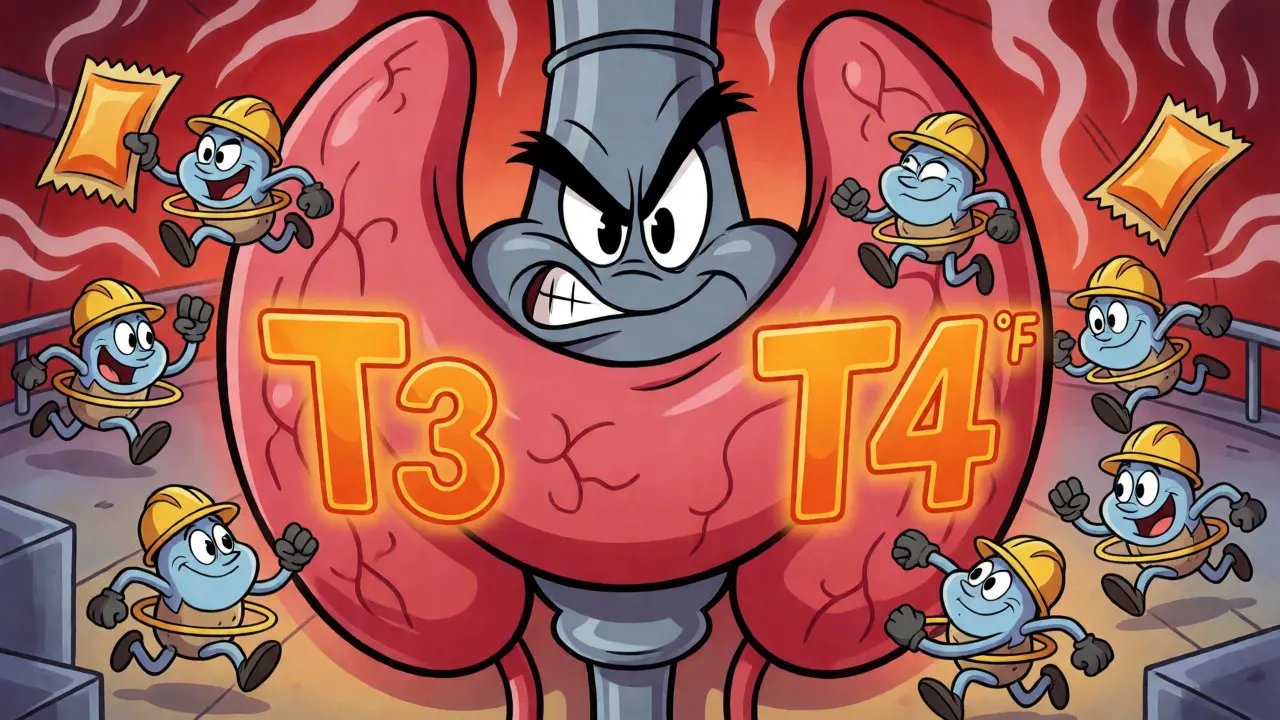
Imagine waking up with a heart racing at 150 beats per minute, a fever spiking to 104°F, and your mind slipping into confusion. You aren't just having a bad day; you are experiencing Thyroid Storm, also known as thyrotoxic crisis. This is not typical hyperthyroidism. It is a rare but catastrophic medical emergency where an excess of thyroid hormones sends your body's metabolism into overdrive, leading to multi-organ failure. Without immediate intervention, the mortality rate can be staggering, but with rapid ICU care, survival rates improve significantly.
What Exactly Is Thyroid Storm?
Thyroid storm is an acute, life-threatening complication of uncontrolled hyperthyroidism characterized by extreme elevations of thyroid hormones (T3 and T4) and severe systemic symptoms. While about 1.2% of the population deals with hyperthyroidism, thyroid storm is exceedingly rare, occurring in roughly 0.2 cases per 100,000 people annually. However, it accounts for 1-2% of hospitalized patients with hyperthyroidism. The condition transforms a manageable chronic issue into a race against time. Unlike standard hyperthyroidism, which develops slowly, thyroid storm hits hard and fast, often over hours rather than weeks.
The physiological mechanism involves a massive release of triiodothyronine (T3) and thyroxine (T4), coupled with increased sensitivity of tissues to these hormones. This surge accelerates cellular metabolism to unsustainable levels. Your body essentially burns through its resources too quickly, overheating and exhausting vital organs. If left untreated, the outcome is almost invariably fatal. Modern medicine has improved survival odds, but the window for effective treatment remains narrow.
Identifying the Warning Signs
Diagnosing thyroid storm relies on recognizing a specific cluster of severe symptoms across multiple organ systems. The Japan Thyroid Association and American Thyroid Association have established criteria that clinicians use to distinguish this crisis from uncomplicated thyrotoxicosis. You don't need to be a doctor to spot the red flags, but understanding them can save a life.
- Extreme Fever: Temperatures often exceed 104°F (40°C). This isn't a mild warm-up; it's dangerous hyperthermia accompanied by heavy sweating (diaphoresis).
- Tachycardia: Heart rates frequently surpass 140 beats per minute. This puts immense strain on the heart, potentially leading to atrial fibrillation or heart failure.
- CNS Manifestations: Altered mental status is present in 90% of cases. Symptoms range from agitation and restlessness to delirium, psychosis, seizures, and coma.
- Gastrointestinal Distress: Nausea, vomiting, and diarrhea occur in 50-60% of patients. Severe cases may involve jaundice due to liver dysfunction.
- Cardiovascular Instability: Systolic blood pressure may spike above 180 mmHg initially, but hypotension (low blood pressure) signals impending cardiovascular collapse and carries a high risk of death.
The Burch-Wartofsky Point Scale is a tool doctors use to quantify severity. A score above 45 is highly suggestive of thyroid storm. Each point added to the score correlates with a 1.05 times higher mortality risk, highlighting why early recognition is critical.
Common Triggers That Spark the Crisis
Thyroid storm rarely happens out of nowhere. It is usually precipitated by a stressor in someone with underlying, often poorly managed, hyperthyroidism. Identifying these triggers helps in prevention and rapid diagnosis.
| Trigger Category | Specific Examples | Frequency/Notes |
|---|---|---|
| Infection | Respiratory infections, urinary tract infections, sepsis | Accounts for 20-30% of cases |
| Medication Issues | Sudden withdrawal of antithyroid drugs, non-adherence | Common in patients stopping meds without consulting doctors |
| Trauma/Surgery | Physical trauma, surgical procedures (especially thyroid surgery) | Occurs in 15-20% of cases |
| Pregnancy | Postpartum period, pre-eclampsia | Hormonal shifts can destabilize thyroid function |
| Medical Procedures | Radioactive iodine therapy, contrast dye exposure | Rarely occurs 1 week post-treatment |
Severe emotional distress, stroke, diabetic ketoacidosis, and pulmonary embolism are other notable triggers. For instance, a patient with Graves' disease who stops taking their methimazole abruptly before a major surgery might spiral into a crisis within days.
ICU Management: The Multi-Pronged Approach
Treating thyroid storm requires aggressive, simultaneous interventions. The Endocrine Society guidelines mandate starting treatment within 1-2 hours of suspicion. Delaying even by a few hours drastically reduces survival chances. The goal is to block hormone production, prevent conversion of T4 to the more active T3, control peripheral effects, and support failing organs.
Step 1: Block Hormone Synthesis
Antithyroid medications are the first line of defense. Propylthiouracil (PTU) is often preferred in severe cases because it blocks the conversion of T4 to T3 in addition to inhibiting new hormone synthesis. A loading dose of 600-1,000 mg is given, followed by 200-250 mg every four hours. Alternatively, Methimazole may be used at 60-80 mg loading dose, then 15-20 mg every 4-6 hours.
Step 2: Inhibit Hormone Release
One hour after administering antithyroid drugs, iodine solutions like potassium iodide or sodium iodide are given. This exploits the Wolff-Chaikoff effect, temporarily blocking the release of stored thyroid hormones from the gland. Crucially, iodine must never be given before antithyroid drugs, as it could provide substrate for more hormone production.
Step 3: Control Peripheral Effects
Beta-blockers, particularly Propranolol, are vital for managing tachycardia, tremors, and anxiety. Propranolol is favored because it also partially inhibits T4-to-T3 conversion. Doses range from 60-80 mg orally every 4-6 hours or intravenous administration for rapid control. For patients who cannot tolerate beta-blockers, calcium channel blockers like diltiazem are alternatives.
Step 4: Supportive Care and Steroids
Corticosteroids such as hydrocortisone (100 mg IV every 8 hours) are administered to treat potential adrenal insufficiency and further reduce T4-to-T3 conversion. Aggressive cooling measures and acetaminophen help manage fever, while fluid resuscitation corrects dehydration. Patients often require mechanical ventilation if consciousness declines and vasopressors if blood pressure drops dangerously low.
Prognosis and Recovery Trajectories
Time is the most significant predictor of outcome. Survival rates jump from 20% when treatment starts after 24 hours to 75-80% when initiated within six hours of symptom onset. Despite modern ICU care, mortality still ranges between 8-25%, rising to 30% in elderly patients or those with delayed diagnosis.
Recovery follows a predictable pattern in survivors. Agitation typically resolves within 24-48 hours of treatment initiation. Confusion improves within 72 hours, though full cognitive recovery may take 7-14 days. According to data from the Cleveland Clinic, 68% of patients require mechanical ventilation for a median of 5.2 days, and the average ICU stay lasts 7.8 days, with total hospitalization around 14.3 days.
Long-term management focuses on preventing recurrence. About 85% of survivors eventually undergo definitive treatment-either radioactive iodine ablation or thyroidectomy-and require lifelong thyroid hormone replacement. Recurrence rates are low (2-3%) if the underlying hyperthyroidism is well-controlled but spike to 25-30% in patients who fail to adhere to follow-up care.
Frequently Asked Questions
Can thyroid storm happen to anyone?
No, it specifically affects individuals with existing hyperthyroidism, such as those with Graves' disease or toxic nodular goiter. It is extremely rare in people with normal thyroid function. However, it can occur in undiagnosed cases where hyperthyroidism has been present but unnoticed until a severe trigger causes a crisis.
How is thyroid storm different from a thyroid nodule?
A thyroid nodule is a lump in the thyroid gland, which may or may not produce excess hormone. Thyroid storm is a systemic medical emergency caused by excessive hormone levels affecting the entire body. While a nodule might cause local symptoms like difficulty swallowing, thyroid storm causes life-threatening systemic issues like heart failure, high fever, and altered mental status.
Is thyroid storm contagious?
No, thyroid storm is not contagious. It is a metabolic disorder resulting from internal hormonal imbalances. While infections can trigger thyroid storm in susceptible individuals, the storm itself is not transmitted from person to person.
What is the role of plasmapheresis in treatment?
Plasmapheresis is a procedure that filters blood to remove excess thyroid hormones and antibodies. It is reserved for severe, refractory cases where conventional medication fails to lower hormone levels. Recent studies suggest a 78% success rate in patients who did not respond to standard drug therapies.
Can I prevent thyroid storm?
Yes, primarily by adhering to prescribed treatments for hyperthyroidism. Never stop antithyroid medications abruptly without consulting your doctor. Manage infections promptly, avoid unnecessary stress, and inform surgeons about your thyroid history before any operation. Regular monitoring of thyroid function tests is essential for long-term stability.



Aurelio Haney
September 4, 2026 AT 15:41Finally someone writes something accurate. Most of you don't even know the difference between T3 and T4 :P
Jim Bisesi
September 6, 2026 AT 10:45Ugh, too much text. I just want to know if it hurts.
Shu Chowdhury
September 8, 2026 AT 09:50it sounds terrifying
my aunt had graves disease but never got to this stage
glad she caught it early
Jeremy Westcott
September 9, 2026 AT 06:13Big Pharma hides the real cures for thyroid issues because they profit off lifelong meds like PTU and Methimazole which have nasty side effects anyway. The iodine part is suspicious too since we are told to avoid iodine but then pumped full of it in the ICU. It feels like a controlled chaos experiment rather than genuine healing.
Falgun R Patel
September 10, 2026 AT 04:28The body is a complex system where balance is key. When that balance tips so violently, it reflects our deeper disconnect from natural rhythms. We must respect the fragility of life and the power of timely intervention. Compassion for those suffering is essential here.
Amanda SF
September 11, 2026 AT 23:50The statistical data provided is adequate but lacks nuance regarding comorbidities. Furthermore, the emphasis on beta-blockers ignores potential contraindications in asthmatic patients which should be highlighted more prominently for clinical accuracy.
Rebecca Makayla Crane
September 13, 2026 AT 12:06OMG this is so important 🤯
I literally thought my anxiety was just me being dramatic until I read about the tachycardia. Scary stuff!! 💀
We need more awareness on this ASAP.
Pramay Dattani
September 13, 2026 AT 22:06In India we see many cases due to lack of proper follow up. Western medicine saves lives but cost is high. Our ayurvedic approach helps maintenance but storm needs hospital care always. Good info for everyone.
Louis Tarro
September 15, 2026 AT 05:35This is a vital piece of information for all of us. It highlights the importance of adhering to medication schedules strictly. Ignoring these signs can lead to catastrophic outcomes indeed.
Amy B
September 16, 2026 AT 15:57Wait, does stress really trigger it that fast? Like, can one bad week at work actually send someone into a crisis if they have underlying issues? That seems insane but also super plausible given how connected everything is.
Rob Alderman
September 17, 2026 AT 02:57The Burch-Wartofsky scale is archaic. Modern diagnostics rely more on free hormone indices and clinical gestalt. This article feels slightly outdated in its pedagogical approach.
Mary Tait
September 17, 2026 AT 04:58American healthcare handles this better than anywhere else. The survival rates cited prove our system works when followed correctly. Other countries struggle with delayed diagnosis due to poor infrastructure.
Neil Sahli
September 19, 2026 AT 04:53You guys are overthinking it! Just take your pills and chill 😂 Seriously though, staying positive helps the immune system fight back. You got this!