
What Deep Brain Stimulation Actually Does for Parkinson’s
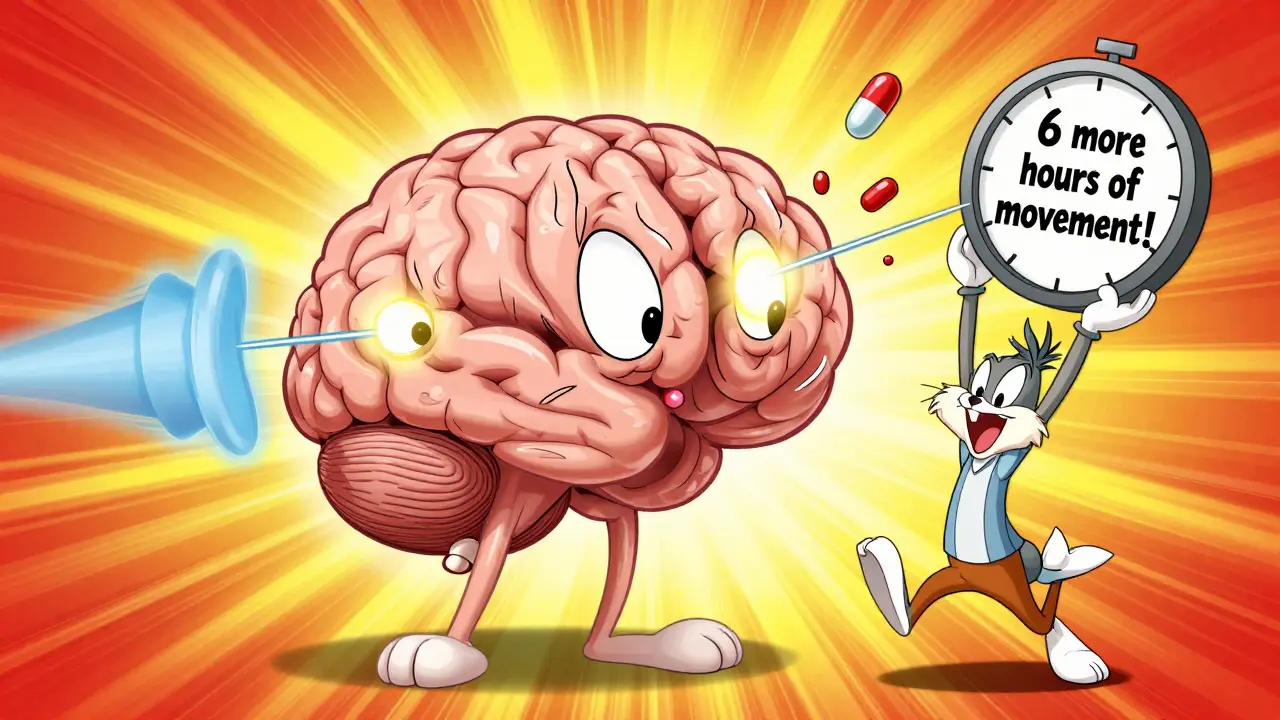
Deep Brain Stimulation, or DBS, doesn’t cure Parkinson’s. It doesn’t stop the disease from progressing. But for many people, it changes everything. If your tremors won’t quit, your meds cause wild swings between too much movement and no movement at all, or you’re stuck in "off" periods where you can barely stand up - DBS can give you back hours of your day. It works by sending tiny electrical pulses to specific spots in the brain that control movement. These pulses don’t destroy tissue like older surgeries did. Instead, they reset the noisy signals causing the shaking, stiffness, and slowness.
The most common targets are the subthalamic nucleus (STN) and the globus pallidus interna (GPi). STN tends to let people cut back on their levodopa pills by 30-50%, which means fewer side effects like involuntary jerks. GPi doesn’t reduce meds as much, but it often handles those jerks - called dyskinesias - better. Neither target fixes balance issues, freezing, or speech problems. That’s important to know upfront. DBS treats the symptoms that respond to levodopa. If your tremor doesn’t improve with medication, DBS probably won’t help either.
Who Is a Good Candidate for DBS?
Not everyone with Parkinson’s qualifies. The rules aren’t vague - they’re strict for good reason. The Core Assessment Program for Surgical Interventional Therapies in Parkinson’s Disease (CAPSIT-PD) laid the groundwork in 1999, and most centers still follow it. You need at least five years of Parkinson’s diagnosis. You must show a clear, strong response to levodopa - at least a 30% improvement on the UPDRS motor scale when you’re on your meds versus off. If you barely move when you’re off meds and then suddenly feel like you’re 40 again after a pill, that’s the kind of response DBS can lock in.
But here’s what most people miss: your brain health matters just as much as your body. You can’t have significant memory loss or depression that hasn’t been treated. A score below 24 on the MMSE or below 21 on the MoCA usually disqualifies you. Why? Because DBS can sometimes make thinking problems worse. If you’re already struggling to remember names or plan your day, adding brain stimulation might push you over the edge. And if you have atypical Parkinson’s - like progressive supranuclear palsy or multiple system atrophy - DBS won’t help. Those conditions don’t respond to levodopa, and they won’t respond to DBS either. Around 90% of people who don’t improve after DBS fall into this category.
The Surgery: What to Expect Before, During, and After
The surgery takes 3 to 6 hours and is usually done while you’re awake. Yes, you’re sedated, but you’re conscious enough to follow commands. That’s because the surgeons need to test your response as they place the electrodes. They use a metal frame on your head, high-res 3T MRI scans, and microelectrode recordings to find the exact millimeter in your brain where the signal needs to be corrected. It sounds intense, but most patients say the discomfort is manageable. The electrodes are thin - just 1.27mm wide - and they’re threaded through small holes in your skull. Then, wires run under your skin to a battery pack, usually placed near your collarbone or abdomen.
After surgery, you’re not done. The device doesn’t turn on right away. You wait about 4 weeks for swelling to go down. Then comes the real work: programming. It’s not like adjusting a TV remote. Every setting - voltage, frequency, pulse width - needs fine-tuning over months. Some people need 6 to 12 visits before they feel stable. During this time, you’ll need to keep a symptom diary: when you feel stiff, when you shake, when your meds kick in. Your neurologist will match those notes to the stimulation settings. The best centers have dedicated DBS coordinators who help you through this. Smaller clinics? You’re on your own.
Real Results: What Patients Actually Experience
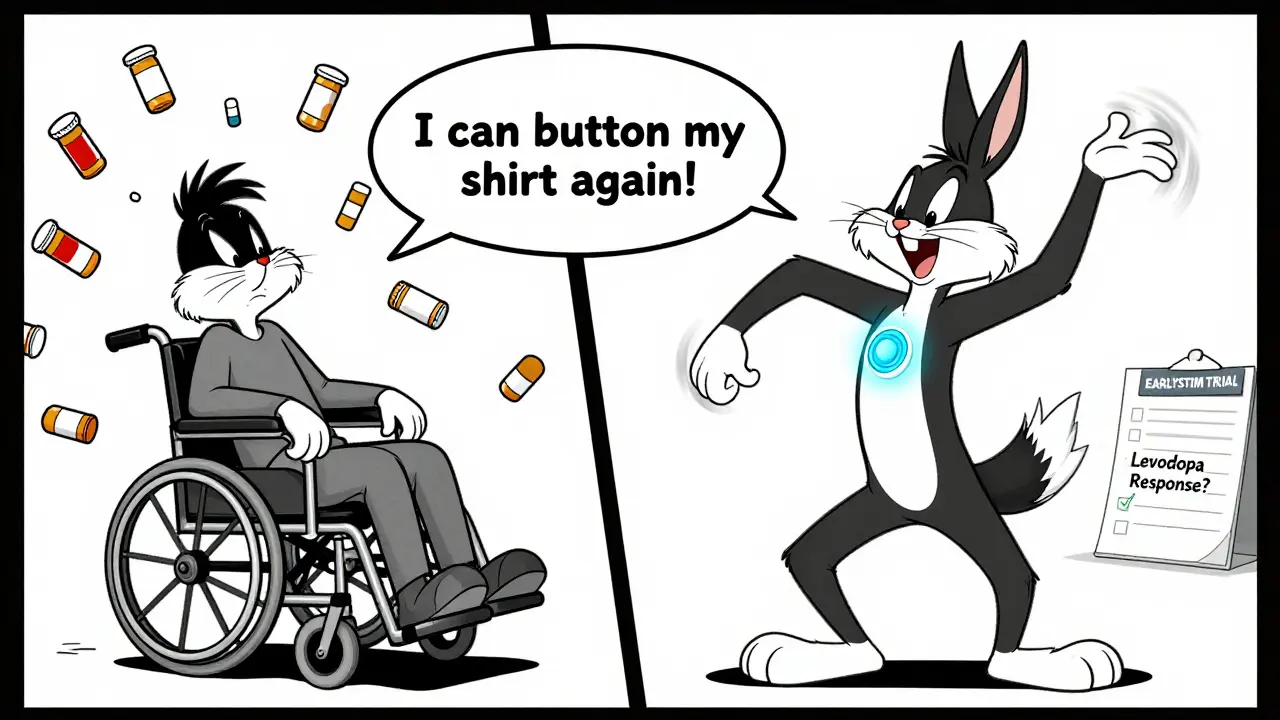
The EARLYSTIM trial from 2013 is the gold standard. It showed patients who got DBS early - after only 4 years of Parkinson’s - improved 23 points on a quality-of-life scale. Those on meds alone improved just 12.5 points. That’s not just a number. That’s being able to button your shirt, walk to the mailbox, or sleep through the night without waking up rigid.
Most people see a 60-80% drop in "off" time. Dyskinesias shrink by up to 80%. Medication doses drop. But here’s the reality check: 10-15% of patients need hardware revisions. Wires can break. Batteries die. Infections happen. Rechargeable batteries last 9 to 15 years. Non-rechargeable ones need replacement every 3 to 5 years. That means more surgeries down the line.
And then there’s the cognitive side. Some patients report trouble finding words, slower thinking, or losing focus. One Reddit user said planning meals took three times longer after DBS. Another said they could move better but felt emotionally flat. These aren’t rare. They’re expected in a subset of patients. That’s why neuropsychological testing before surgery isn’t a formality - it’s a safety net.
DBS vs. Other Treatments
What about focused ultrasound? It’s non-invasive, no surgery needed. But it only works on one side of the brain, so it’s best for tremor-dominant cases. It doesn’t help with stiffness or slowness as well. And you can’t adjust it after the fact. DBS is adjustable, reversible, and bilateral.
What about lesioning surgeries like pallidotomy? They destroy tissue permanently. One mistake, and you could have lasting weakness or speech problems. DBS doesn’t burn anything. You can turn it off. You can reprogram it. It’s the safer, smarter long-term choice - if you’re a good candidate.
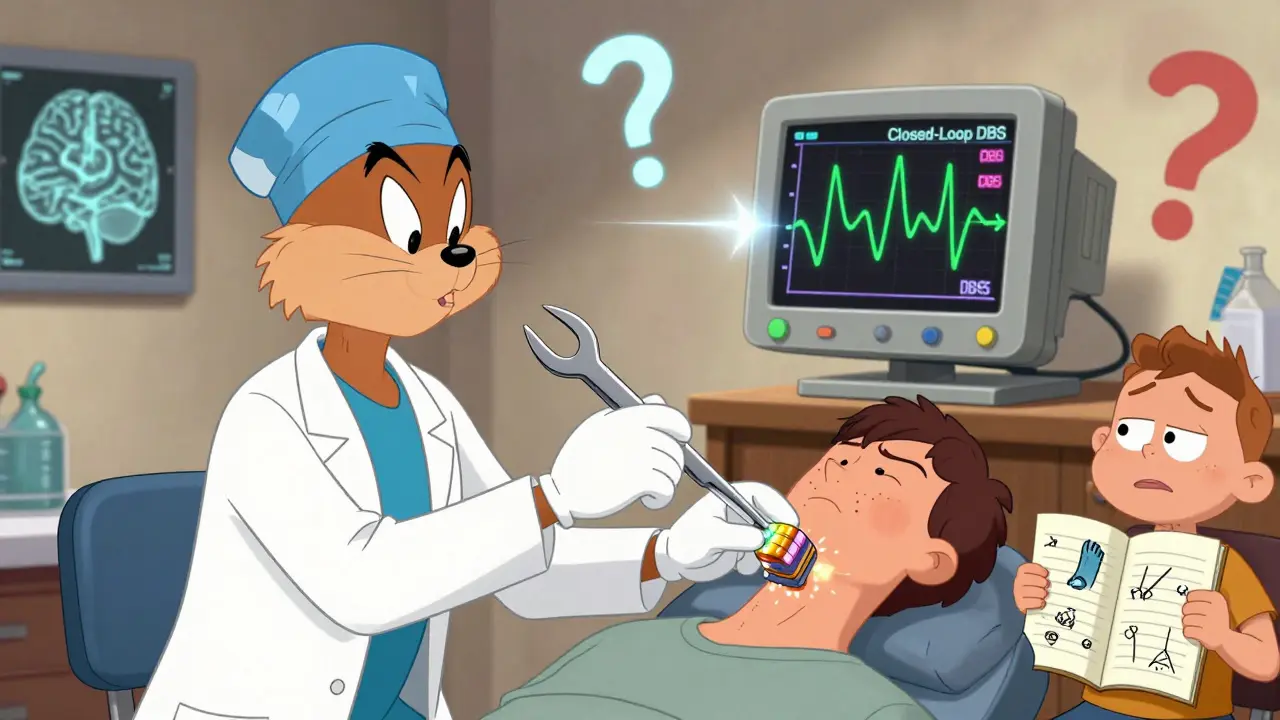
And then there’s the new stuff: closed-loop DBS. Medtronic’s Percept™ PC system, approved in 2020, can actually sense brain activity. It detects abnormal beta wave patterns (13-35 Hz) and adjusts stimulation automatically. Early data shows it’s 27% more effective than traditional DBS. This isn’t science fiction - it’s happening now. These systems record data, store it, and even let your doctor monitor your brainwaves remotely via Bluetooth.
Cost, Insurance, and Access
DBS isn’t cheap. In the U.S., the total cost - surgery, device, hospital stay, follow-ups - runs between $50,000 and $100,000. Medicare covers it for Parkinson’s since 2003. Most private insurers do too, but you’ll need to prove you’ve tried and failed on optimal medication for at least 6 months. That paperwork alone can take 3 to 6 months.
And here’s the biggest problem: most people who qualify never even get referred. Studies show only 1 to 5% of eligible Parkinson’s patients get DBS. Why? Many neurologists don’t bring it up until the disease is advanced. Others assume patients won’t want surgery. But the data is clear: the earlier you do it - once you’re past 5 years and still responding well to levodopa - the better your long-term outcome. Waiting until you’re in a wheelchair or can’t swallow doesn’t help.
The Future: Personalized DBS and Beyond
Research is moving fast. The EARLYSTIM-2 trial is testing DBS in people with just 3 years of Parkinson’s. If it works, we might start offering it before motor symptoms become disabling. There’s also work on using genetic markers. People with the LRRK2 mutation respond 15% better to DBS, according to a 2023 Lancet Neurology study. That could mean future screenings include DNA tests.
Doctors are also looking at non-motor symptoms. Can DBS help with depression? With sleep? With anxiety? Early signals say yes - but it’s still experimental. The goal isn’t just to make you move better. It’s to make you feel better, too.
What to Do If You Think You Might Be a Candidate
Start with your movement disorder neurologist. Ask: "Do I still respond well to levodopa?" If yes, ask for a referral to a DBS center. Don’t settle for a general neurologist. You need a team: a neurologist who specializes in Parkinson’s, a neurosurgeon who does at least 50 DBS procedures a year, and a neuropsychologist who tests for thinking and mood changes. Ask about their outcomes. How many complications do they have? How many patients need revisions? Don’t be shy.
And don’t wait. If you’re still getting good results from meds, but you’re tired of the rollercoaster - now is the time. DBS isn’t a last resort. It’s a life upgrade. And for the right person, it’s the best thing that’s happened since their diagnosis.
Can DBS cure Parkinson’s disease?
No, DBS does not cure Parkinson’s. It does not stop the disease from progressing. It only treats motor symptoms that respond to levodopa - like tremors, stiffness, slowness, and dyskinesias. It does not improve balance, speech, swallowing, or cognitive decline. Patients still need to take medication, though often at lower doses.
How long does DBS last?
The effects of stimulation last as long as the device works. Most modern DBS systems last 9 to 15 years with rechargeable batteries. Non-rechargeable batteries need replacement every 3 to 5 years. The brain’s response to stimulation typically remains stable for at least 10 years, with 85% of patients still benefiting at that point. However, Parkinson’s continues to progress, so symptoms not controlled by DBS - like balance issues - may worsen over time.
Is DBS safer than taking more medication?
For many patients, yes. Long-term high-dose levodopa causes dyskinesias, nausea, low blood pressure, and hallucinations. DBS reduces the need for these meds by 30-50%, which cuts those side effects significantly. Surgical risks - like bleeding or infection - are low (1-3% for bleeding, 5-15% for hardware issues). For someone struggling with uncontrolled movements and medication side effects, DBS often offers a better risk-benefit balance than adding more pills.
Can DBS help with freezing or falling?
Not reliably. DBS improves walking speed and stride length in some patients, but it rarely fixes freezing of gait or balance problems. These symptoms don’t respond well to levodopa, and DBS doesn’t either. Some newer closed-loop systems show promise, but current evidence shows only 20-30% improvement in axial symptoms. Patients with frequent falls need other strategies - physical therapy, assistive devices, home modifications.
What happens if the battery dies?
If the battery dies, stimulation stops. Symptoms return to their pre-DBS state - often within hours. For non-rechargeable devices, a minor outpatient surgery replaces the pulse generator. Rechargeable batteries last longer but require daily charging. Most systems have alerts to warn you before the battery runs out. Never ignore a low-battery warning. Always carry a backup device programmer if you travel.
Are there alternatives to DBS for Parkinson’s?
Yes, but they’re limited. Focused ultrasound (Exablate Neuro) is non-invasive and FDA-approved for tremor-dominant Parkinson’s, but only on one side of the brain. It doesn’t help with stiffness or slowness. Lesioning surgeries like pallidotomy are irreversible and risk permanent side effects. Medication adjustments are always the first step, but when they stop working or cause intolerable side effects, DBS is the next best option for eligible patients.
Why is DBS underused in Parkinson’s patients?
Many neurologists don’t bring it up early, assuming patients won’t want surgery or that it’s only for advanced cases. Others lack access to specialized DBS centers. Insurance delays and lack of coordination between specialists also slow things down. Studies show only 1-5% of eligible patients get DBS, even though 30-40% meet the criteria. The result? Thousands of people live with avoidable disability because they never got referred.
Can DBS help with depression or anxiety in Parkinson’s?
Some patients report mood improvements after DBS, especially if their depression was tied to motor disability. But DBS is not approved or reliably effective for treating depression or anxiety on its own. In fact, some patients experience new or worsened mood symptoms, especially with STN stimulation. Careful screening and ongoing mental health support are essential before and after surgery.

Christina Bischof
December 16, 2025 AT 20:45Lisa Davies
December 17, 2025 AT 07:24Nupur Vimal
December 17, 2025 AT 22:03Jocelyn Lachapelle
December 19, 2025 AT 13:19Cassie Henriques
December 21, 2025 AT 00:31Mike Nordby
December 22, 2025 AT 14:01John Samuel
December 23, 2025 AT 13:01RONALD Randolph
December 24, 2025 AT 06:52Jake Sinatra
December 25, 2025 AT 22:18