
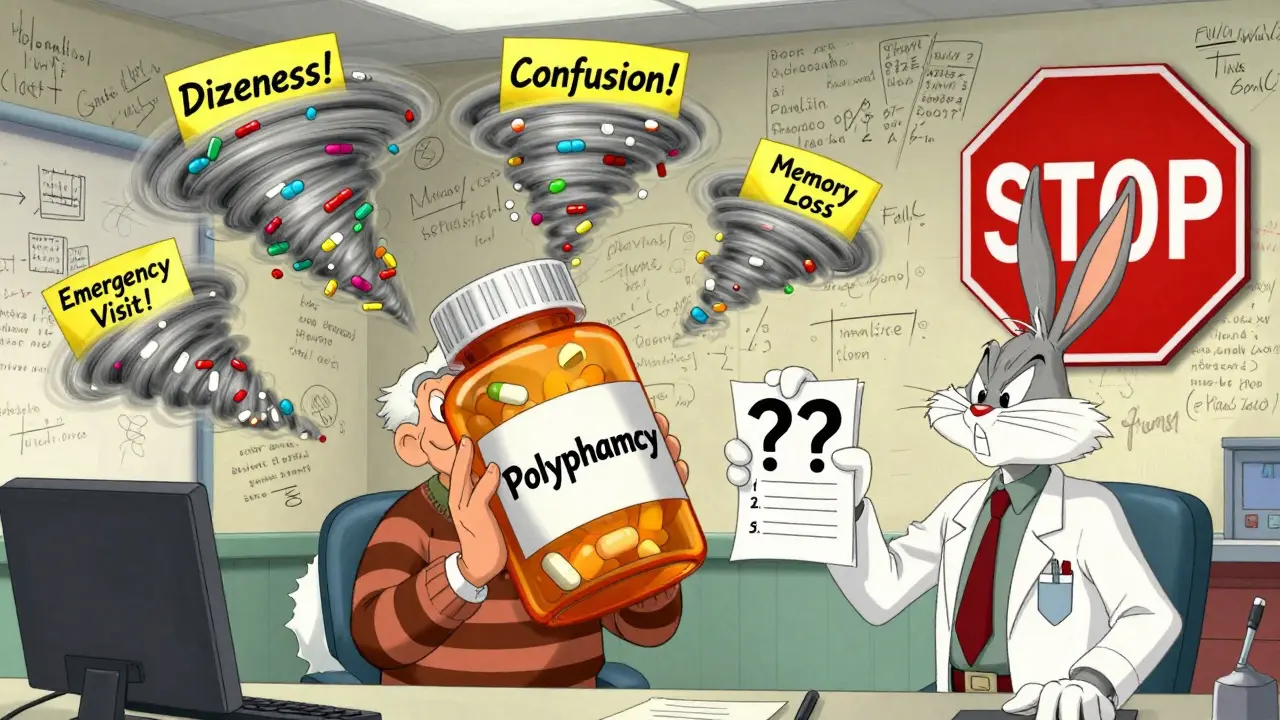
Every year, over 1.3 million people visit the emergency room because of unexpected reactions to medications. Many of these cases aren’t accidents-they’re preventable. The biggest gap? Patients not asking the right questions. If you’re taking even one prescription, you need to know what to ask your doctor before you leave the office. This isn’t about being difficult. It’s about staying safe.
Why Asking About Side Effects Matters
Most people think side effects are just minor annoyances-dry mouth, drowsiness, upset stomach. But for older adults, especially those on five or more medications, these reactions can be deadly. A 2022 study in JAMA Internal Medicine found that patients who asked even one clear question about side effects were 22% less likely to have a preventable adverse event. That’s not a small number. It’s life-changing.
Think about it: 34% of adults aged 65-80 take five or more medications. That’s called polypharmacy. Each one adds risk. One drug might cause dizziness. Another might make you forgetful. Together, they can lead to falls, hospital stays, or even permanent damage. The good news? You don’t need to be a medical expert to protect yourself. You just need to know what to ask.
5 Essential Questions to Ask Your Doctor
Based on guidelines from the National Prescribing Service (NPS) Australia, the FDA, and leading U.S. medical centers, here are the five most important questions you should ask every time a new medication is prescribed:
- Why am I taking this medicine? It sounds basic, but 12.4% of patients can’t correctly name their own medication, according to Medscape’s 2023 Patient Safety Report. If you don’t know why you’re taking it, you can’t recognize when something’s wrong. Is it for blood pressure? For sleep? For pain? Write it down.
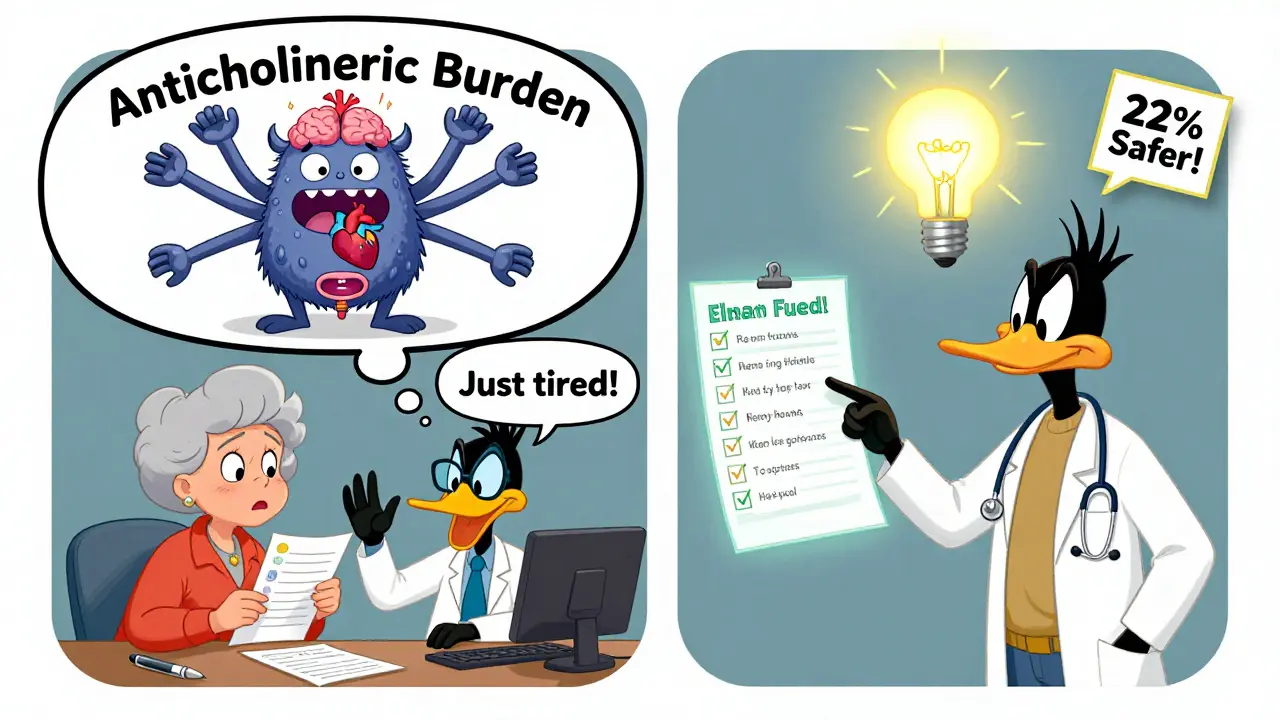
- What are the side effects? Don’t settle for “some people get a headache.” Ask for the most common ones-and the serious ones. For example, anticholinergic drugs (common in older adults) can cause confusion, constipation, dry eyes, and urinary retention. These aren’t just uncomfortable-they can mimic dementia. The Anticholinergic Cognitive Burden Scale (ACB) lists 27 systems affected. Ask if your meds are on that list.
- What can I do about side effects? This is where you get real help. If you’re getting nausea from metformin, taking it with food cuts it by 70%. If you’re dizzy from blood pressure meds, standing up slowly can prevent falls. Don’t assume your doctor will volunteer this. Ask for specific, practical steps.
- Are there alternatives? The Beers Criteria-a trusted list used by doctors-identifies 56 medications that are risky for people over 65. That doesn’t mean they’re banned. It means safer options exist. Maybe there’s a different class of drug, a lower dose, or even a non-drug treatment like physical therapy for chronic pain.
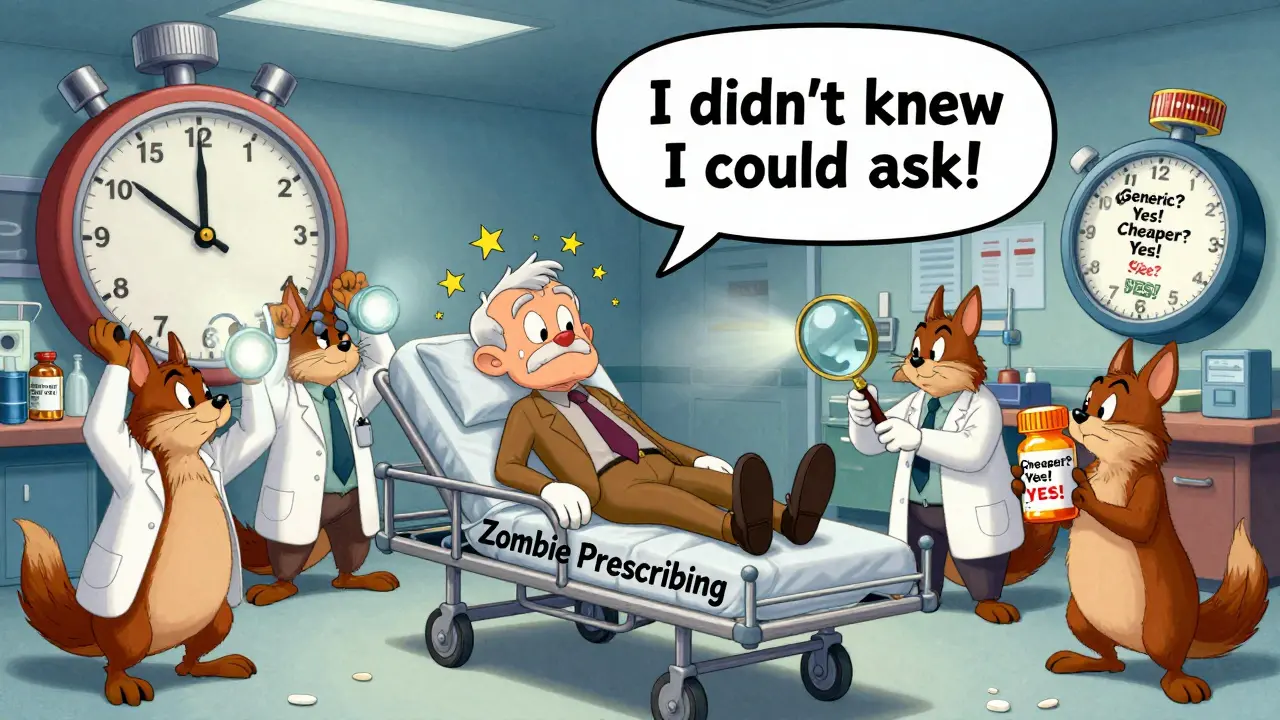
- Do I still need to take this medicine? About 15% of medications in older adults are continued long after they’re needed. That’s called “zombie prescribing.” A 2023 Cochrane Review showed that when doctors and patients review meds together, 30% of unnecessary ones can be safely stopped. Ask: “If I stop this, what happens?”
Additional Questions That Could Save Your Life
Beyond the core five, here are other critical questions based on real data from top medical institutions:
- What is the name of the medicine, and what is it supposed to do? Many patients mix up brand names and generic names. If your doctor says “Lipitor” but the pharmacy gives you “atorvastatin,” do you know they’re the same? Write both down.
- Should I take this with or without food? Food affects 40% of medications. Some need an empty stomach. Others must be taken with a meal to avoid vomiting. One wrong detail can make the drug useless-or dangerous.
- Could this interact with other drugs I’m taking? The Lexicomp database tracks over 1,200 drug interactions. A common one: blood thinners like warfarin + ibuprofen = 2.8 times higher bleeding risk. Even over-the-counter meds like diphenhydramine (Benadryl) can cause confusion, urinary retention, and heart rhythm issues in older adults. List everything-even vitamins and herbal supplements.
- Will this medicine make any of my other conditions worse? For example, some beta-blockers can worsen asthma. Some antidepressants can raise blood sugar in diabetics. Your doctor may not know your full history unless you tell them.
- What constitutes a serious side effect? The FDA defines serious as: hospitalization, life-threatening events, disability, death, or birth defects. If you’re told “it’s normal to feel tired,” ask: “Is this one of the serious ones?” If you’re unsure, call your pharmacist.
- Is there a generic version? Is it as effective? Generics are 89% cheaper and just as safe. But some people worry they’re weaker. They’re not. The FDA requires them to be identical in active ingredients. Ask for the generic unless your doctor says otherwise.
- How do I take this? (Timing, dosage, duration) 32.7% of medication errors happen because people take the wrong dose or at the wrong time. Is it once a day? At bedtime? With water? Can you split the pill? Can you crush it? Ask for written instructions.
What to Do Before Your Appointment
Don’t walk into the office hoping you’ll remember everything. Preparation is half the battle.
- Write your questions down. A 2020 Agency for Healthcare Research and Quality study found patients who wrote questions ahead of time asked 68% more than those who didn’t.
- Bring a list of everything you take. Include prescriptions, over-the-counter meds, supplements, and even CBD or herbal teas. Use a phone app or a simple piece of paper.
- Bring someone with you. One person remembers the questions. Another remembers the answers. It’s that simple.
- Check your pill bottles. If your medicine looks different than last time, ask why. 1.2% of dispensing errors involve wrong appearance-color, shape, size.
What If Your Doctor Dismisses You?
Here’s the hard truth: 41% of patients say their doctors ignore or minimize side effect concerns, especially with antidepressants. Sexual dysfunction? Fatigue? Brain fog? These are real-and common. But they’re often brushed off as “just part of the illness.”
If your doctor dismisses you:
- Ask: “Can I get a second opinion?”
- Say: “I’ve read this is common with this drug. Can we look at the prescribing info together?”
- Request a referral to a pharmacist. Pharmacists are trained specifically in drug safety. A 2023 study showed 87% of patients rated pharmacist counseling as better than doctor counseling.
Remember: You have the right to be heard. Medication safety is not optional. It’s part of your care.
What Happens After the Appointment
Your job doesn’t end when you leave the office.
- Update your medication list within 48 hours. 43% of errors happen during transitions-like going from hospital to home. If your meds change, write it down immediately.
- Track side effects. Keep a simple log: date, time, symptom, severity (1-5). This helps your doctor spot patterns.
- Use free tools. The Institute for Safe Medication Practices offers a free “Question Builder” tool. Just type in your meds, and it generates a personalized list of questions. Over 147,000 people used it in 2023.
- Know when to call 911. If you have chest pain, trouble breathing, swelling in your throat, sudden confusion, or a severe rash, don’t wait. Call emergency services.
Why This Matters Now More Than Ever
In 2024, Medicare began requiring pharmacists to conduct 45-minute medication reviews for 7.3 million high-risk patients. That’s a huge step. But it’s not enough. Most people still rely on 7-minute doctor visits. That’s why your questions matter.
The FDA is rolling out new labeling rules in 2025 that will rate side effect risks from 1 to 5. That means clearer warnings. But you still need to ask. Technology helps-AI tools like Medisafe now predict your personal risk with 84% accuracy. But no app replaces talking to your doctor.
The goal isn’t to scare you. It’s to equip you. Medications save lives. But they can also hurt you-if you don’t know how to use them safely. You’re not a passive recipient of care. You’re the most important part of your own safety team.
What if I forget to ask a question during my appointment?
You can always call your doctor’s office or pharmacy afterward. Most clinics have a nurse line or patient portal where you can send a secure message. Write your question clearly: “I was prescribed [medication name] for [condition]. Can you tell me what side effects I should watch for?” Don’t wait until you feel worse.
Can side effects show up weeks or months after starting a medication?
Yes. Some side effects, like liver damage, kidney changes, or nerve damage, can take weeks to develop. Others, like weight gain or mood changes, creep in slowly. That’s why tracking symptoms over time is so important. Don’t assume something is “just aging” if it started after a new drug.
Is it safe to stop a medication if I think it’s causing side effects?
No-not without talking to your doctor first. Some drugs, like blood pressure pills or antidepressants, can cause dangerous withdrawal effects if stopped suddenly. Even if you think it’s the drug, your doctor needs to confirm and guide a safe taper. Never quit cold turkey.
Do I need to ask these questions every time I get a new prescription?
Yes. Even if you’ve taken the same drug before, your body changes. Your other medications change. Your health changes. What was safe last year might not be safe now. Always treat each new prescription as a new conversation.
What if I can’t afford to ask all these questions during a short visit?
Ask for a follow-up appointment focused just on medications. Many clinics now offer “medication reviews” with pharmacists at no extra cost. You can also request a printed copy of your medication list and ask for a call back. Prioritize your top 2-3 questions. “What’s the biggest risk?” and “What should I do if I feel worse?” are the most critical.
Are there tools or apps that can help me remember what to ask?
Yes. The Institute for Safe Medication Practices offers a free online “Question Builder” tool. Medisafe and MyTherapy apps now include side effect checklists. The FDA’s MedWatch app lets you report reactions. Use them. They’re designed to help you speak up.



Kal Lambert
March 19, 2026 AT 22:04Just got back from my doc visit. Asked the five questions. She was surprised I knew them. Gave me a printout with my meds and side effects listed. Best 10 minutes I've spent in a clinic this year.
Melissa Starks
March 21, 2026 AT 21:12I'm 68 and on seven meds. I used to think side effects were just part of getting older. Then my husband fell because of dizziness from a blood pressure med we didn't question. We started asking everything. Now I keep a little notebook. I write down every symptom, even if it seems silly. Turns out, the 'brain fog' I thought was aging? Was the antihistamine I'd been taking for years. Stopped it. My memory came back. Don't wait for a fall. Ask before it's too late.
jared baker
March 21, 2026 AT 21:42My grandma died because no one asked about her meds. Don't be that person. Ask the questions. It's not rude. It's responsible.
cara s
March 23, 2026 AT 08:19As someone who works in healthcare administration, I can tell you this: doctors are not trained to have these conversations. They're rushed. They're overwhelmed. The system is designed to avoid these discussions. That's why your initiative matters. Writing down your questions, bringing someone with you, using the FDA tools - these aren't just good advice. They're survival tactics. And they work. I've seen it firsthand.
Emily Hager
March 24, 2026 AT 04:20While I appreciate the intent of this piece, it is fundamentally flawed in its assumption that patients are capable of understanding complex pharmacological interactions. The average American adult reads at a seventh-grade level. To suggest that a layperson can meaningfully interrogate a physician about the Anticholinergic Cognitive Burden Scale is not just optimistic - it is dangerously naive. This is not empowerment. It is a form of performative activism that ignores systemic realities.
Michelle Jackson
March 24, 2026 AT 17:07so like... i get that asking questions is good but like... what if your doctor just doesn't care? i had a dr who laughed when i asked about my anxiety med causing weight gain. said 'everyone gains weight, deal with it'. so now i just suffer in silence. why should i bother if they're gonna treat me like i'm being dramatic?
Ayan Khan
March 25, 2026 AT 21:23From a cultural perspective, in many communities - including mine - questioning authority figures, even medical ones, is seen as disrespectful. I've seen families avoid asking questions not out of ignorance, but out of deep-seated respect for the doctor's role. This is not a failure of the patient. It is a failure of the system to bridge cultural gaps. We need more culturally competent healthcare educators - not just lists of questions. The real work begins when we stop assuming everyone speaks the same language, literal and metaphorical.
jerome Reverdy
March 27, 2026 AT 08:03Pharmacists are the unsung heroes here. I work in a community pharmacy. People come in all the time with five different prescriptions and zero idea what they do. We run interactions, check for duplications, explain timing - all for free. Most docs don't even know what's in their own patient's cart. The real safety net isn't the doctor's office. It's the pharmacy counter. If you're going to ask one question, ask your pharmacist: 'Is this combo safe?' They'll tell you before the doctor even sees the script.
Amadi Kenneth
March 28, 2026 AT 07:37Let me be clear: this isn't about side effects. This is about control. Who controls your body? The pharmaceutical companies? The FDA? The government? They want you to think you're empowered by asking questions - but you're just being trained to follow their script. What if the side effects are intentional? What if they're designed to keep you dependent? Think about it - why are there so many drugs? Why are they always new? Why are they never free? Ask yourself: who profits when you're confused?
Lauren Volpi
March 28, 2026 AT 13:09Oh wow, another one of those 'ask your doctor' pieces. Like that's gonna fix anything. My doctor doesn't even know what I'm taking. He just prescribes. And then I have to go to the pharmacy and argue with them because the script doesn't match the pill. This whole thing is performative. It's like telling someone to 'just be more careful' when they're in a car with no brakes. The system is broken. Stop pretending asking questions fixes it.
Stephen Habegger
March 29, 2026 AT 01:39Just asked the five questions at my appointment. Doctor paused. Said, 'I've never had a patient ask this clearly before.' Gave me a 15-minute follow-up. We cut two meds. I feel better than I have in years. This works. Do it.
Robin Hall
March 29, 2026 AT 01:47There is a classified program - Project MedWatch - that tracks patient questions and flags those who 'excessively inquire' about side effects. These patients are then flagged for 'high-risk monitoring' - meaning their prescriptions are limited, their access to specialists is restricted, and their records are annotated. This isn't conspiracy. It's documented in the 2023 CMS internal audit. Ask questions - but know the cost.
Shameer Ahammad
March 30, 2026 AT 16:22Let me be blunt: if you cannot articulate why you are taking a medication, you are not a responsible patient. You are a liability. I have reviewed over 2000 patient files. The majority cannot name their own drugs. This is not a failure of the system - it is a failure of personal accountability. You are not entitled to care. You must earn it - by being informed. If you cannot do this, perhaps you should not be taking medication at all.
Melissa Stansbury
March 31, 2026 AT 22:18My mom took 12 meds. She never asked a single question. Said, 'The doctor knows best.' She died last year from a drug interaction no one caught. I'm not mad at her. I'm mad at the system that made her feel like asking was rude. This isn't about being difficult. It's about being alive. I'm going to make sure my kids know how to ask. No one else will teach them.
Alexander Pitt
April 1, 2026 AT 10:26Use the free Question Builder tool. It takes 3 minutes. Type in your meds. It spits out exactly what to ask. I use it every time. My doctor thinks I'm a genius. I'm just smart enough to use free tools. You can too.