
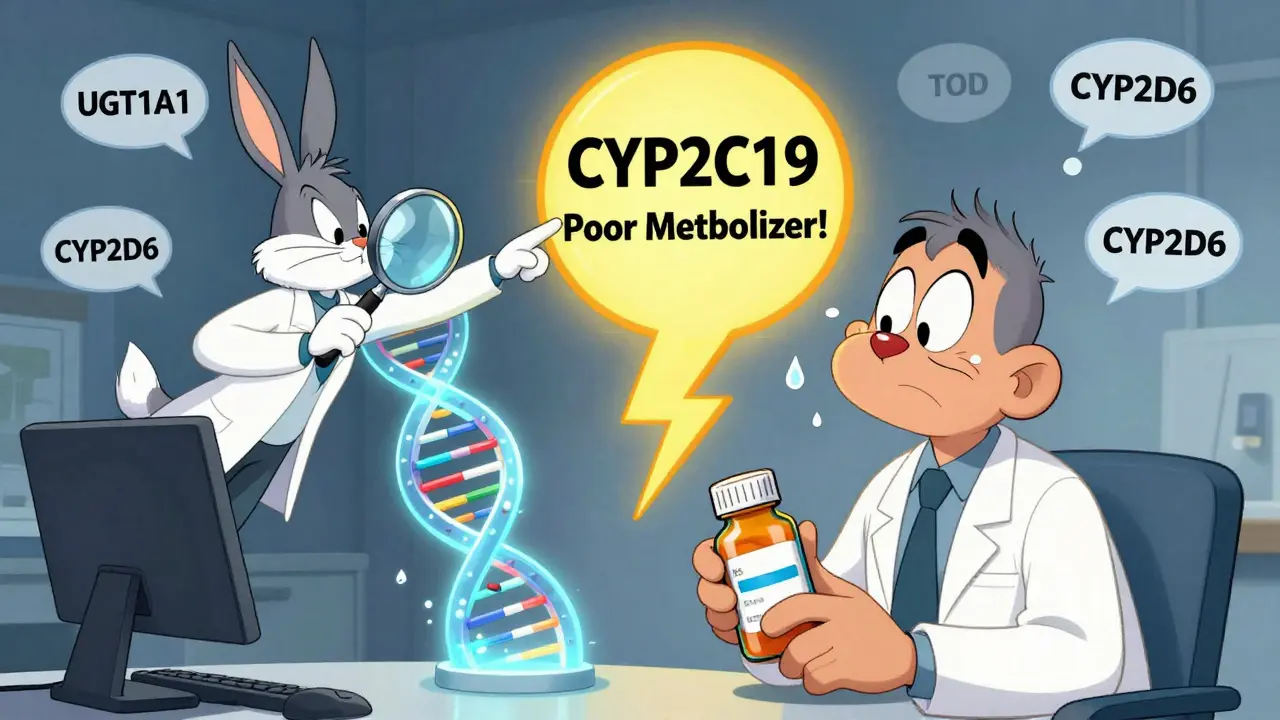
Imagine this: you walk into an online pharmacy, order your usual generic blood pressure pill, and within minutes, the system tells you, "This medication isn’t right for you. Try this one instead. Here’s why." It’s not magic. It’s AI and pharmacogenomics working together - and it’s already happening in real clinics and pharmacies, quietly reshaping how generic drugs are prescribed and dispensed.
What Exactly Is Pharmacogenomics?
Pharmacogenomics (PGx) sounds complicated, but it’s simple in practice: it’s how your genes affect how your body responds to drugs. Two people can take the same generic pill - say, clopidogrel for heart health - and one might get relief while the other has no effect, or worse, a dangerous reaction. Why? Because of small differences in their DNA, especially in genes like CYP2C19 or CYP2D6 that control how drugs are broken down in the liver.
For decades, doctors guessed. Now, with genetic tests, we know. But reading those test results? That’s where things get messy. A typical PGx report can be 20 pages long, full of terms like "intermediate metabolizer" or "ultrarapid genotype." Most pharmacists spend 15-20 minutes just interpreting one. That’s not scalable - especially for online pharmacies handling hundreds of prescriptions daily.
How AI Is Fixing the Problem
Enter artificial intelligence. In 2024, a study in the Journal of the American Medical Informatics Association showed an AI tool using GPT-4 could interpret PGx results with 89.7% accuracy - better than most human experts. This wasn’t just a lab experiment. The AI was trained on the Clinical Pharmacogenetics Implementation Consortium (CPIC) guidelines, the gold standard for drug-gene matching. It learned which gene variants mean which drug doses should be adjusted, and which combinations are dangerous.
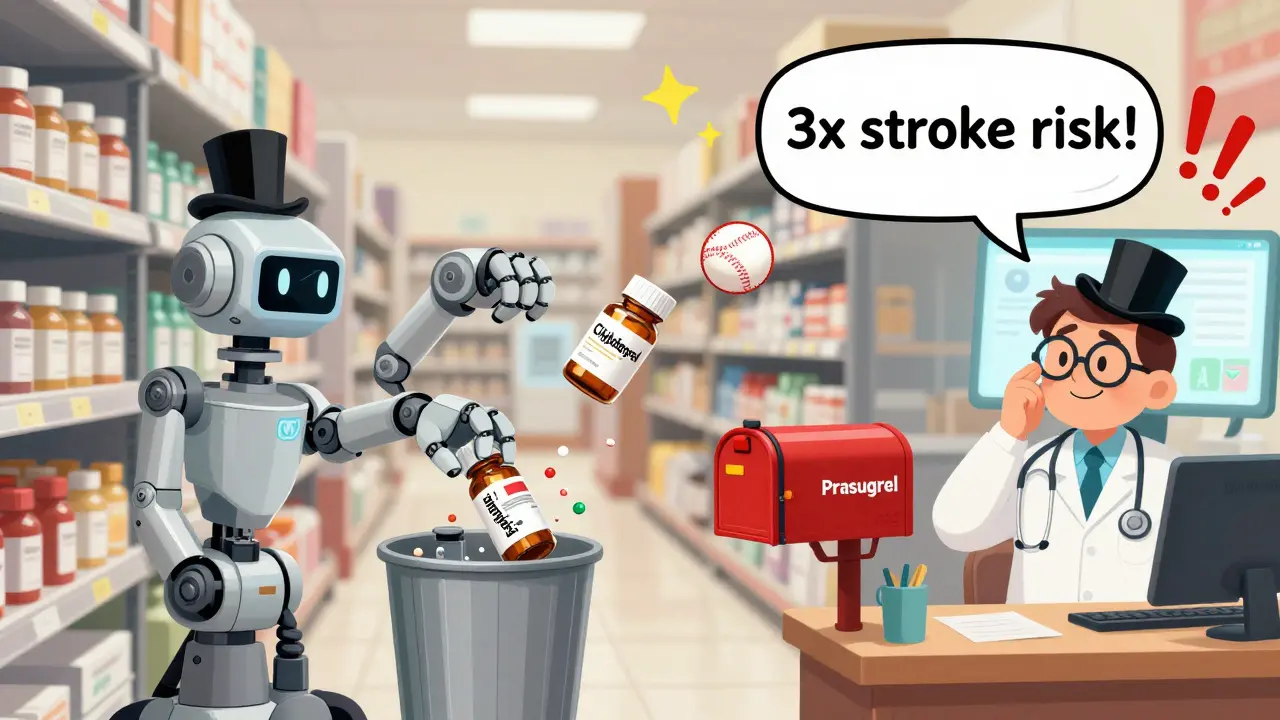
Here’s how it works in practice: When a patient orders a generic medication online and has previously done a PGx test (through a clinic or direct-to-consumer service like 23andMe Health), their genetic data - already processed into variant calls - is sent securely to the pharmacy’s AI system. The AI checks the drug against their genetic profile, cross-references known interactions, and flags risks in seconds. It doesn’t just say "avoid this." It says: "Based on your CYP2C19 poor metabolizer status, clopidogrel is unlikely to work. Switch to prasugrel. Dose: 10 mg daily. Risk of stroke if unchanged: 3x higher."
And it explains it in plain language. In the same study, 92% of patients said the AI’s explanation was easy to understand. Compare that to traditional reports - only 45% found them clear. That’s huge for online pharmacies, where patients don’t have a pharmacist standing next to them.
Why This Matters for Generic Drugs
Generic drugs are the backbone of affordable healthcare. But they’re not all created equal when it comes to your genes. A generic version of warfarin might work perfectly for one person but cause dangerous bleeding in another due to a VKORC1 variant. Without genetic insight, online pharmacies just fill the prescription - no questions asked.
AI changes that. It turns generic prescriptions from a one-size-fits-all model into a precision tool. For example, a patient with a CYP2D6 ultrarapid metabolizer status might need 2-3 times the standard dose of tramadol for pain - otherwise, it won’t work. But if they’re given the standard dose, they might end up switching to opioids unnecessarily. The AI spots this. It recommends the right generic, at the right dose, based on biology, not guesswork.
It’s not just about avoiding bad reactions. It’s about effectiveness. A 2022 Mayo Clinic study found that using AI-guided PGx reduced adverse drug events by 22% in cardiac patients. That’s not just safer - it’s cheaper. Fewer ER visits. Fewer hospital stays. Fewer wasted prescriptions.
How It’s Built: The Tech Behind the Scenes
This isn’t some sci-fi fantasy. The system uses retrieval-augmented generation (RAG), which means the AI doesn’t just spit out answers from memory. It pulls real-time data from trusted sources like CPIC and PharmGKB, then combines it with the patient’s genetic profile. Think of it like a supercharged medical librarian that never sleeps.
The AI connects to the pharmacy’s electronic health record (EHR) via secure APIs - usually built on FHIR standards - so it can pull in medication history, allergies, and current prescriptions. It also uses federated learning, meaning the pharmacy’s patient data never leaves its servers. Only encrypted, anonymized insights are shared for model improvement. HIPAA and GDPR compliance are built in from day one.
And it’s fast. One query takes about 2.3 seconds. Compare that to the 15-20 minutes a human takes. At scale, that means a pharmacy can personalize thousands of generic orders daily without slowing down.
Where It Falls Short - And Why That Matters
It’s not perfect. The AI can’t read raw DNA sequences. You need a lab to process your spit or blood sample first and give it clean variant data. It also struggles with rare mutations - if your gene variant isn’t in the database, the AI won’t know what to do. And yes, it hallucinates sometimes. The JAMIA study found 3.2% of responses had clinically significant errors - like missing a critical gene-drug interaction.
That’s why no reputable system goes fully autonomous. Every AI recommendation still requires a pharmacist to review it before dispensing. Think of the AI as a super assistant, not a replacement. It flags the risks. The human decides.
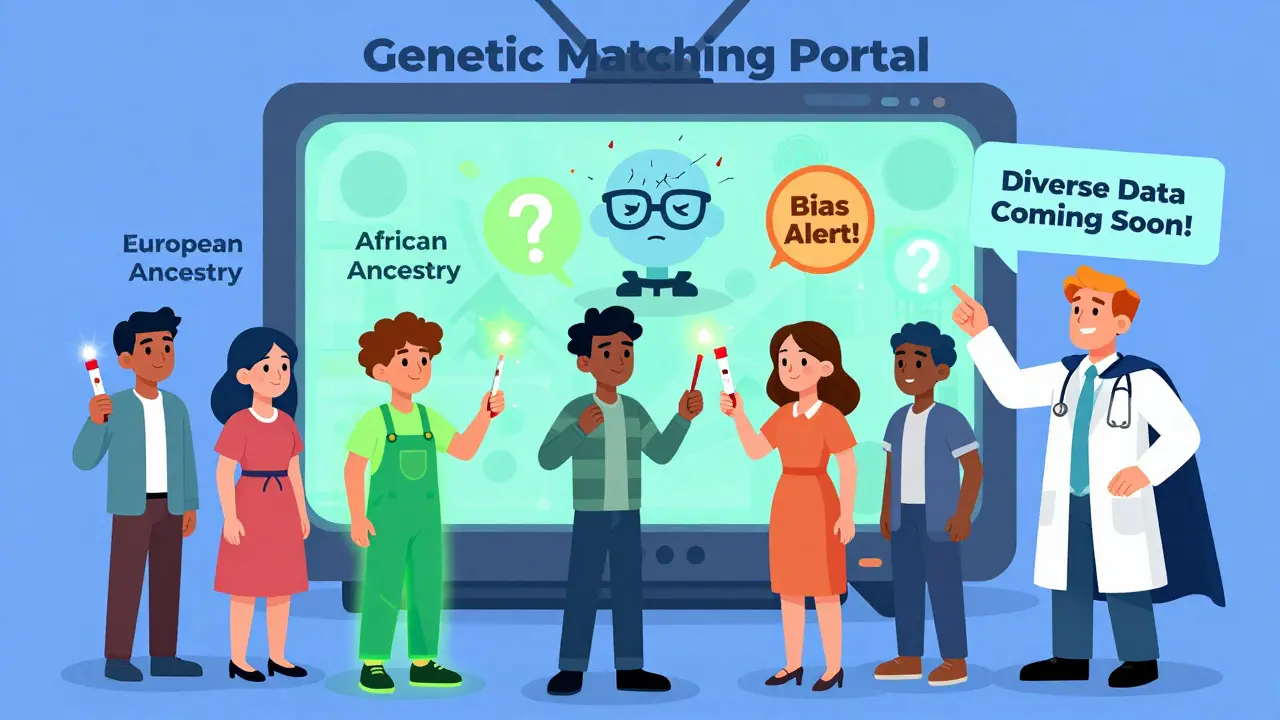
Another big issue: bias. Over 78% of genetic data in global databases comes from people of European descent. That means if you’re of African, Asian, or Indigenous ancestry, the AI might give you a less accurate recommendation. The NIH just launched a $125 million initiative in April 2024 to fix this. But it’s not solved yet.
Real-World Impact: Who’s Using This Today?
At the University of Florida Health system, 78 doctors using the AI tool saved an average of 12.7 minutes per patient. That’s time that can be spent explaining options, answering questions, or just listening.
One online pharmacy in Australia, partnered with a local genomics lab, started offering AI-enhanced generic prescriptions in late 2023. They saw a 31% drop in returns and complaints about medications not working. Patients reported feeling more confident. One wrote: "I’ve taken this pill for years. No one ever told me my genes might make it useless. Now I know why I felt nothing."
Meanwhile, companies like Deep Genomics and Google Health are racing to build better models. Even traditional PGx testing firms like OneOme and Myriad Genetics are adding AI interpretation to their packages. The FDA has already cleared the first AI-PGx tool - GeneSight Psychotropic - for depression meds in 2023. More approvals are coming.
What You Need to Get Started
If you’re a patient: You don’t need to do anything special. If you’ve had a genetic test - whether through a doctor, 23andMe, or a direct-to-consumer service - check if your online pharmacy offers AI-based PGx matching. Some now ask during checkout: "Do you have genetic test results we can use to personalize your meds?" If yes, upload the PDF. If not, you can order a simple saliva test (under $100) that covers key PGx genes.
If you’re an online pharmacy: Start small. Integrate with an existing PGx platform that offers AI interpretation as a white-label API. InterSystems and other health tech providers offer plug-and-play solutions. Training for pharmacists takes 8-12 hours. Most get comfortable in a week. The biggest hurdle? Getting EHRs to talk to each other. FHIR APIs solve most of that.
The Big Picture: Where This Is Headed
By 2027, experts predict that 45% of academic medical centers will combine AI-powered pharmacogenomics with polygenic risk scores - meaning your medication plan won’t just look at one gene, but dozens, predicting not just how you’ll react to a drug, but your risk for heart disease, diabetes, or depression too. Your generic pill won’t just be chosen for cost - it’ll be chosen for your biology.
McKinsey estimates this could save $8-12 billion annually in U.S. healthcare costs by 2030. That’s billions in avoided hospitalizations, fewer side effects, and better outcomes. For online pharmacies, it’s not just a competitive edge - it’s becoming a baseline expectation.
AI isn’t replacing pharmacists. It’s giving them superpowers. And it’s making generic drugs - the most affordable option for millions - finally work the way they should: for you, not just for the average person.
Can AI really personalize generic medications?
Yes. AI analyzes your genetic data - like CYP2C19 or CYP2D6 variants - and matches it to known drug-gene interactions. It doesn’t change the generic drug itself, but it tells the pharmacy which one is best for your body. For example, if you’re a poor metabolizer of clopidogrel, the AI will recommend a different antiplatelet drug instead, even if it’s still a generic.
Do I need a genetic test to use this service?
You need your genetic data, yes. That usually comes from a lab test - either ordered by your doctor or done through a direct-to-consumer service like 23andMe Health or AncestryDNA’s health add-on. The test must cover key pharmacogenomic genes. If you haven’t been tested, you can order a simple saliva test for under $100 that includes PGx markers. Once you have the report, upload it to the pharmacy’s portal.
Is this safe? Can AI make dangerous mistakes?
AI can make errors - studies show about 3% of recommendations have clinically significant inaccuracies. That’s why no system allows fully automated dispensing. Every AI suggestion is reviewed by a licensed pharmacist before your order ships. Think of it as a second opinion, not a final decision. The goal is to reduce human error, not remove human oversight.
Is this only for expensive branded drugs?
No. This is most valuable for generics. Because generics are cheaper, they’re often chosen without considering individual biology. That’s where AI helps - it ensures the cheapest option is also the safest and most effective for your genes. For example, a generic statin might work great for one person but cause muscle pain in another due to SLCO1B1 variants. The AI spots that.
Is my genetic data safe with online pharmacies?
Reputable pharmacies use encrypted, HIPAA-compliant systems. Your genetic data is stored separately from your prescription records and is never sold. Most use federated learning, meaning only anonymized insights are used to improve the AI - never your raw DNA file. Always check the pharmacy’s privacy policy. If they don’t mention PGx data handling, avoid them.
Will this work if I’m not of European descent?
Current databases are biased - over 78% of genetic data comes from people of European ancestry. That means recommendations may be less accurate for African, Asian, Indigenous, or mixed-ancestry patients. The NIH is funding new research to fix this, but it’s not solved yet. If you’re from a non-European background, ask your pharmacist if the system uses diverse data. Some newer platforms are already improving.
How do I know if my online pharmacy offers this?
Look for phrases like "personalized medication guidance," "genetic matching," or "PGx-enabled prescriptions" on their website. During checkout, they may ask if you have genetic test results. If you don’t see anything, contact customer support and ask directly: "Do you use AI to match generic medications to patients’ genetic profiles?" If they don’t know what you’re talking about, they likely don’t offer it yet.
What’s Next? Your Next Steps
If you’re taking generic meds and they’re not working - or you’ve had side effects - ask your doctor about pharmacogenomic testing. It’s not expensive, and many insurance plans now cover it.
If you run an online pharmacy, start talking to your EHR and pharmacy software vendors. Ask if they support AI-powered PGx integration. If not, push them. Demand is growing. Patients are asking for it.
This isn’t about replacing doctors or pharmacists. It’s about giving them better tools to do their jobs - and making sure the cheapest medicine is also the right one for you. The future of online pharmacies isn’t just faster delivery. It’s smarter medicine.


bob bob
January 5, 2026 AT 08:35This is actually kind of revolutionary. I’ve been on generic clopidogrel for years and never knew my genes might’ve made it useless. Finally, someone’s making meds work for the person, not the population average.
Chris Cantey
January 5, 2026 AT 15:14The idea that biology can be reduced to a data point and optimized like a software update is both fascinating and deeply unsettling. We’re not algorithms. We’re not variables. We’re messy, contradictory, biological organisms shaped by history, trauma, and luck - not just CYP2D6 SNPs.
Dee Humprey
January 7, 2026 AT 14:13As a nurse, I’ve seen so many patients stop meds because they ‘didn’t work’ - turns out, it was their genetics. This tech could save so many lives. If your pharmacy offers it, DO IT. No joke. It’s like getting a personalized manual for your body.
Uzoamaka Nwankpa
January 9, 2026 AT 14:00They say it’s safe because a pharmacist reviews it… but what if the pharmacist is overworked? What if they just click ‘approve’ because they’re on their 12th shift this week? This feels like outsourcing judgment to a machine and then pretending the human is still in charge.
Abhishek Mondal
January 11, 2026 AT 01:37Let’s be honest: this is just corporate healthcare repackaging old pharmacogenomics with buzzwords like ‘AI’ and ‘RAG’ to justify another $$$ subscription model. The science is real-but the implementation? It’s a profit-driven Trojan horse disguised as innovation. And don’t get me started on the Euro-centric bias… it’s not ‘bias,’ it’s colonialism with a database.
Vicki Yuan
January 11, 2026 AT 17:36Abhishek, you’re not wrong about the bias-but dismissing the entire system because of it is like refusing to use seatbelts because they don’t work for every car crash scenario. The data is improving. The NIH is funding diversity initiatives. The fact that we’re even having this conversation means progress is happening. Let’s push for better, not reject it entirely.
Also, if you’re going to cite ‘colonialism,’ at least spell it right. And maybe read the JAMIA study before calling it a ‘Trojan horse.’
Aaron Mercado
January 13, 2026 AT 00:58THIS IS A DISASTER!! PEOPLE ARE BEING MEDICATED BY ALGORITHMS NOW??!! WHERE’S THE HUMAN TOUCH??!! MY GRANDMA TOOK ASPIRIN FOR 50 YEARS AND NEVER HAD A PROBLEM!! THIS IS JUST BIG PHARMA’S WAY OF MAKING US ALL LAB RATS!!
Oluwapelumi Yakubu
January 13, 2026 AT 18:03My dear friends, let us contemplate the metaphysical implications of this technological incursion: if our pharmacological destiny is now dictated by a neural net trained on the genomic whispers of predominantly Northern European corpses, are we not merely the unwitting vessels of a post-human pharmacopeia? Are we not, in essence, becoming biocodes in the machine’s grand symphony? And yet-what if the machine, in its cold logic, finally understands us better than our own doctors ever did?
Terri Gladden
January 14, 2026 AT 00:29OMG I JUST GOT MY PGX RESULTS AND THE AI SAID MY TRAMADOL WAS USELESS AND NOW I’M CRYING BECAUSE I’VE BEEN TAKING IT FOR 8 YEARS AND I THOUGHT I WAS JUST WEAK 😭😭😭