
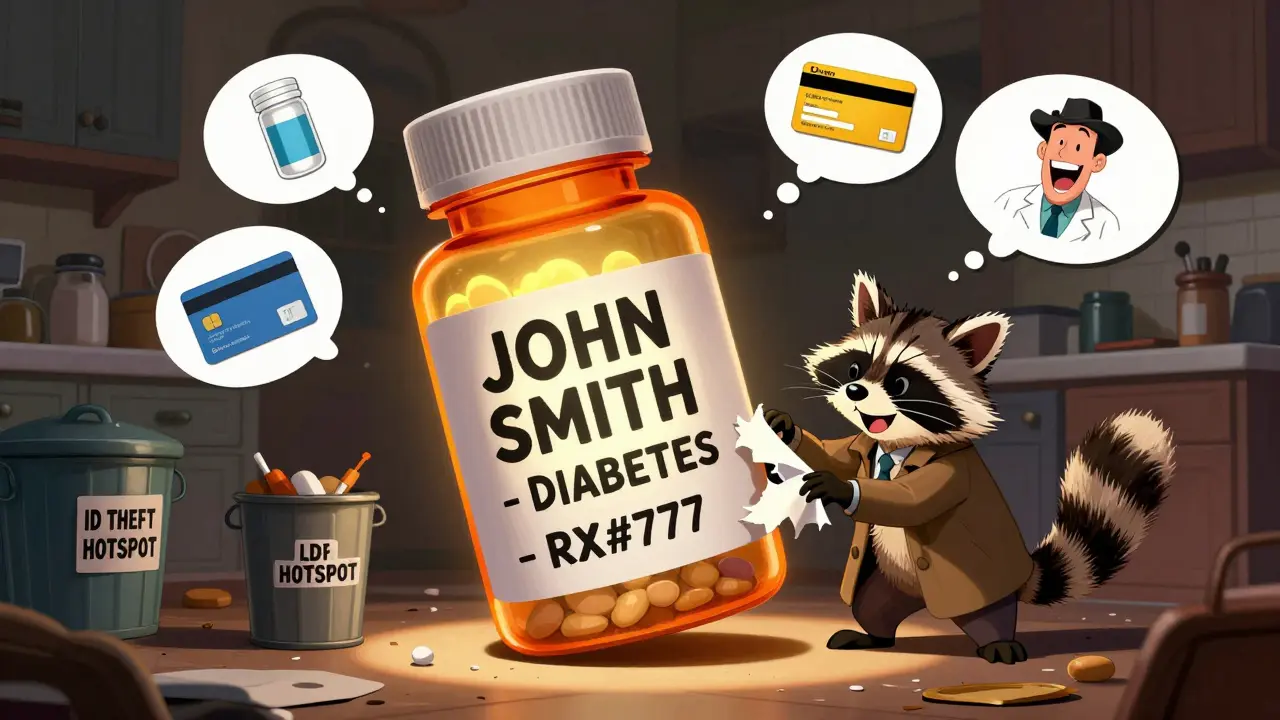
When you finish a prescription, you might toss the bottle into the trash without a second thought. But that little plastic container holds more than empty pills-it holds your name, your doctor’s name, your condition, and your prescription number. All of it. And if someone else finds it, they can use that info to steal your identity, fake prescriptions, or even commit insurance fraud. In 2021, over 412,000 cases of identity theft in the U.S. were tied directly to discarded prescription labels. That’s not a rare accident-it’s a common mistake. And it’s entirely preventable.
Why You Can’t Just Throw It Away
Prescription labels are printed on waterproof, adhesive-backed plastic that sticks to the bottle like glue. Even if you peel it off by hand, you’re not getting rid of the data. Most people try peeling it off with their fingers, but 92% of the time, the adhesive stays behind, and the ink is still fully readable. A video from Titan Labs in 2022 showed a label peeled off manually, leaving every word intact on the sticky residue. That’s not just messy-it’s dangerous.The Federal Trade Commission lists prescription labels as one of the top five sources for identity thieves. In 2022, healthcare fraud cost Americans $560 million. Criminals don’t need to hack a database-they just need to go through your recycling bin. They’ve been doing it for years. And with more people filling prescriptions online, the number of discarded bottles has only gone up.
Three Proven Ways to Remove the Data
There are three reliable methods to erase your personal info from medication bottles. Not all of them work the same, and some are better than others depending on what you plan to do with the bottle afterward.1. Chemical Dissolution (Best for Reusing Bottles)
If you want to reuse the bottle-for vitamins, supplements, or even as a travel organizer-you need a clean, residue-free surface. The most effective way is using a solvent specifically designed for this: Cleanup Solvent-22 a proprietary acetone-based solution made by Titan Labs that dissolves prescription label adhesive without damaging the plastic.Here’s how it works:
- Place the bottle on a flat surface in a well-ventilated area.
- Apply the solvent directly onto the label-just enough to soak through.
- Wait 15 to 20 seconds. The adhesive breaks down instantly.
- Gently peel the label off. It should come off in one piece, with no sticky residue.
- Rinse with warm water and dry.
This method removes 98.7% of labels completely, according to Titan Labs’ internal testing on over 500 bottles. It’s fast, clean, and leaves the plastic ready for reuse. The bottle won’t smell, scratch, or warp. The cost is around $15, which is less than the average cost of one refill. For people who reuse bottles regularly, it’s a no-brainer.
Warning: Don’t use household cleaners like vinegar, rubbing alcohol, or nail polish remover. They don’t work. CHOC tested vinegar soaks-78% failed. Hairdryers? 63% success. Solvent is the only method that works consistently.
2. Marker Obscuration (Best for Disposal)
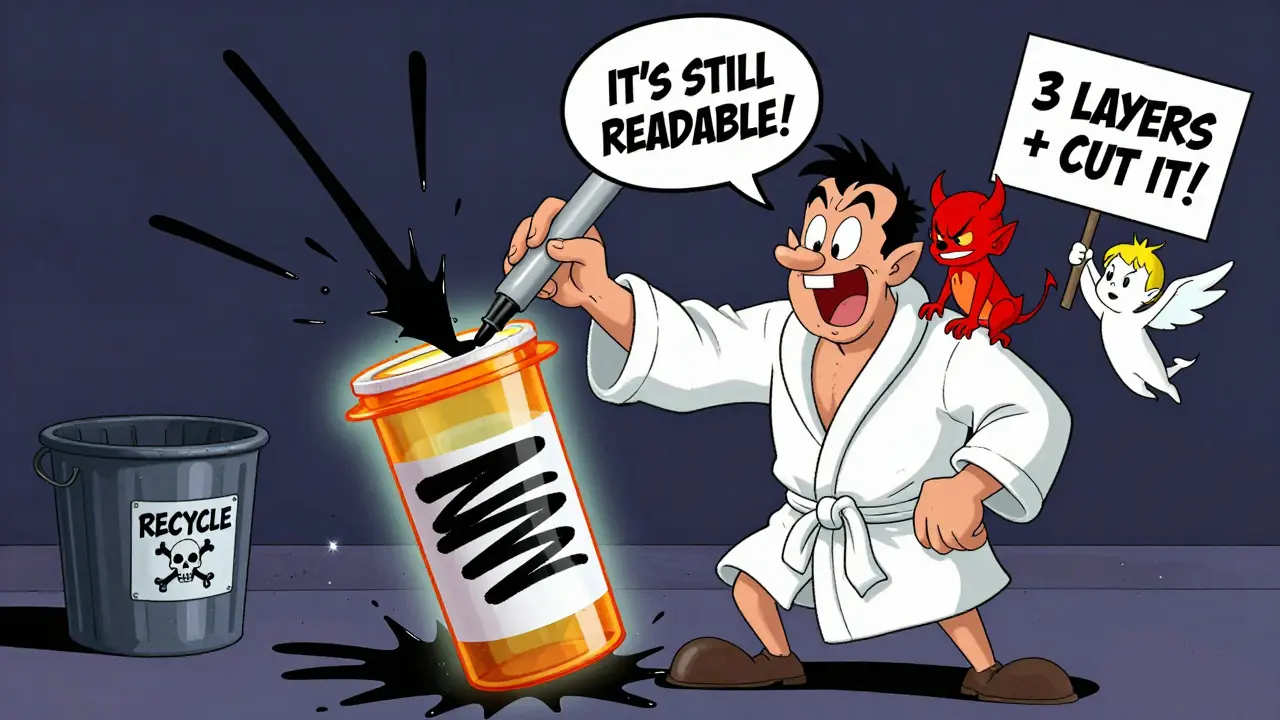
If you’re just throwing the bottle away and don’t care about reusing it, a permanent marker can work-but only if you do it right.Most people scribble over the label with a Sharpie and think they’re done. That’s not enough. In 2023, CHOC tested 127 bottles where people used markers. In 63% of cases, the original text was still recoverable using a smartphone camera and photo-enhancing apps. The ink doesn’t block the ink underneath-it just covers it. Under infrared light or with contrast tools, the original data pops right back up.
To make marker obscuration work:
- Use a Sharpie Permanent Marker a standard black permanent marker with oil-based ink that resists fading and water.
- Apply three thick, overlapping layers across every letter, number, and symbol.
- Let it dry for 10 minutes.
- Hold the bottle up to a bright light. If you see any shadow of text, go over it again.
This takes about 47 seconds per bottle. It’s not perfect, but if you’re not reusing the bottle, it’s acceptable according to the FTC’s 2023 guidelines. Just don’t assume it’s foolproof. Always pair this with physical destruction.
3. Physical Shredding (Best for Complete Destruction)
The most secure option? Shred the bottle. Not just the label-the whole thing.Companies like LegalShred.com offer professional bottle-shredding services, and some pharmacies now have drop-off bins with built-in shredders. But you don’t need a commercial machine. If you have a cross-cut paper shredder that can handle thin plastic, you can do it yourself.
Here’s how:
- Remove the cap.
- Cut the bottle into strips using scissors or a utility knife.
- Feed the pieces into your shredder one at a time.
Shredding ensures no data can be recovered. Even if someone finds the pieces, they can’t reconstruct the label. The DEA’s National Prescription Drug Take-Back Day accepts bottles only if all patient identifiers are gone-and shredding is the only method they explicitly endorse.
What Doesn’t Work (And Why)
You’ve probably heard these tips:- Soaking in hot water - Doesn’t loosen the adhesive. Only works on old, cheap labels.
- Scraping with a knife - Scratches the plastic, leaves ink behind, and risks injury.
- Putting it in the dishwasher - The label might peel, but the data stays readable.
- Just tossing it in the trash - That’s how theft starts.
These methods are myths. They give a false sense of security. The data is still there. And someone, somewhere, will find it.
What You Should Do Right Now
Here’s your simple action plan:- As soon as you finish a prescription, don’t wait. Do this within 24 hours. Delaying increases your risk of identity theft by 40%.
- If you plan to reuse the bottle: use Cleanup Solvent-22. It’s worth the $15.
- If you’re throwing it away: use three thick layers of Sharpie, then cut the bottle into strips and toss it in the recycling.
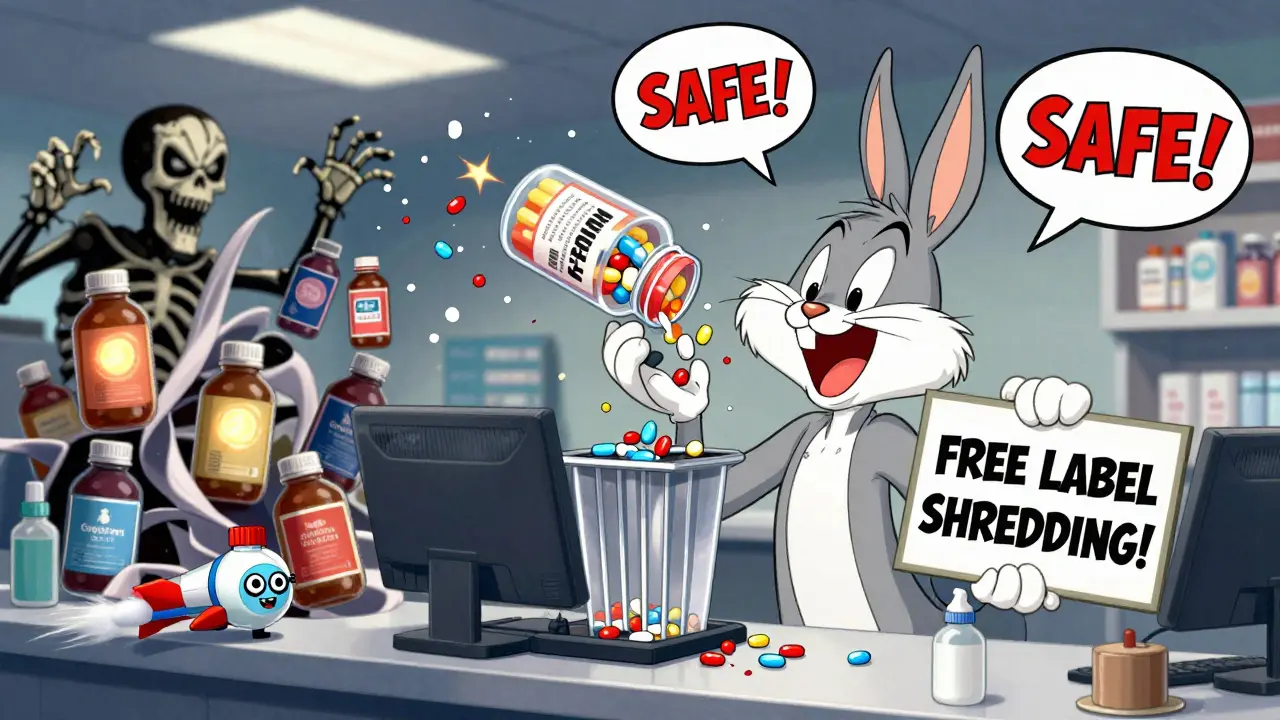
- If you’re unsure: take it to a pharmacy. CVS, Walgreens, and other chains now have label-removal stations. Ask at the counter.
There’s no excuse not to do this. It takes less than a minute. And the cost of doing nothing? The average victim of prescription-related identity theft loses $1,347. That’s more than the cost of 10 bottles of solvent.
What’s Coming Next
Some drug companies are testing new labels with UV-erasable ink and RFID chips that erase data automatically after 30 days. McKesson started a pilot program in late 2023. But those are years away from being standard. For now, you’re the only one who can protect your data.Don’t wait for someone else to fix it. This is your responsibility. The FTC says so. The DEA says so. Hospitals say so. And if you’ve ever had a prescription, you’ve already left your name on a bottle. Make sure it doesn’t end up in the wrong hands.
Can I just throw away the bottle without removing the label?
No. Throwing away a labeled bottle is one of the top ways identity thieves steal personal data. Prescription labels contain your name, address, prescription number, and sometimes your medical condition. Criminals use this to fake prescriptions, file false insurance claims, or even open credit accounts in your name. Always remove or destroy the label before disposal.
Is a Sharpie marker enough to hide my information?
Only if you use it correctly. A single pass with a Sharpie isn’t enough. You need three thick, overlapping layers covering every letter and number. Even then, advanced photo apps can sometimes recover the original text under infrared light. For full security, combine marker use with cutting the bottle into pieces before recycling.
Where can I get a label-removing solvent?
The most tested product is Cleanup Solvent-22, available online through Amazon and Titan Labs’ website. It’s designed specifically for prescription labels and works on polypropylene and HDPE plastic. You won’t find it in regular stores, but it’s affordable at $15 and lasts for dozens of bottles. Some pharmacies may carry similar products-ask at the counter.
Do pharmacies help with label removal?
Yes. Since 2020, major pharmacy chains like CVS and Walgreens have installed label-removal stations at their drop-off bins. These stations use professional-grade solvents or shredders to remove labels safely. If you’re unsure how to remove the label yourself, take your empty bottle to the pharmacy. They’ll handle it for free.
What should I do with the bottle after removing the label?
If the bottle is clean and intact, you can reuse it for vitamins, supplements, or small household items like screws or beads. If you’re not reusing it, cut it into pieces and put it in the recycling bin. Never leave it whole-even without a label, a full bottle can be mistaken for an active prescription. Shredding or cutting ensures no one can mistake it for something usable.
Is this really a big deal? I’ve never heard of anyone being stolen from this way.
You don’t hear about it because most victims never report it. In 2022, over 1.35 million healthcare-related identity theft cases were reported in the U.S., and nearly 1 in 5 were linked to discarded prescription labels. The average loss per victim was $1,347. It’s quiet, it’s common, and it’s preventable. If you’ve ever taken a prescription, your data is already on a bottle somewhere. Don’t let it become someone else’s tool.


Kelsey Vonk
March 15, 2026 AT 12:20Emma Nicolls
March 17, 2026 AT 04:41Jimmy V
March 17, 2026 AT 08:37Richard Harris
March 18, 2026 AT 14:11Kandace Bennett
March 20, 2026 AT 05:33Tim Schulz
March 20, 2026 AT 07:27Jinesh Jain
March 22, 2026 AT 04:00douglas martinez
March 24, 2026 AT 03:15Sabrina Sanches
March 25, 2026 AT 06:20Shruti Chaturvedi
March 25, 2026 AT 20:19Katherine Rodriguez
March 26, 2026 AT 13:04